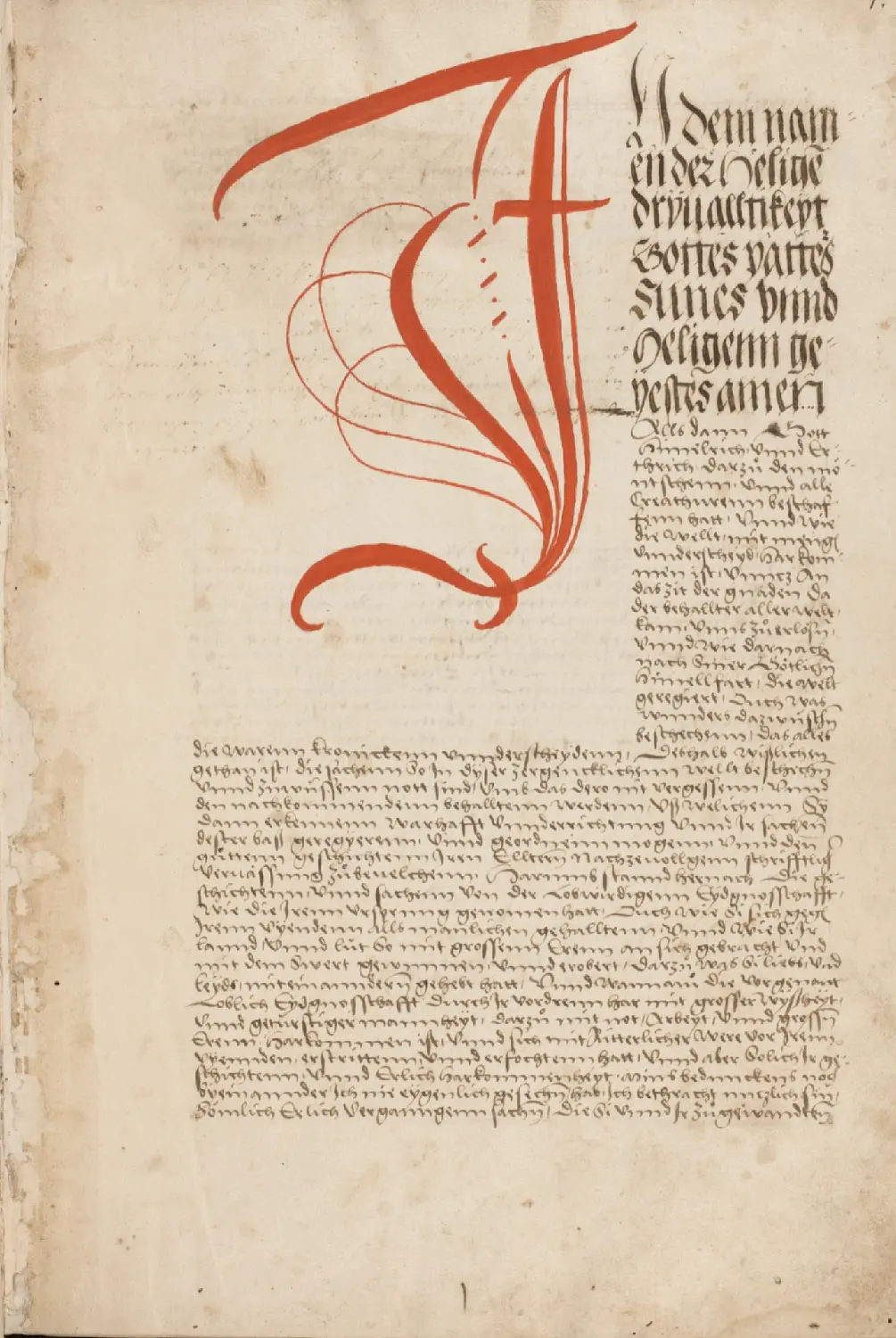


Werner Schodoler’s *Eidgenössische Chronik* is one of the most significant historical works of early Switzerland. Written between 1514 and 1537—with its fourth and final volume completed in 1535—the chronicle stands as one of the most impressive testimonies to Swiss historical consciousness in the early 16th century. It combines historical tradition, the formation of political identity, and exceptional book art into a work of enduring cultural and historical value.
Werner Schodoler (1480–1541) was the town clerk of Bremgarten in what is now the canton of Aargau. Unlike many chroniclers of his time, he was not merely interested in compiling historical events but sought to present the history of the Swiss Confederation as a coherent narrative. In doing so, he drew upon older chronicles—particularly the works of Diebold Schilling and other late-medieval historians—but supplemented them with his own research and a careful selection of sources.
The chronicle focuses on the origins and development of the Old Swiss Confederacy. Schodoler describes the legendary beginnings with William Tell and the Rütli Oath, as well as the struggles against the Habsburgs, the expansion of the Confederacy, and the great military successes of the 15th century. History is presented not merely as a sequence of events, but as the shared memory of a political community. The chronicle makes a significant contribution to reinforcing the image of the Swiss Confederation as a community united by freedom, loyalty to the alliance, and mutual support.
The numerous illustrations are particularly impressive. Schodoler’s chronicle contains hundreds of colored miniatures depicting battles, assemblies, cities, landscapes, and notable figures. These images serve not only as decoration but also convey history in a vivid and accessible way. They rank among the highlights of 16th-century Swiss book illumination and make the work a fusion of historiography and art.
Like many Renaissance chronicles, Schodoler’s work blends historical facts with legends. Modern research clearly distinguishes between historically verifiable events and the mythical narratives surrounding the founding of the Swiss Confederation. Nevertheless, this does not diminish the work’s value. It is precisely this fusion of history and memory that reveals how political identity is formed. Nations thrive not only on facts, but also on shared narratives, symbols, and role models.
The period in which the chronicle was written was marked by profound upheavals. The Reformation had begun, religious tensions were mounting, and the political order of the Swiss Confederation faced new challenges. By emphasizing the shared past, Schodoler reminded readers of the unifying foundations of the Confederation. His chronicle was therefore not only a look back but also a contribution to the political self-understanding of his own time.
From a bibliophile’s perspective, the Swiss Confederation Chronicle ranks among the most precious manuscripts in Swiss cultural history. The elaborately executed miniatures, the calligraphic script, and the high-quality binding make every surviving copy a unique work of art. They impressively document the high standard of book production immediately prior to the complete establishment of the printed book.
Werner Schodoler’s *Eidgenössische Chronik* is therefore far more than a collection of historical events. It recounts how the Swiss Confederation understood itself and what values shaped its identity. Freedom, solidarity, personal responsibility, and loyalty to the confederation emerge as the cornerstones of a political community. Thus, Schodoler’s work remains not only an indispensable source for the history of Switzerland but also a striking example of how historiography can shape a nation’s self-image over the course of centuries.

