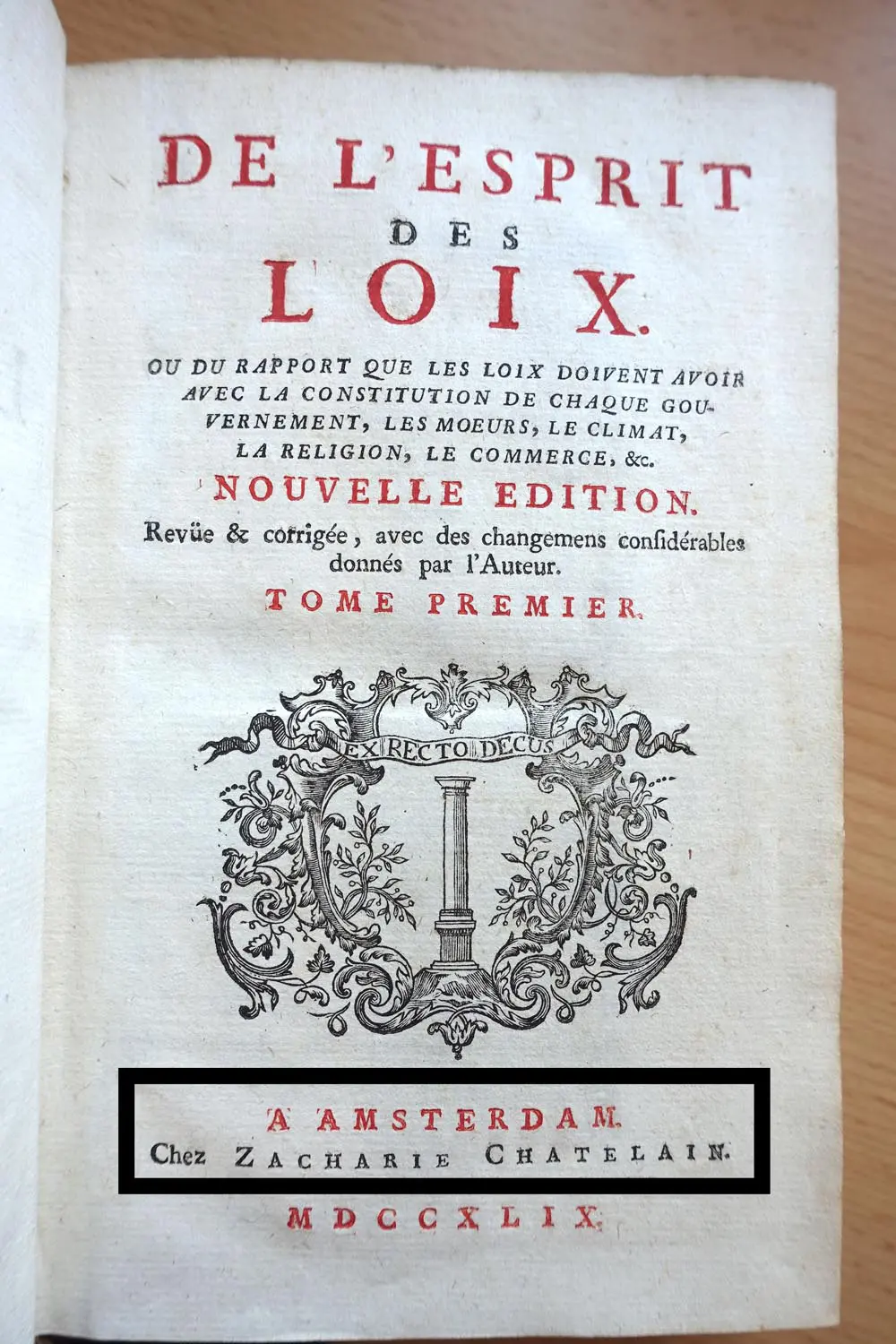


De l'esprit des loix : Ou du rapport que les loix doivent avoir avec la constitution de chaque gouvernement, les mœurs, le climat, la religion, le commerce, &c.
Essay by
Jurg Conzett

When Charles de Secondat, Baron de Montesquieu, published his magnum opus *De l’esprit des lois* in 1748, he fundamentally transformed political thought in Europe. Just one year later, the 1749 edition appeared, contributing to the rapid dissemination of a work that is still considered one of the most important texts in political philosophy. Montesquieu did not ask which laws were ideal, but rather why different societies produce different laws and under what conditions they enable freedom.
The title can be translated as “The Spirit of the Laws.” By this, Montesquieu did not mean individual legal provisions, but rather the totality of forces that shape a legal system. In his view, laws never arise in a vacuum. They are related to a state’s constitution, its customs and traditions, its religion, its climate, its economic system, its trade, and the history of its people. Good laws must therefore be suited to the specific living conditions of a society.
This comparative perspective was revolutionary for the 18th century. Instead of establishing universally applicable rules, Montesquieu examined a wide variety of forms of government—from ancient republics to European monarchies to Asian empires. He collected historical examples and sought to derive general principles from them. In doing so, he became one of the founders of comparative political science and sociology.
His best-known contribution is the doctrine of the separation of powers. Montesquieu distinguished between legislative, executive, and judicial powers. If all three functions are concentrated in a single authority, there is a risk of arbitrariness. Freedom can only exist if the powers check and balance one another. This idea had a lasting influence on the constitutions of many modern states. In particular, the Constitution of the United States and numerous European constitutions incorporate this principle.
Montesquieu devoted particular attention to trade. He was convinced that economic exchange not only creates prosperity but also promotes peace. Trade compels people of different backgrounds to cooperate and fosters moderation and mutual respect. In this way, he linked economic freedom with political stability—an idea that later became of great significance for the development of liberal economic systems.
Not all of the work’s ideas are accepted today without modification. His so-called “climate theory”—which posits that climate and environment influence the behavior of entire peoples—appears oversimplified and, in some respects, problematic from today’s perspective. Nevertheless, this approach was also an expression of his effort to explain political systems not only morally but also scientifically. Montesquieu sought the causes of social differences, thereby opening up new avenues of political thought.
A 1749 edition also holds bibliophilic appeal. Printed during the Age of Enlightenment, it represents an era in which books became the most important medium for new ideas. The meticulous typography, high-quality printing, and multi-volume editions reflect the high standard set for permanently preserving scientific knowledge and making it accessible to an educated audience.

