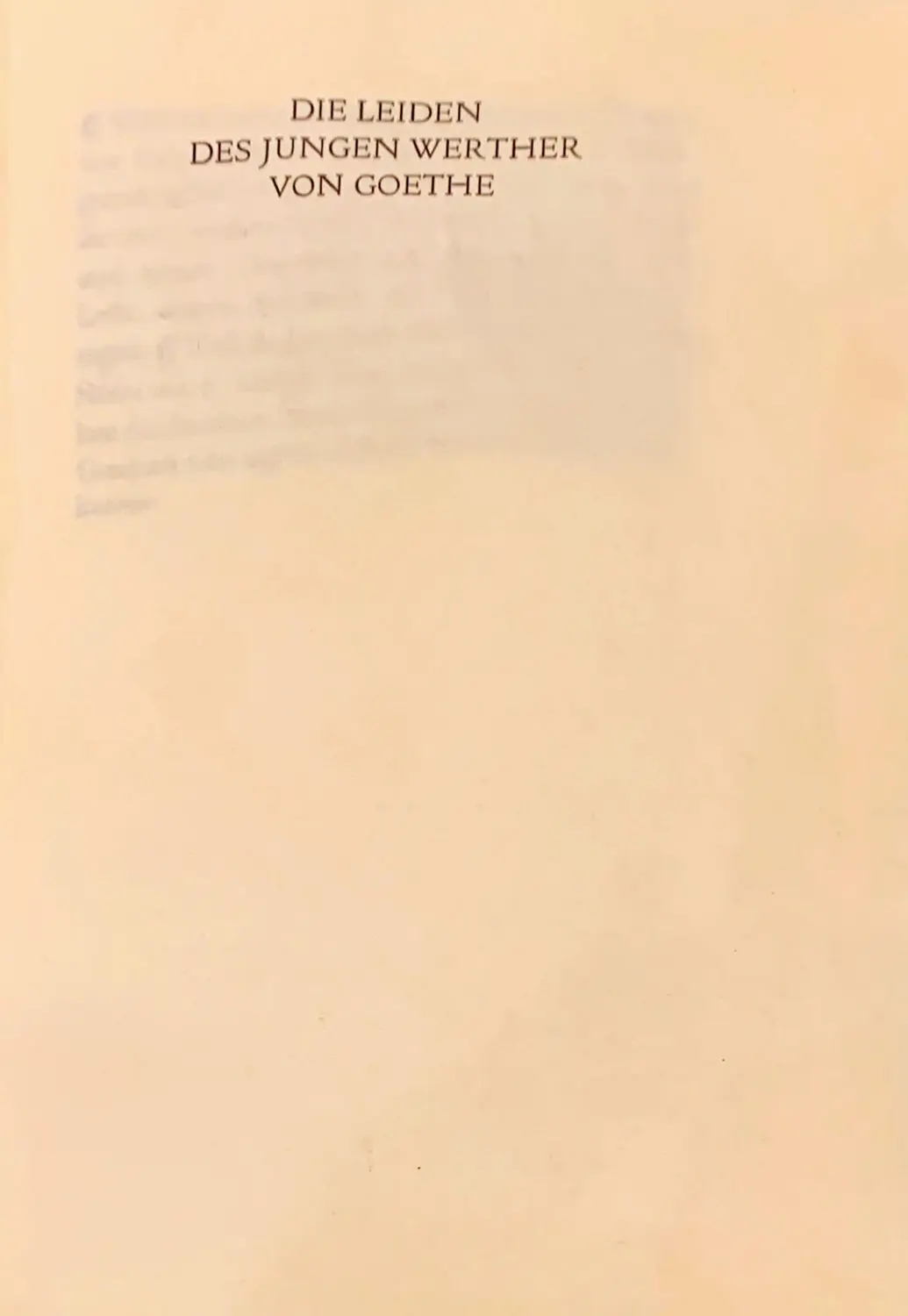


Johann Wolfgang von Goethe’s The Sorrows of Young Werther, first published in 1774, is one of the most influential novels in German literature. Few other works of the eighteenth century had a comparable impact on their contemporaries. The novel made Goethe famous almost overnight, sparked a wave of enthusiasm across Europe, and became a defining work of the Sturm und Drang movement. At the same time, it raises questions that remain relevant to this day: To what extent should emotion prevail over reason? What responsibility does the individual bear for his or her own life? And what happens when reality fails to correspond to one’s ideals?
The novel is written in the form of an epistolary narrative. Through a series of letters to his friend Wilhelm, Werther recounts his experiences, thoughts, and emotions, allowing the reader to witness the story directly from the protagonist’s perspective. At the heart of the novel is Werther’s passionate love for Charlotte, known as Lotte. Although she is already engaged to Albert, Werther’s attachment to her grows ever stronger. His love remains unfulfilled and gradually turns into despair. In the end, seeing no escape from his suffering, Werther takes his own life.
Yet the novel is about far more than an unhappy love affair. Goethe explores the conflict between the sensitive individual and the ordered conventions of bourgeois society. Werther experiences social norms as restrictive and longs for freedom, authenticity, and a life guided entirely by genuine feeling. It is precisely this uncompromising attitude that makes him both captivating and tragic. He cannot accept the world as it is, yet he is equally unable to change it.
Goethe wrote the novel during a period of profound intellectual and cultural transformation. The Sturm und Drang movement placed emotion, creativity, and individuality above rigid rules and social constraints. Werther embodies this new ideal of humanity in its most radical form. His enthusiasm for nature, his admiration for ordinary people, and his rejection of courtly formality reflect a yearning for an authentic life. At the same time, Goethe demonstrates the dangers of unrestrained emotionalism. Werther gradually loses the ability to distance himself from his own emotions, and his passion ultimately becomes an instrument of self-destruction.
The novel’s impact was extraordinary. Many young readers identified with Werther, dressed like him, and quoted his letters. Contemporary accounts even reported a number of copycat suicides, although the true extent of this phenomenon remains disputed. What is beyond doubt, however, is that the novel sparked an intense debate about literature, morality, and social responsibility. In later years, Goethe himself regarded the work with greater detachment, seeing it also as the literary resolution of a personal crisis.
From a literary perspective, The Sorrows of Young Werther is remarkable for the power of its language. Goethe combines poetic descriptions of nature with keen psychological insight. Werther’s shifting emotional states—from exuberant joy to profound despair—are rendered with exceptional linguistic sensitivity. The result is a work that transcends the boundaries of a simple love story, revealing the complex inner dynamics of human emotion.
The 1911 edition presented here is of particular significance. Printed in a strictly limited edition of only twenty copies on vellum, it ranks among the rarest and most luxurious editions of Werther. It was printed by T. J. Cobden-Sanderson at the legendary Doves Press, one of the most distinguished private presses of the English Arts and Crafts Movement.

