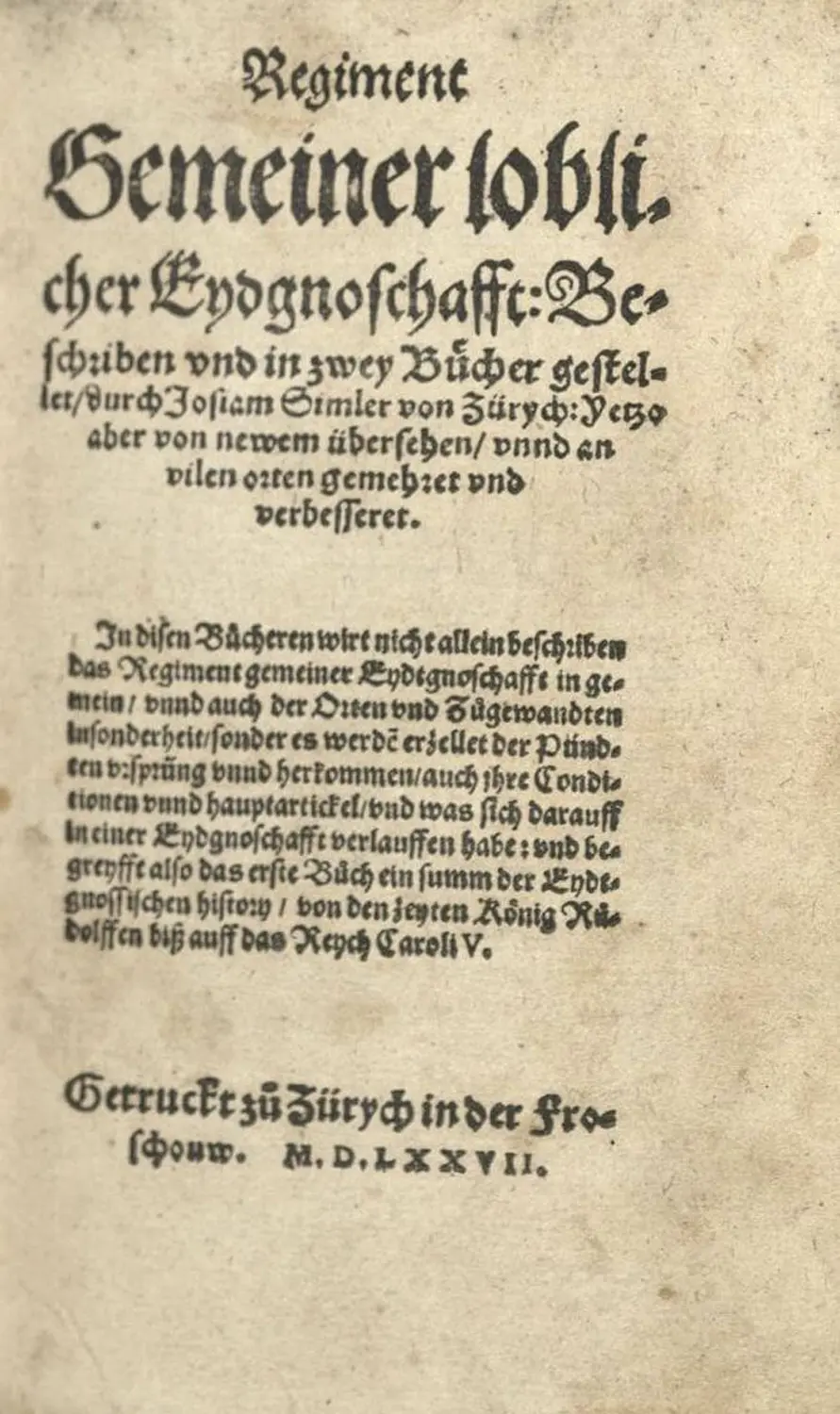


Josias Simler’s *Regiment Gemeiner loblicher Eydgnoschafft*, published in 1577, is one of the most significant works on political science of the early modern period. In it, the Zurich theologian and scholar provided the first comprehensive description of the political order of the Old Swiss Confederacy. While chronicles primarily recounted the origins and heroic tales of the Swiss Confederates, Simler focused his attention on the inner workings of the Confederation itself. His work explains how the Confederation was governed, what rights and duties the individual cantons possessed, and how political decisions were reached. The result was one of the earliest systematic analyses of a European political community.
Josias Simler (1530–1576) served as a professor of theology at Zurich’s Grossmünster and was one of the leading scholars of his time. He wrote during an era of profound religious and political tensions. The Reformation had divided the Swiss Confederation into Catholic and Reformed cantons, yet the Confederation remained intact. It was precisely this ability to cooperate despite confessional differences that made the Swiss Confederation’s political system particularly interesting to European observers.
The focus of the work is not on a single ruler, but on the joint government of the cantons. Simler describes the Swiss Confederation as an alliance of independent communities that preserve their autonomy while still cooperating on important issues. Decisions are not made by the command of a king, but through negotiation and mutual consent. This federal order was exceptional in 16th-century Europe, as most states were ruled by monarchs or princes.
Simler depicts the various cantons with great precision. He explains their political institutions, their courts, their military obligations, and the Diet as the common governing body of the Confederates. At the same time, he describes the diverse landscapes, economic foundations, and social conditions. As a result, the book conveys a comprehensive picture of 16th-century Switzerland and highlights just how diverse the Swiss Confederation already was at that time.
Simler’s sober style is particularly noteworthy. Unlike earlier chroniclers, he largely refrains from legends and heroic embellishments. His goal is not to glorify the past, but to provide an objective explanation of political structures. In this way, his work approaches a modern description of the state. It combines historical knowledge with legal and political analyses and is therefore considered an early precursor to comparative political science.
Economic aspects also play an important role. Simler demonstrates that the political stability of the Swiss Confederation was closely linked to its economic foundations. Cities such as Zurich, Bern, and Basel developed into major commercial centers, while the Alpine passes served as vital transportation links between northern and southern Europe. Agriculture, crafts, mercenary service, and trade complemented one another and formed the economic foundation of the Confederation. Political independence thus rested not solely on military strength, but equally on functioning economic relations.
The work garnered attention far beyond Switzerland’s borders. Just a few years after its publication, it was translated into Latin and published under the title *De Republica Helvetiorum*. This edition introduced the Swiss Confederation to a European scholarly audience. For many humanists and political thinkers, Simler’s description was the most important source of information on Switzerland’s political order. It played a key role in shaping the image of the Swiss Confederation as a republic of free communities.
Regiment Gemeiner loblicher Eydgnoschafft is therefore far more than a historical description. The work documents an early attempt to systematically analyze political institutions and explain them in an accessible manner. It demonstrates that stability arises not solely from central power, but also from cooperation, mutual trust, and mutually agreed-upon rules. It is precisely this insight that makes Simler’s work an important document in the history of European constitutional thought and ideas to this day.

