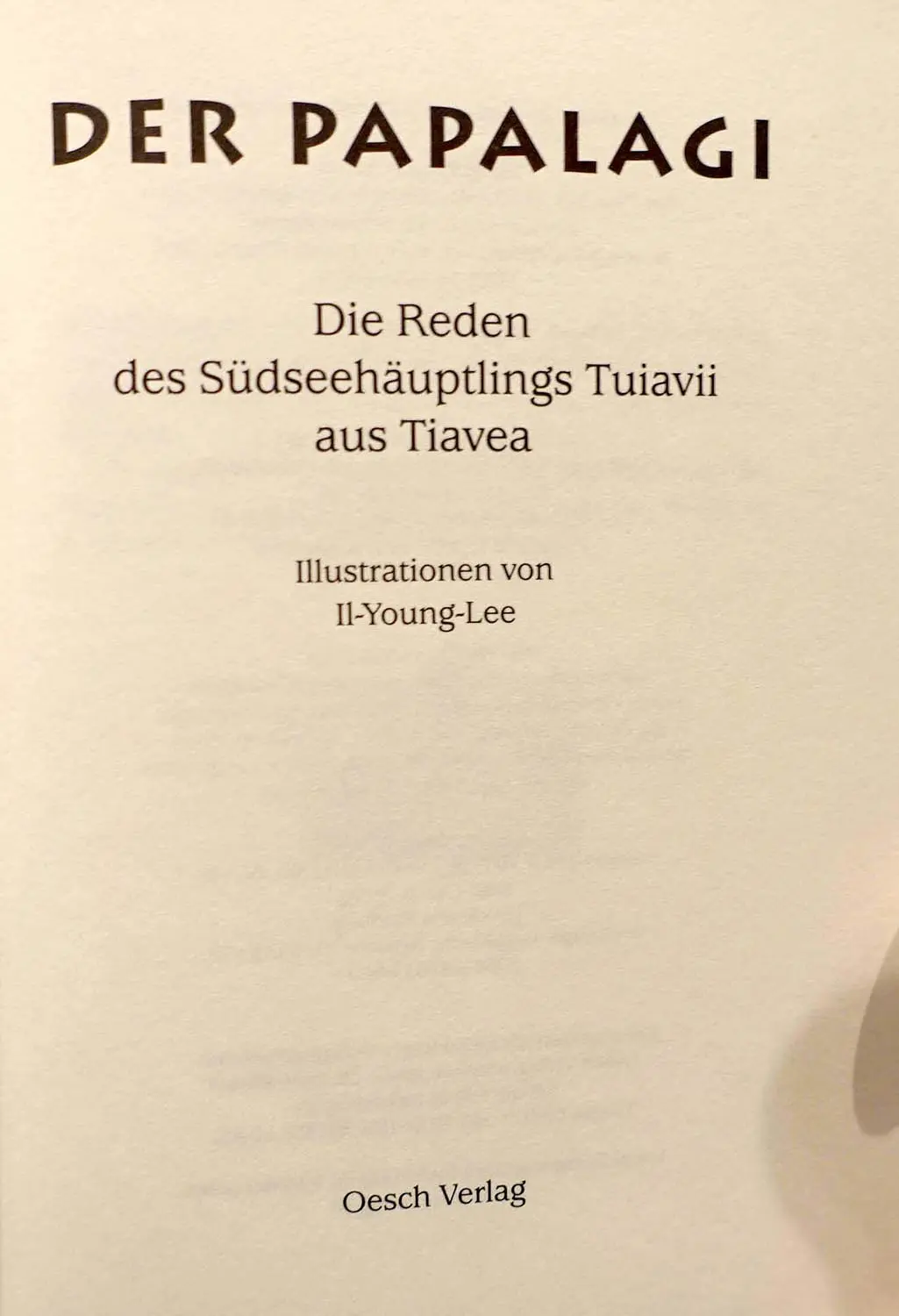


*The Papalagi: The Speeches of Tuiavii, Chief of Tiavea in the South Seas* by Erich Scheurmann:
Hardly any other German-language book of the 20th century has reflected Western civilization in such an unusual way as *The Papalagi: The Speeches of Tuiavii, Chief of Tiavea in the South Seas* by Erich Scheurmann. Since its publication in the 1920s, the work has been read, discussed, and reprinted time and again. It is considered a classic of cultural criticism, even though the story behind its creation continues to raise questions to this day.
The book presents itself as a collection of speeches by a Samoan chief named Tuiavii, who is said to have traveled through Europe and subsequently reported to his countrymen on the strange customs of the “Papalagi”—the Europeans. With a sense of wonder, he describes big cities, clothing, money, machines, work, time, and property. Much of what Europeans take for granted appears strange, contradictory, or even absurd from his perspective.
The passages on money and time are particularly well-known. Tuiavii describes how people spend their lives amassing small round metal discs or printed paper, even though these are neither edible nor beautiful. He offers even sharper criticism of the dominance of the clock. People have cut time into tiny pieces and have become servants of their own invention. Instead of living in tune with nature’s rhythm, they rush from appointment to appointment, losing the ability to consciously experience the moment.
It is precisely this reversal of perspective that makes the book so compelling. By viewing Europe through the eyes of a supposed “stranger,” many habits suddenly seem to require explanation. Everyday life becomes something strange. Possessions, competition, consumption, and the drive for achievement no longer seem self-evident, but rather like cultural choices. The book invites its readers to view their own society from a certain distance.
However, *Der Papalagi* is not an ethnographic report. Today, it is widely accepted that Erich Scheurmann wrote the speeches himself or, at the very least, gave them a strongly literary form. Whether Tuiavii actually expressed these thoughts cannot be proven. The work is therefore less an authentic voice of Samoa than a literary construction through which Scheurmann articulated his critique of European modernity. From today’s perspective, this background must be openly acknowledged.
Yet it is precisely this that does not diminish the book’s value. It belongs to a long tradition of cultural criticism in which authors examine their own society from the perspective of an imaginary stranger. Montesquieu, for instance, used this method in his *Persian Letters* to critically examine France. Scheurmann takes up this idea and applies it to the encounter between Europe and the South Seas.
To 21st-century readers, much of it seems surprisingly relevant. Critiques of consumerism, the fast pace of life, materialism, and alienation preoccupy our society today more than ever. Questions about sustainable living, mindfulness, or the relationship between work and quality of life can already be found in the Papalagi’s speeches. The book serves as a reminder that prosperity does not automatically mean contentment and that cultural progress can always entail losses as well.
*The Papalagi* is therefore less a book about Samoa than a mirror of Europe. Its strength lies not in ethnological accuracy, but in its ability to challenge familiar certainties. Anyone reading the work today should understand it as literary cultural criticism—as an invitation to view one’s own way of life through the eyes of an outsider. It is precisely this perspective that makes the book a fascinating and thought-provoking classic to this day.

