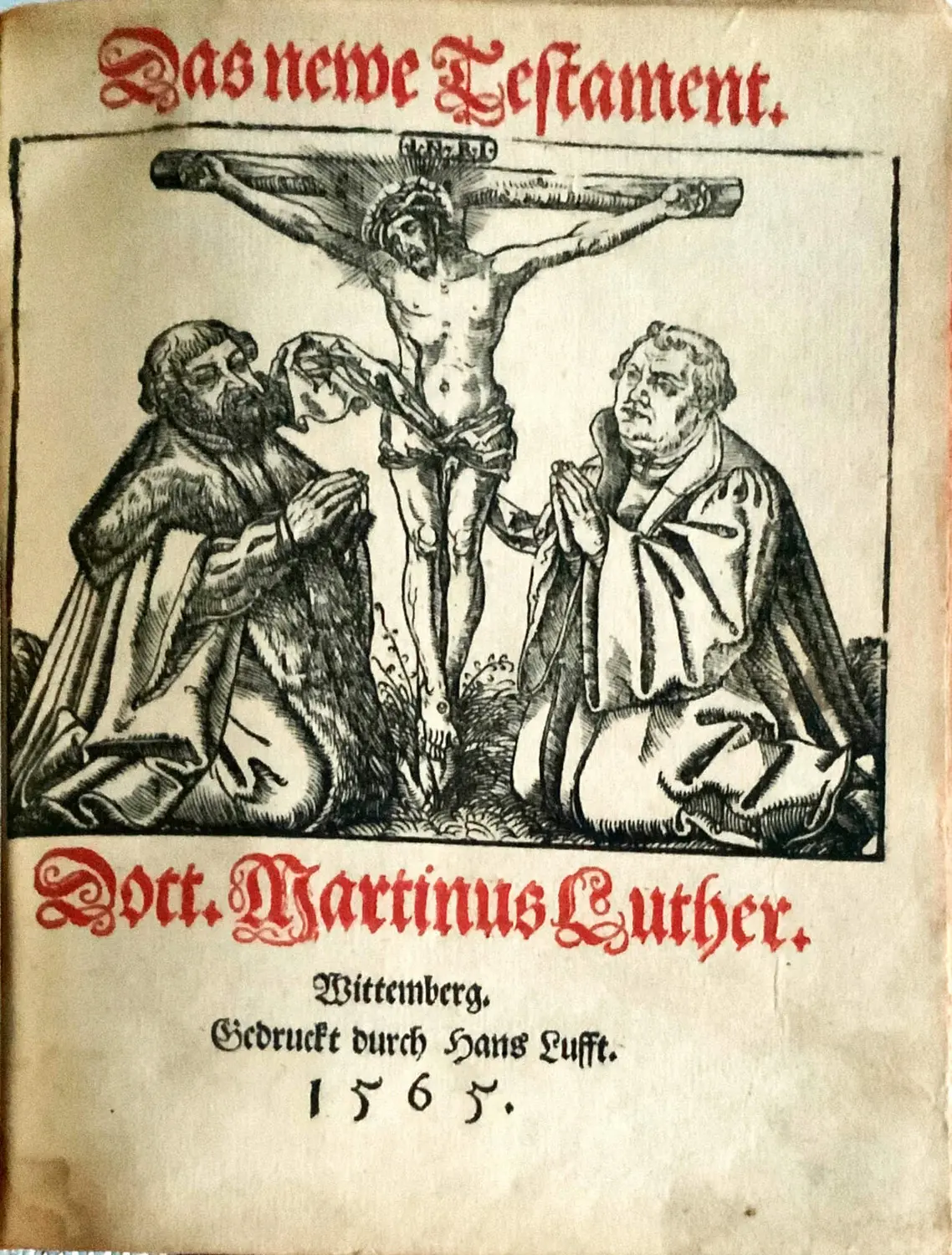


Martin Luther’s translation of the New Testament is one of the most influential books in European history. An edition from 1565 marks the end of a decisive phase of the Reformation and documents how Luther’s literary work had long since become an integral part of religious, cultural, and social life. Although Martin Luther had already died in 1546, his Bible translation continued to be reprinted, revised, and distributed. The 1565 edition is a testament to this enduring success.
Luther first published the New Testament in 1522, after translating the original Greek text into German during his stay at Wartburg Castle. His goal was to make the Holy Scriptures understandable to all people. He did not translate word for word, but rather drew on the language of the people. His famous principle was that one must “listen to the people.” The result was a translation that was linguistically vivid, precise, and at the same time literarily impressive.
The 1565 edition shows how quickly this translation established itself as the standard. Thanks to the printing press, Bibles could be produced in large print runs. What had previously been accessible only to a few scholars or clergy now found its way into the hands of citizens, artisans, and wealthy farmers. Reading the Bible became a personal act of faith and strengthened the individual’s sense of personal responsibility vis-à-vis ecclesiastical authority.
At the same time, the Luther Bible was far more than a religious work. It had a lasting impact on the development of the German language. Many idioms that seem self-evident today originate from Luther’s translation. His choice of language created a common written language reference point at a time when Germany consisted of numerous principalities with different dialects. In this way, the Bible contributed significantly to the development of a written German language that could be understood across regions.
From the perspective of the history of the book, a 1565 edition is also of great value. It was produced at a time when the art of printing and typography had already reached a high level of sophistication. Many copies feature artistically designed title pages, woodcuts, or richly decorated initials. The quality of the paper and the bindings shows that Bibles were not merely practical objects but often also prestigious family heirlooms passed down through generations.
In terms of content, the New Testament is at the heart of the Christian faith. It recounts the life of Jesus Christ and contains the Gospels, the Acts of the Apostles, the Epistles of the Apostles, and the Revelation of John. For Luther, the message of justification by faith alone was of particular central importance. This conviction shaped his translation as well as his theological prefaces and annotations, which were intended to guide readers.
Today, a Luther Bible from 1565 stands as an important testament to European cultural history. It uniquely intertwines religion, language, politics, and media history. The book serves as a reminder that translations do not merely convey texts but can also transform ways of thinking. Luther’s New Testament made the Bible a book for everyone, thereby permanently altering the religious landscape of Europe. Its linguistic power continues to resonate to this day, making every early edition a significant historical and cultural document.

