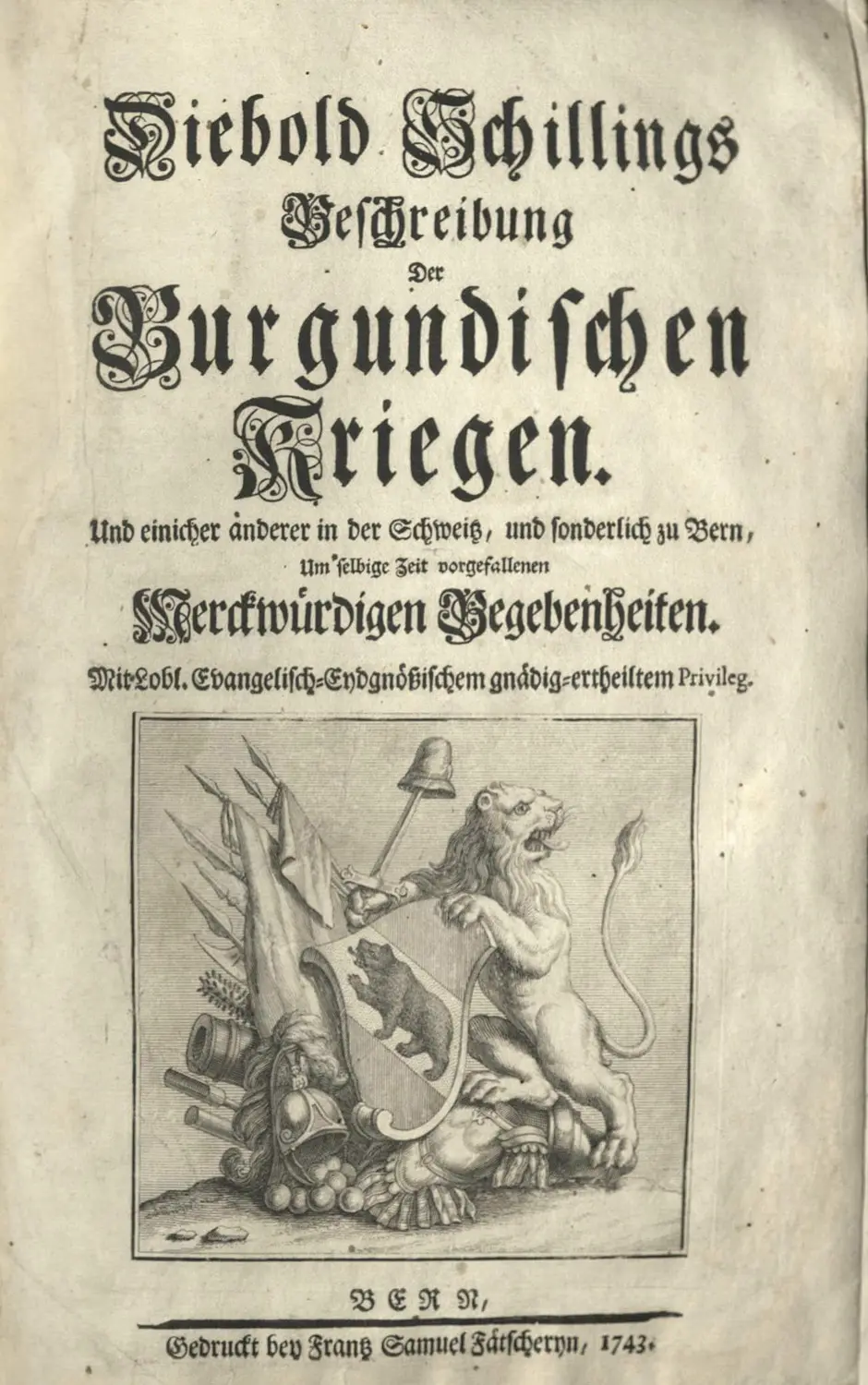


Diebold Schilling and the Burgundian Wars – The First Edition of 1743
Published in 1743, this account of the Burgundian Wars once again makes one of the most significant chapters in Swiss history accessible to an Enlightenment-era audience. The work is based on the famous chronicle by the Bernese town clerk Diebold Schilling, who recorded the events of the late 15th century almost as an eyewitness. Although Schilling’s original chronicle was written shortly after the Burgundian Wars (1474–1477), the 1743 printed edition impressively demonstrates how vivid the interest in these events remained even centuries later. It combines historical memory with political self-affirmation and ranks among the most important works of Swiss historiography.
The Burgundian Wars mark a turning point in the history of the Old Swiss Confederacy. Duke Charles the Bold of Burgundy was one of the most powerful princes in Europe and sought to establish a contiguous empire spanning France and the Holy Roman Empire. This clashed with the interests of the Swiss Confederates, who sought to secure their political independence and their trade routes. In the battles of Grandson, Murten, and Nancy, the Burgundian army suffered crushing defeats. The death of Charles the Bold in 1477 not only put an end to his expansionist plans but also enhanced the Confederation’s reputation far beyond its borders.
Diebold Schilling describes these events with great vividness. His chronicle combines historical account with narrative power. Military campaigns, council meetings, and battles are described in as much detail as individual figures and their decisions. Particularly impressive is the integration of text and imagery. Schilling’s richly illustrated manuscripts are among the most significant visual sources of the late Middle Ages. They depict weapons, clothing, cities, and military formations with astonishing attention to detail and continue to shape our image of the Burgundian Wars to this day.
The 1743 edition was produced at a time when the Swiss Confederation was taking an increasing interest in its own past. Historical works served not only to impart knowledge but also to foster political identity. The memory of the victory over one of Europe’s most powerful princes became a symbol of unity, military strength, and the will to be free. Schilling’s chronicle provided the historical foundation for this. The new edition made this narrative accessible to a new generation of readers and helped to strengthen the Swiss Confederation’s collective memory.
The Burgundian Wars are also of great significance in economic history. The spoils of war from Grandson and Murten were extraordinarily extensive. Gold and silver tableware, weapons, fabrics, jewelry, and coins came into the possession of the victors. These treasures were not only distributed or sold but also influenced the prosperity of individual towns. At the same time, they highlighted the economic resources that underpinned the power of late medieval princes. War has always been a struggle for wealth, trade routes, and political control.
From today’s perspective, the account of the Burgundian Wars is far more than a report on military successes. It offers insight into the political thinking of the late Middle Ages, the formation of historical memory, and the significance of history for the identity of a community. Schilling’s work shows how individual events give rise to national narratives that endure across generations. This is precisely why the 1743 edition holds enduring value. It not only preserves the memory of the Burgundian Wars but also documents how history is continually reinterpreted, reimagined, and made relevant to the present.

