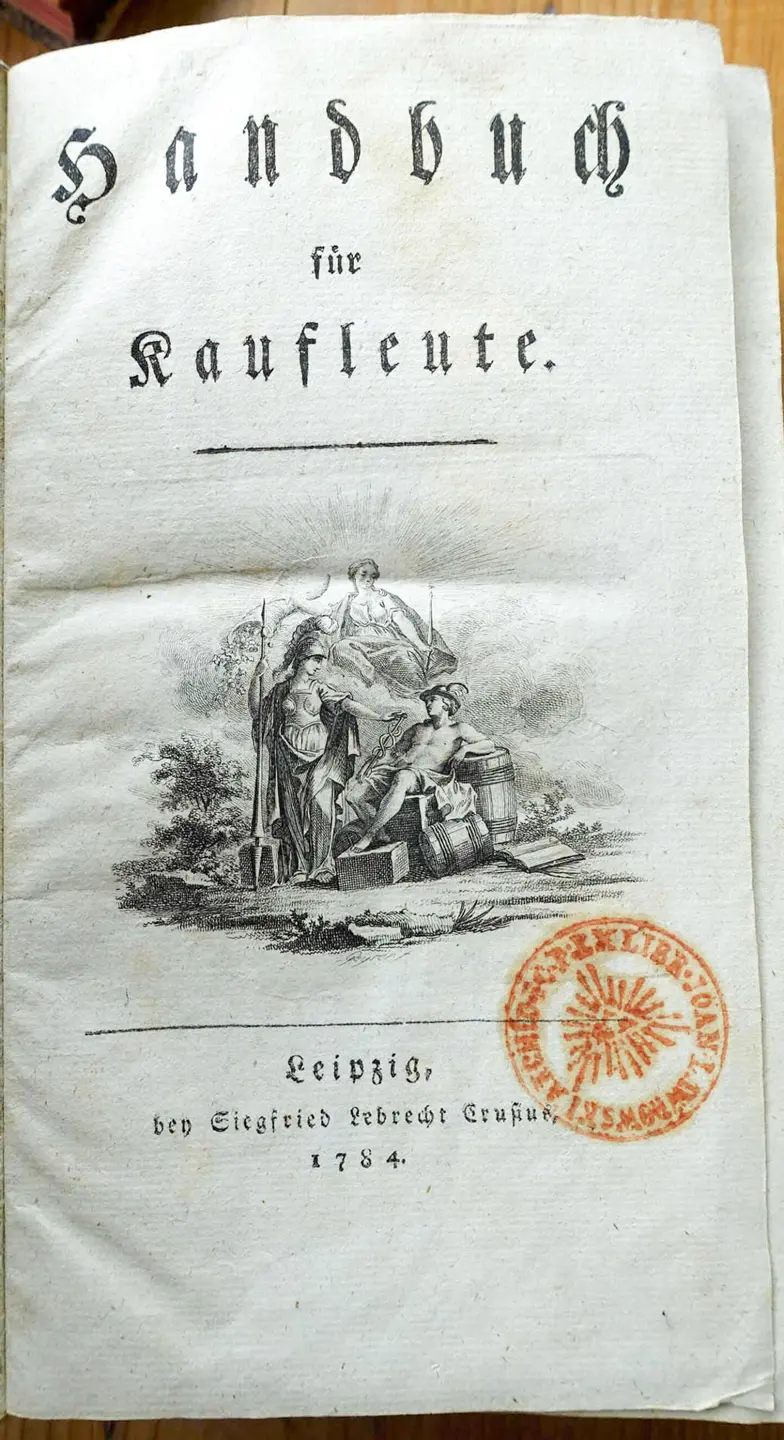


August Friedrich Wilhelm Crome’s *Handbuch für Kaufleute* (*Handbook for Merchants*), published in 1784, is one of the most significant economic reference works of the late 18th century. The book was written at a time when trade and the economy were undergoing profound changes. International trade was on the rise, new trade routes were emerging, and the Enlightenment fostered a more rational understanding of economic relationships. Crome sought to provide merchants with a practical tool that systematically compiled economic knowledge and met the demands of an increasingly interconnected world of trade.
August Friedrich Wilhelm Crome (1753–1833) was a geographer, statistician, economist, and professor at the University of Giessen. He became particularly well-known for his statistical analyses of Europe and his early economic maps. He was among the first scholars to not only collect economic information but also to evaluate it comparatively. His interest lay in the real conditions of trade: production sites, transportation routes, raw materials, prices, and political frameworks. The “Handbook for Merchants” reflects precisely this empirical approach.
The work covers nearly all areas that were important to a successful merchant. It provides information on weights and measures in various countries, currencies, exchange rates, customs regulations, commodities, insurance, transportation options, and commercial practices. In an era without the internet, modern reference works, or international standards, such a book was invaluable. Anyone doing business with Amsterdam, London, Hamburg, Venice, or the trading centers of the Mediterranean region needed reliable information about local conditions to avoid economic risks.
Noteworthy is Crome’s understanding of the merchant. Trade is not portrayed as a mere pursuit of profit, but as a demanding profession that requires knowledge, judgment, and responsibility. A successful merchant must not only be able to do calculations but also monitor political developments, possess geographical knowledge, and understand the economic structures of various countries. In this way, Crome significantly broadens the professional profile of the merchant. Economic success is based not solely on capital, but equally on education and information.
The book also symbolizes the transition from mercantilism to classical economics. While older economic concepts viewed a state’s wealth primarily in terms of precious metals and state control, Crome focuses more strongly on production, trade, and the division of labor. Prosperity arises through exchange, specialization, and international interdependence. His perspective thus aligns with the ideas that Adam Smith had formulated just a few years earlier in *The Wealth of Nations*.
Crome’s approach to data seems particularly modern. He systematically collects information and attempts to make economic developments comparable. Statistical overviews, tables, and geographical data serve to ground economic decisions in verifiable facts. This makes Crome one of the early pioneers of data-driven economic analysis, which today seems self-evident.
The work is also of great significance for the history of money. It illustrates how complicated international payments were before the introduction of nationally standardized currencies. Different coinage systems, measures, exchange rates, and trade rules made economic knowledge indispensable. Money appears here not as an abstract concept, but as a practical instrument whose value and function depended on the respective political and economic context.
Today, the “Handbook for Merchants” is far more than a historical textbook. It documents the dawn of a modern information society in which economic success is increasingly based on knowledge. At the same time, it serves as a reminder that trade is always based on trust, shared rules, and reliable information. In a globalized world where data and markets are even more closely interconnected than in the 18th century, Crome’s fundamental idea seems remarkably relevant today: sound economic decisions arise where experience, education, and carefully gathered information come together.

