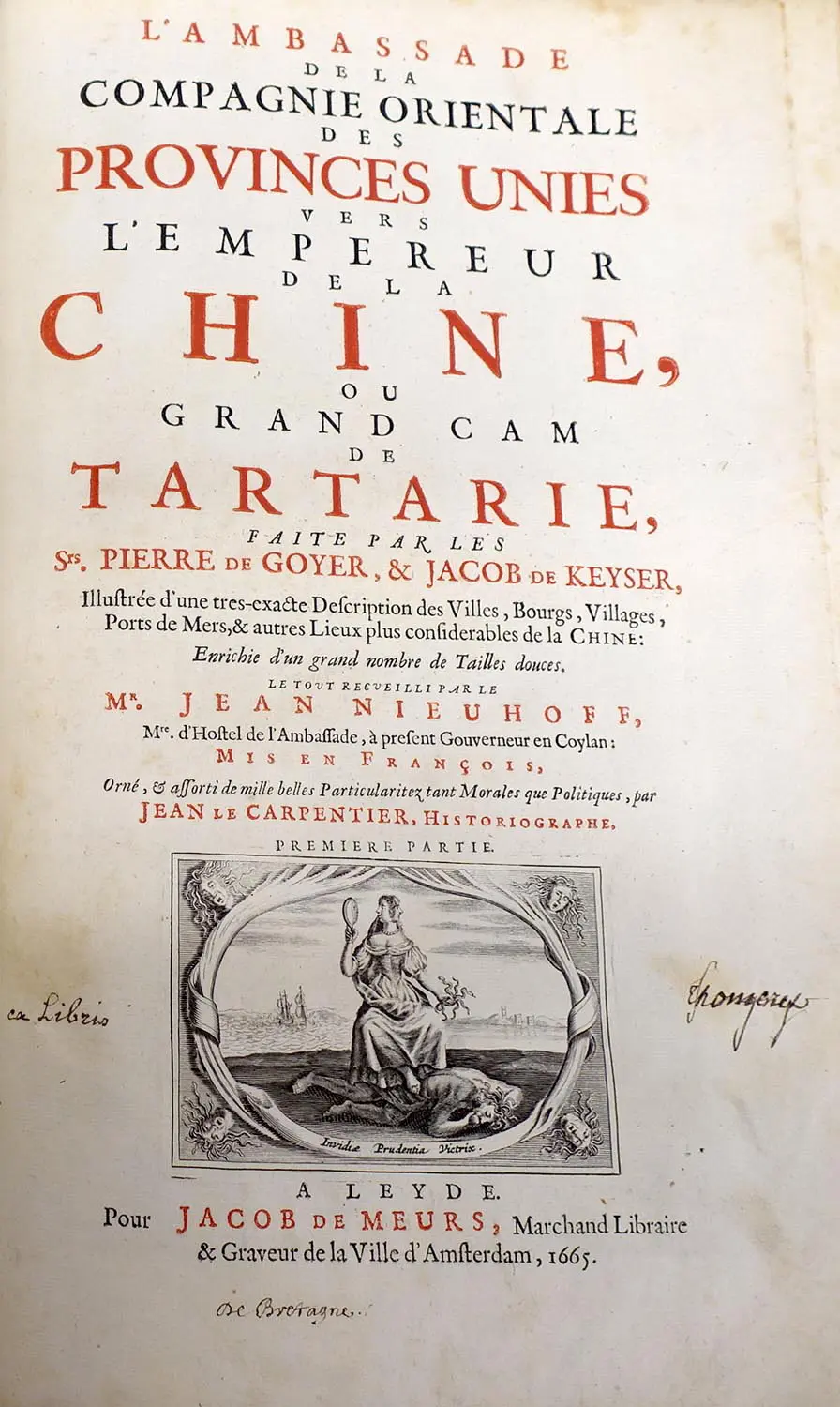


L'Ambassade de la Compagnie Orientale des Provinces Unies vers l'Empereur de la Chine
Essay by
Jurg Conzett

With *L’Ambassade de la Compagnie Orientale des Provinces Unies vers l’Empereur de la Chine*, the Dutch traveler Joan Nieuhoff published one of the most influential books on China of the 17th century in 1665. The work describes the diplomatic mission of the Dutch East India Company (VOC) to the Emperor of the Qing Dynasty from 1655 to 1657. It combines a detailed travelogue with numerous illustrations and descriptions of cities, landscapes, people, and customs. For many European readers, it was the first comprehensive and relatively reliable account of China and shaped the European perception of China for generations.
The mission had a clear economic goal. The Dutch East India Company sought to gain direct access to the Chinese market and secure trade privileges. China was of extraordinary interest to Europe. Silk, porcelain, tea, lacquerware, and other luxury goods were in growing demand. While Portugal already had trading posts and other European powers were competing for influence, the VOC hoped for an official opening of the Chinese Empire. Although the diplomatic mission led by Pieter de Goyer and Jacob de Keyser was largely unsuccessful politically, the journey itself yielded a wealth of information about a country that was virtually unknown to most Europeans.
Joan Nieuhoff accompanied the expedition as a member of the delegation. His particular merit lies in his precise observations. Unlike many earlier travel accounts, he largely refrains from fantastical tales of mythical creatures or legendary riches. Instead, he describes architecture, agriculture, rivers, canals, administration, clothing, and everyday life with remarkable precision. His descriptions convey the impression of a highly developed society with an efficient bureaucracy and an impressive infrastructure.
The work became famous above all for its numerous copperplate engravings. They depict temples, palaces, bridges, ships, cities, and landscapes with extraordinary attention to detail. Although some of the illustrations were later artistically retouched, they were long regarded as the most authentic depictions of China in Europe. Many later books reproduced these illustrations, and as a result, Nieuhoff’s view of China had a lasting impact on the European imagination.
At the same time, the work makes clear how closely knowledge and trade were intertwined. For the East India Companies, geographical and cultural knowledge was not an end in itself. Anyone who wanted to trade successfully had to know the trade routes, understand political conditions, and observe the rules of the court. Travel accounts thus became economic tools. They helped merchants, diplomats, and governments assess the opportunities and risks of foreign markets.
At the same time, the book reveals the limits of European influence. The Chinese government did not regard the European delegations as equal diplomatic partners, but rather as visitors within the existing Chinese world order. The so-called tribute system was based on the notion that the Emperor stood at the center of the civilized world. These differing conceptions of international relations repeatedly led to misunderstandings. Nieuhoff’s account therefore documents not only a journey but also the encounter between two political and cultural orders.
From today’s perspective, *L’Ambassade de la Compagnie Orientale des Provinces Unies vers l’Empereur de la Chine* holds great historical value. It depicts Europe during a phase of growing global interconnectedness and China at the height of its early modern power. The work combines exploration, economic interests, and ethnographic observation into an impressive testament to early globalization. It serves as a reminder that trade is always more than just the exchange of goods: it brings cultures into contact with one another, expands knowledge, and changes our view of the world—even if mutual understanding is often more difficult to achieve than economic exchange.

