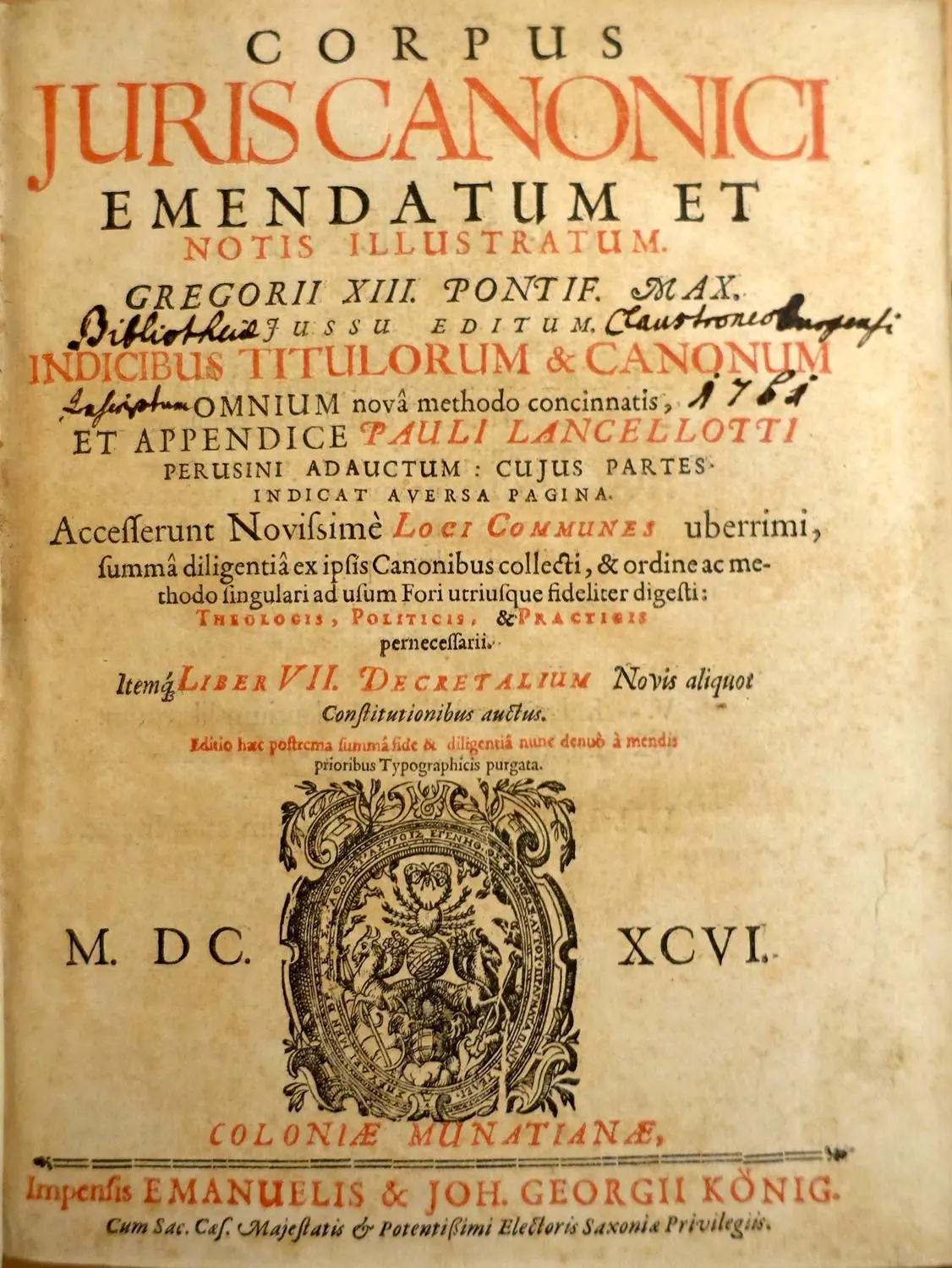


The Corpus iuris canonici, whose 1696 edition—emendatum et notis illustratum (revised and annotated)—is considered one of the most significant legal works of the early modern period, served for centuries as the fundamental collection of canon law for the Catholic Church. It formed the foundation of ecclesiastical jurisdiction, regulated the lives of the clergy, and at the same time influenced the development of European law far beyond the religious sphere.
The work was not created all at once but evolved over several centuries. Its starting point was the “Decretum Gratiani,” compiled around 1140, in which the monk Gratian organized contradictory sources of canon law and attempted to reconcile them. Over the course of the following centuries, papal collections of laws were added, including Pope Gregory IX’s “Liber Extra,” the “Liber Sextus,” the “Clementinae,” and other supplements. It was not until the late Middle Ages that the name “Corpus iuris canonici” became established for this extensive collection.
The 1696 edition follows in the tradition of scholarly legal scholarship. It is not limited to a mere reprint of the text but contains numerous annotations, cross-references, and explanations. Such annotated editions served as working tools for jurists, theologians, and judges. The editors sought to compare different manuscripts, correct earlier printing errors, and make the often complex provisions understandable. In this way, the edition demonstrates the high scholarly standards of 17th-century legal scholarship.
Canon law governed far more than just religious matters. Among other things, it defined the requirements for a valid marriage, the rights and duties of clergy, the inheritance laws of ecclesiastical institutions, issues of jurisdiction, and numerous areas of education and university life. At a time when the Church and the state were closely intertwined, canon law had a profound impact on people’s daily lives. Many legal procedures that seem self-evident today first developed in ecclesiastical courts.
The influence of canon law on European legal culture was particularly significant. Together with Roman law, it formed the so-called “ius commune,” the common law of Europe. At universities, both legal systems were taught in parallel and integrated with one another. Numerous principles of modern jurisprudence—such as careful presentation of evidence, written documentation, appellate procedures, and the systematic interpretation of laws—were shaped by this tradition. The understanding of contracts, property, and legal entities also continued to develop under its influence.
The 1696 edition was published at a time of profound change. The Reformation had permanently shattered Europe’s religious unity, and states were increasingly establishing their own legal systems. Nevertheless, the “Corpus iuris canonici” remained of central importance within the Catholic world. It ensured uniform rules across national borders and helped organize the administration of the Church in an increasingly complex society.
Today, the “Corpus iuris canonici” is primarily of historical value, as it was replaced in 1917 by the modern “Codex Iuris Canonici.” Nevertheless, its significance remains undiminished. It documents the centuries-long development of European law and illustrates how closely religion, politics, and law were intertwined. The 1696 edition serves as a reminder that law encompasses not only statutes but is also a cultural tradition that is passed down, commented upon, and further developed across generations. It thus stands as a striking testament to the emergence of the legal system upon which many elements of modern Europe are still built today.

