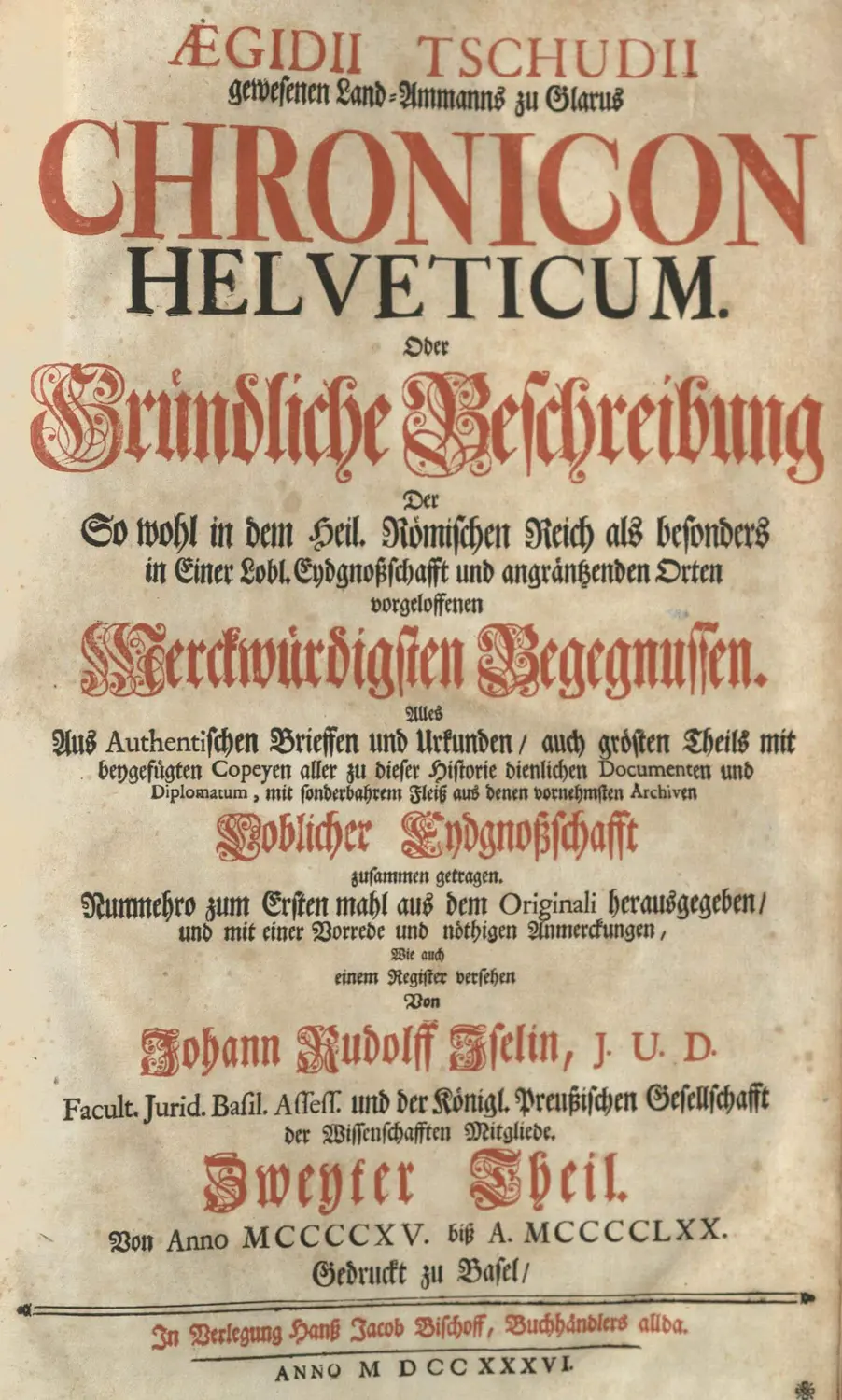


Chronicon Helveticum, Zweyter Teil Von Anno MCCCCXV (= 1415) bis A. MCCCCLXX (= 1470)
Essay by
Jurg Conzett

The Chronicon Helveticum is one of the most significant historical works of early Switzerland. Its author, Aegidius Tschudi (1505–1572), is considered one of the most influential chroniclers of the Swiss Confederation. Although the work was written as early as the 16th century, the second part was not published until 1736. It covers the years 1415 to 1470—an era in which the Swiss Confederation evolved from a loose alliance into a regional power.
The period under consideration encompasses some of the most decisive events in Swiss history. It begins with the conquest of Aargau in 1415, when the Swiss Confederates exploited the weakness of the House of Habsburg to extend their rule westward. This is followed by tensions within the Confederation, conflicts with the Habsburgs, and the political and military developments that ultimately led to the Burgundian Wars. Tschudi depicts these events not as a random sequence but as an expression of a shared historical calling among the Swiss Confederates.
His chronicle is far more than a collection of facts. It weaves together historical documents, oral traditions, local chronicles, and narrative embellishments into a grand national narrative. From today’s perspective, much of it can no longer be historically substantiated. Tschudi embellishes speeches, rearranges themes, and blends historical facts with legends. Nevertheless, his goal was not to deceive, but to provide meaning. History was meant to explain why the Swiss Confederation had come into being and what virtues had made its success possible.
At the heart of the narrative are values such as freedom, loyalty, bravery, and unity. The Swiss appear as a community of free people defending their independence against powerful princes. This perspective reflected the political thinking of the 16th century and shaped the Swiss sense of identity for centuries to come. Numerous later historians, artists, and politicians drew upon Tschudi’s account, making it an important part of the nation’s culture of remembrance.
The 1736 edition, in particular, is historically significant. It was published at a time when the Old Swiss Confederacy was reaffirming its identity in the face of shifting power dynamics in Europe. The publication made Tschudi’s extensive work accessible to a wider readership for the first time. As a result, the *Chronicon Helveticum* became a central source for historical consciousness during the Enlightenment, even though its account was already the subject of critical debate at the time.
From today’s perspective, Tschudi’s work is interpreted in a more nuanced way. Historians carefully examine his sources and distinguish between established facts and literary embellishment. Yet it is precisely this combination that makes the chronicle particularly valuable. It shows not only what happened in the 15th century, but also how people in the 16th and 18th centuries imagined their past and what significance they attributed to it.
The Chronicon Helveticum is therefore both a historical account and a cultural testament. It documents the emergence of a historical narrative that has shaped Switzerland across generations. Anyone who reads the chronicle encounters not only the events between 1415 and 1470, but also the question of how nations recount their past and use it to develop their identity, legitimacy, and visions of the future. The enduring significance of Tschudi’s work lies in this tension between historical research and national memory.

