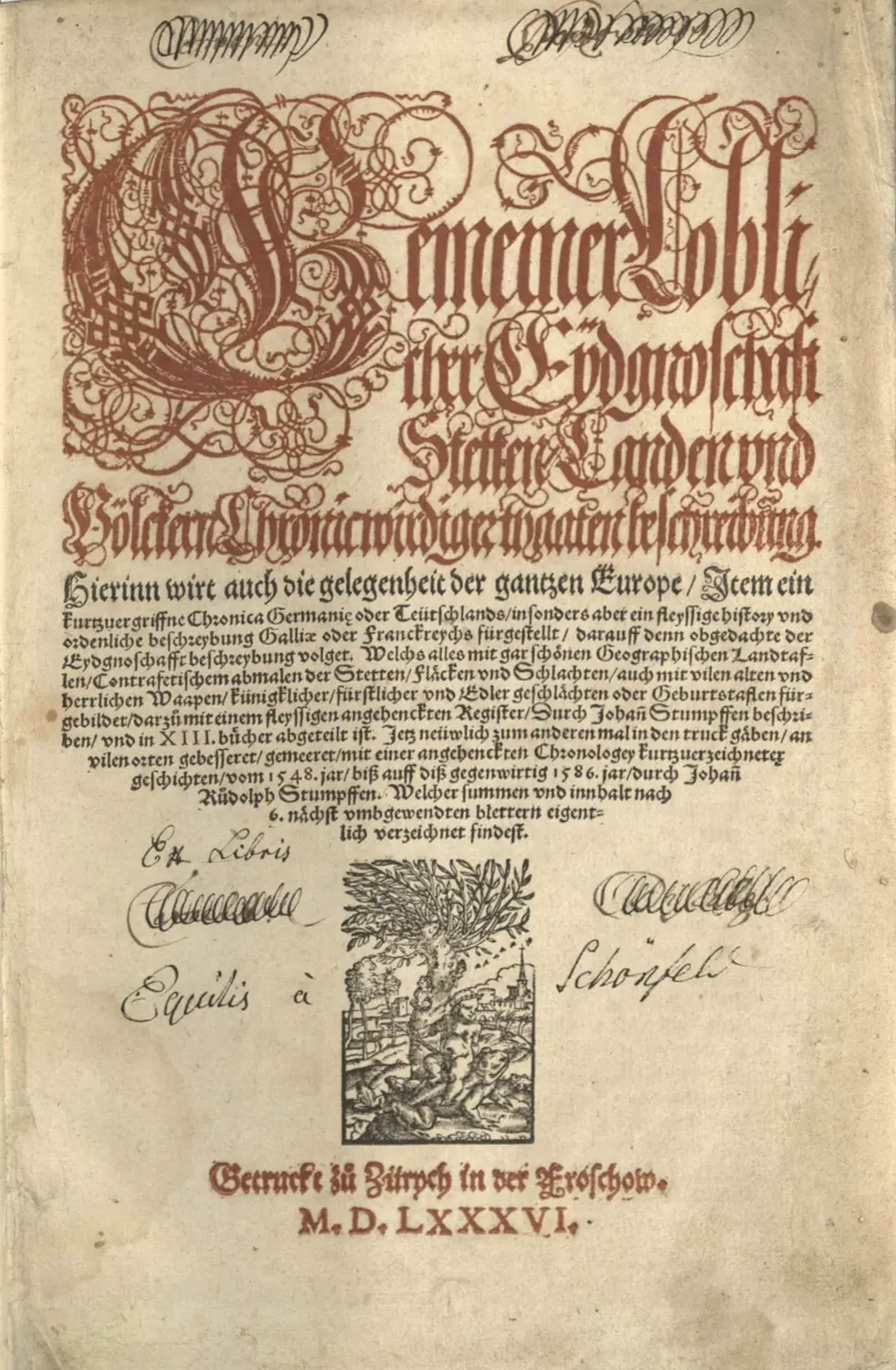


Gemeiner Löblicher Eidgenossenschaft Städte, Länder und Völker Chronik, würdiger Taten Beschreibung
Essay by
Jurg Conzett

Johannes Stumpf’s *Chronicle of the Cities, Cantons, and Peoples of the Noble Swiss Confederation: A Description of Their Worthy Deeds* is one of the most important historical works of early Switzerland. First published in 1548 and reprinted in 1586, the chronicle is far more than a collection of historical events. It is a comprehensive portrait of the Swiss Confederation, its regions, cities, people, and political order. At a time when Switzerland was redefining itself in the wake of the Burgundian Wars and the Reformation, Stumpf created a work that interwove history, geography, and national identity.
Johannes Stumpf (1500–1577) was a Reformed pastor, scholar, and historian. His goal was to systematically present the history of the Swiss Confederation and place it within a broader European context. The chronicle not only covers the origins of individual towns and their political developments but also describes rivers, mountains, cities, castles, monasteries, and notable figures. The result was an encyclopedia of Switzerland at that time, bringing together knowledge from a wide variety of fields.
Particularly noteworthy is the integration of text and imagery. The chronicle contains numerous detailed woodcuts, maps, and cityscapes. These illustrations served not only as embellishments but also transformed the work into a visual reference book. For many places, they represent the oldest surviving depictions and retain great cultural and historical value to this day. They offer a unique glimpse into 16th-century Switzerland and reveal how cities, landscapes, and buildings were perceived at that time.
Stumpf did not view history as a mere list of dates. For him, it was a means of conveying political virtues. Courage, loyalty, solidarity, and the defense of freedom form the central theme of his account. The history of the Swiss Confederation is presented as a collective endeavor of various cities, cantons, and peoples who, despite their differences, are united by alliances and mutual obligations. This perspective strengthened the sense of a shared identity long before a modern nation-state emerged.
At the same time, the chronicle reflects the mindset of its era. Historical narratives are often intertwined with legends, and moral judgments shape the portrayal of many events. From today’s perspective, not all accounts are historically verified. Nevertheless, this hardly diminishes the work’s value. Rather, it shows how people of the 16th century understood history and what significance they attributed to it for the present.
Linguistically as well, the chronicle is an impressive testament to its time. Early New High German conveys the transition from medieval to modern language usage. While the language requires patience from today’s readers, it offers direct access to the intellectual world of the Renaissance.
The 1586 edition also documents the development of book printing. By this time, extensive works with high-quality illustrations could be produced in larger numbers and reached scholars, councilmen, and wealthy citizens. Books thus became important vehicles for historical knowledge and political education.
Today, Johannes Stumpf’s chronicle is of great value not only to historians. It serves as a source for geography, art history, linguistics, and cultural history alike. Above all, however, it reminds us that history forges identity. Anyone seeking to understand how the Swiss Confederation developed its sense of self and why shared memories are so important for living together will find in Stumpf’s chronicle one of the most impressive testimonies to the Swiss Renaissance.

