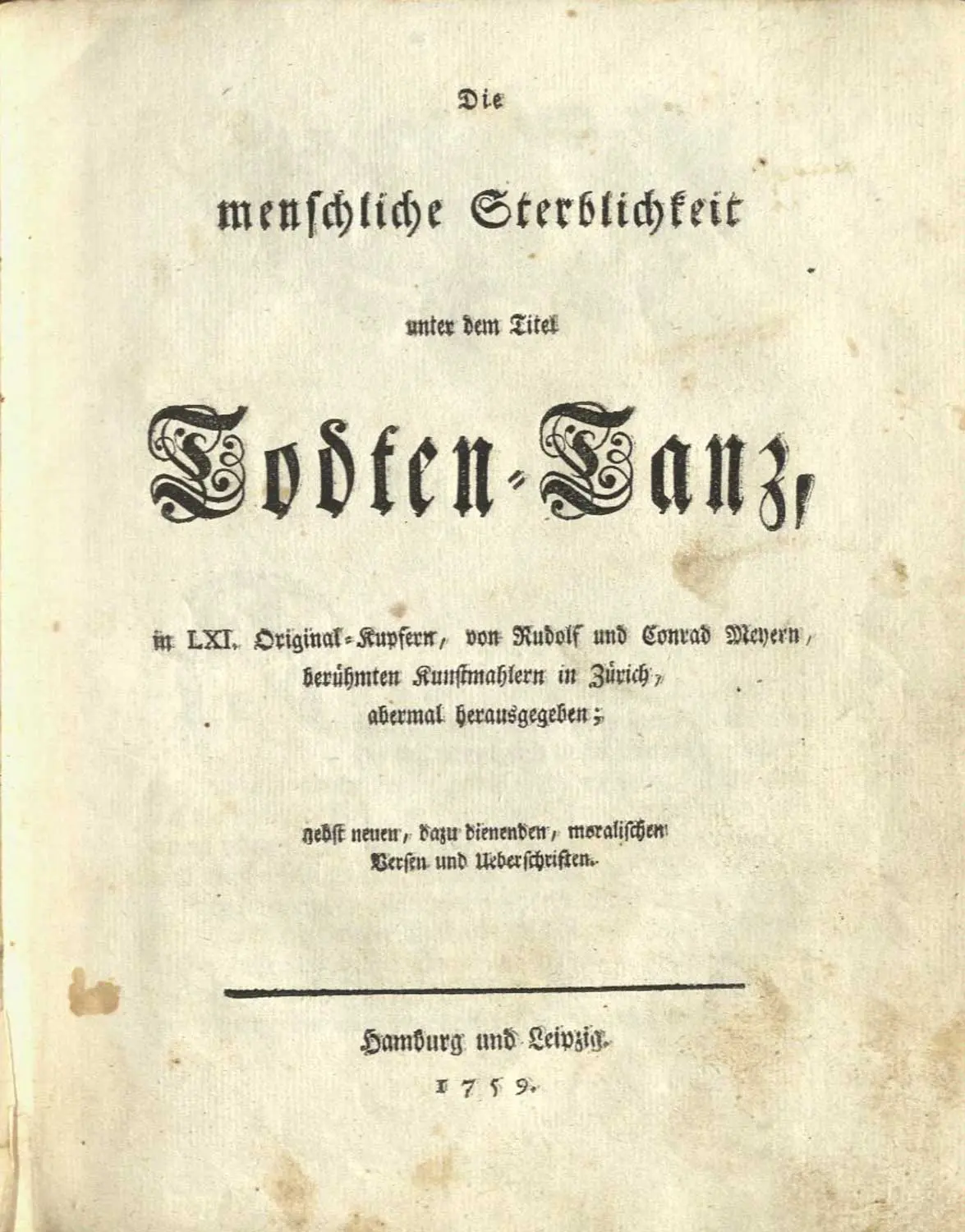


Sterbensspiegel, das ist sonnenklare Vorstellung menschlicher Nichtigkeit durch alle Ständ und Geschlechter
Essay by
Jurg Conzett

Salomon Wolf’s *Sterbensspiegel* (*Mirror of Death*), a crystal-clear portrayal of human insignificance across all social classes and genders, published in 1650, is a striking testament to Baroque piety and European *vanitas* literature. The work was written just two years after the end of the Thirty Years’ War, one of the most devastating catastrophes in European history. Millions of people had lost their lives to war, famine, and plague. In this era marked by uncertainty and loss, Wolf’s book reminded his readers of a truth that unites all people: the inevitability of death.
The title alone makes the work’s central theme clear. The “Mirror of Death” is intended to hold up a mirror to people, revealing their own transience. Regardless of whether one is a prince or a peasant, a scholar or a craftsman, rich or poor—no one can escape death. All social distinctions lose their significance in the face of life’s finitude. In doing so, Wolf takes up a motif that had been deeply rooted in Christian culture since the Middle Ages and gained new intensity during the Baroque period.
The work follows in the tradition of the so-called *Ars moriendi*, the “Art of Dying.” These writings were not intended to frighten people, but rather to prepare them for a good death. Death should not come as a surprise but be consciously contemplated as a transition to eternal life. For this reason, Wolf combines urgent warnings with religious comfort. The transience of the world is not presented as a reason for despair but as a call to align one’s own life with Christian values.
The distinctive visual language is typical of the Baroque period. Skulls, hourglasses, wilting flowers, and dying candles were familiar symbols of transience. Even though the *Spiegel der Sterblichkeit* is primarily a text, it follows the same line of thought. Everything earthly appears transient, while only God and eternal salvation endure. This perspective shaped not only literature but also 17th-century painting, music, and architecture.
The book’s universal message is remarkable. Wolf does not address a specific social group, but explicitly “all classes and genders.” For that time, this was a far-reaching statement. Death creates an equality that no worldly order can overturn. Nobility, wealth, or political power lose their significance when human life ends. In this regard, the work also contains a subtle critique of excessive ambition and material self-importance.
From today’s perspective, this constant preoccupation with death may seem strange at first. Modern societies often push dying out of everyday life and shift it to hospitals or nursing facilities. In the 17th century, however, death was ever-present. High infant mortality, epidemics, and wars made it a constant experience. The “Mirror of Death” therefore reflects not only religious beliefs but also the reality of life in its time.
Nevertheless, the work remains relevant to this day. Its true message focuses less on death than on life. Those who become aware of their own mortality inevitably question the meaning of their actions. What values endure? What is truly important? What significance do possessions, power, or fame hold? Such questions continue to occupy people’s minds even in the 21st century.
The Mirror of Death is therefore far more than a religious devotional book. It documents the worldview of the Baroque era and reminds us that grappling with transience can be a source of reflection and guidance. Precisely because life is finite, every decision takes on greater weight. In this sense, Salomon Wolf’s work remains a timeless invitation to reflect on the relationship between finitude, responsibility, and the meaning of human life.

