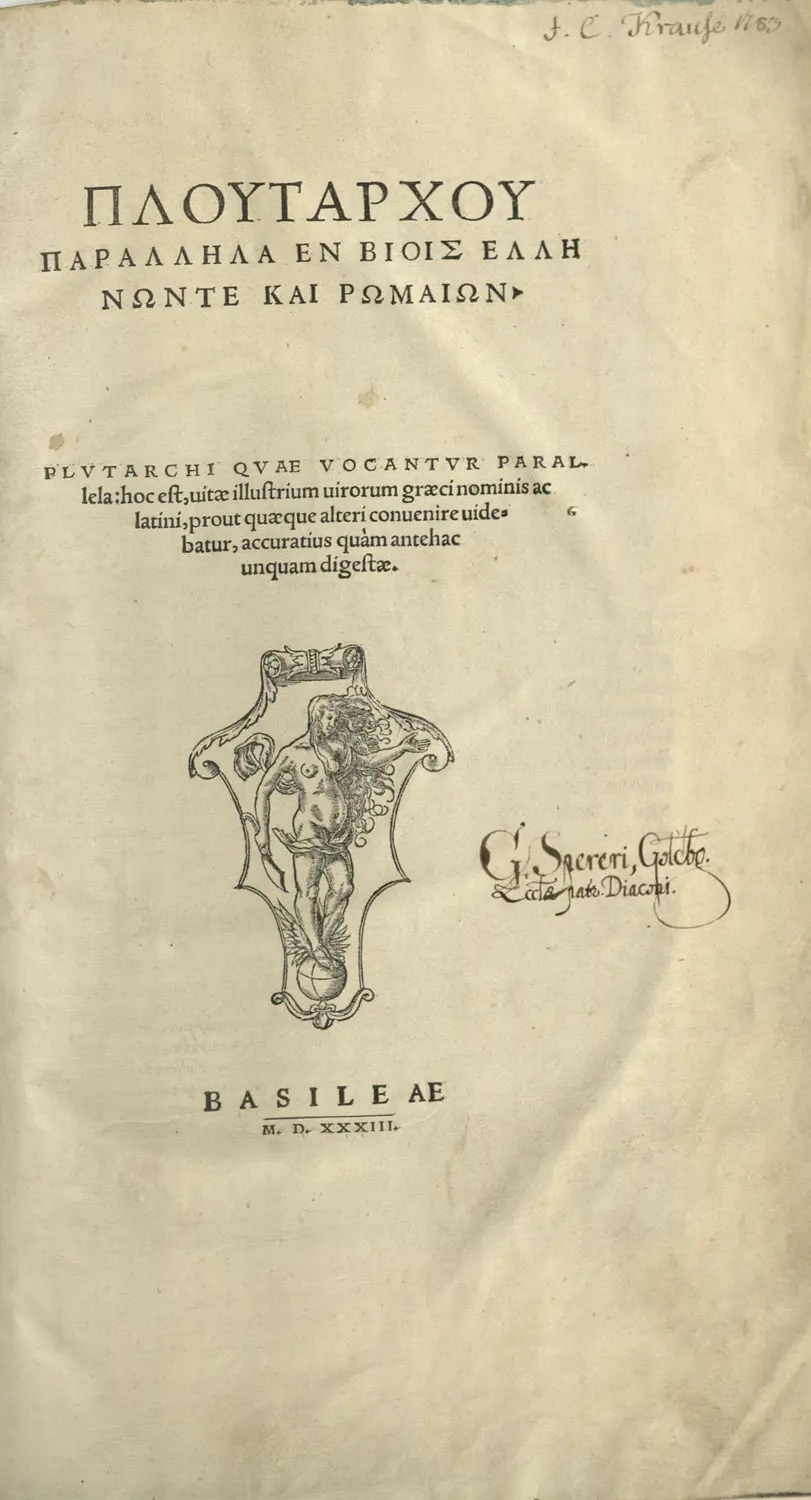


The Greek edition of Plutarch’s *Parallela en Biois Hellenon te kai Romaion* (*Parallel Biographies of the Greeks and Romans*), published in 1533, is one of the most significant book publications of the Renaissance. Although the Greek philosopher and writer Plutarch lived as early as around 100 CE, his works experienced a remarkable rediscovery in the 16th century. Humanists sought out the sources of ancient culture and wanted to read the original texts as unadulterated as possible. The 1533 edition exemplifies this return to the origins of European thought.
Plutarch was born around 45 AD in Chaeronea, Greece, and worked as a philosopher, priest, and writer. His best-known work is the *Parallel Lives*, in which he juxtaposes a prominent Greek figure with a prominent Roman. For example, he compares Alexander the Great with Julius Caesar, Demosthenes with Cicero, and Lycurgus with Numa Pompilius. The aim of these comparisons, however, is not to provide a complete historical account of a life, but rather to compare character, virtue, and moral conduct.
For Plutarch, history is first and foremost a school of life. He is famous for his remark that often a small deed or a casual word reveals more about a person’s character than great battles or political decisions. That is why his interest focuses less on dates or military campaigns than on the personalities of his subjects. What qualities led to success? What weaknesses caused decline? Readers are meant to learn from the biographies how to shape their own lives more wisely.
It was precisely this connection between history and ethics that made the work so influential during the Renaissance. Humanists such as Erasmus of Rotterdam and Jacques Amyot saw Plutarch as a teacher of political wisdom. His biographies were read throughout Europe and served as models for princes, scholars, and statesmen. William Shakespeare, too, drew extensively on Plutarch. His plays *Julius Caesar*, *Antony and Cleopatra*, and *Coriolanus* are based in large part on the Greek author’s biographies. Plutarch thus shaped not only historiography but also European literature.
The 1533 edition also holds special significance in the history of the book. Printing had developed rapidly since the mid-15th century, making the widespread dissemination of original Greek texts possible for the first time. Previously, many ancient works had been accessible only in a few manuscripts or Latin translations. Printed Greek editions enabled scholars to work directly with the original texts. They became a cornerstone of humanistic education and scholarly philology.
The Parallel Biographies remain politically significant to this day. Plutarch shows that good institutions alone are not enough. What remains decisive is the character of the people who bear responsibility. Power demands self-control, justice, and wisdom. Ambition can bring about great things, but it can just as easily lead to self-destruction. These questions concern modern democracies just as much as they did the ancient city-states and the Roman Republic.
The Parallel Lives are therefore far more than a collection of ancient biographies. They combine historical narrative with philosophical reflection and make it clear that history is always, in part, an examination of human behavior. The 1533 edition documents the decisive moment when the knowledge of antiquity became accessible to a new European public through the invention of the printing press. Its influence on historiography, literature, political theory, and education extends to the present day, making Plutarch one of the most enduringly influential authors in European intellectual history.

