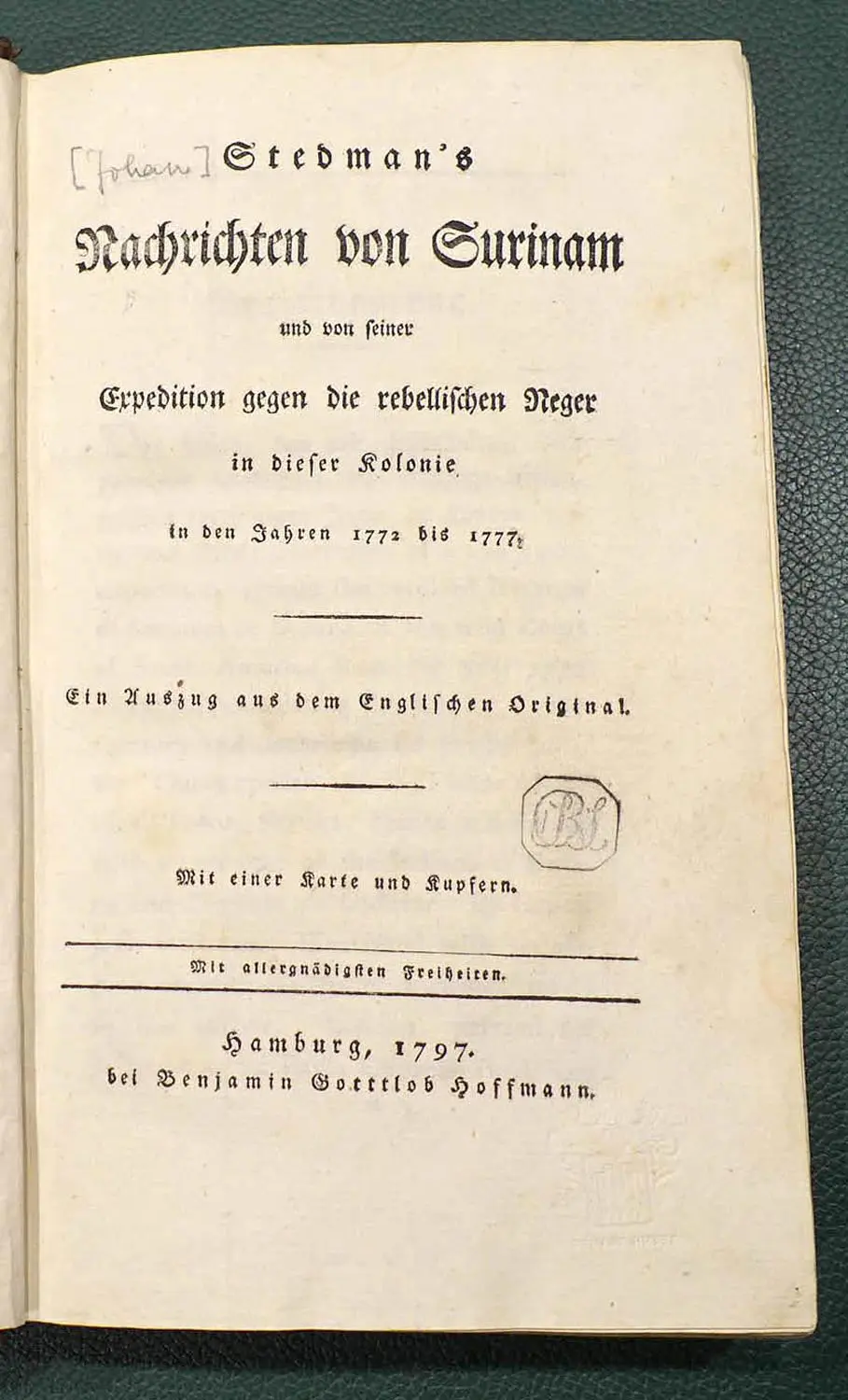


Nachrichten von Surinam und von seiner Expedition gegen die rebellischen Neger in dieser Kolonie in den Jahren 1772 bis 1777
Essay by
Jurg Conzett

John Gabriel Stedman’s *News from Suriname and of His Expedition Against the Rebellious Negroes in That Colony in the Years 1772 to 1777*, published in German translation in 1797, is one of the most compelling accounts of the colonial world of the 18th century. The work describes Stedman’s service as an officer in the Dutch colony of Suriname, in what is now South America. His mission was to crack down on escaped enslaved Africans—the so-called Maroons—who had established independent communities in the dense rainforest. What begins as a military expedition report, however, evolves into an unflinching account of slavery, violence, and colonial rule.
Stedman entered the service of the Dutch colonial forces in 1772. Suriname’s plantation economy relied on the labor of tens of thousands of enslaved people who produced sugar, coffee, cocoa, and cotton under extreme conditions. Many of them fled into the forests, where they established independent communities and successfully defended themselves against colonial attacks. The expedition in which Stedman participated was intended to break this resistance and secure the colonial power’s control.
The author’s stance is remarkable. Although he fought as a soldier on the side of the colonial government, he depicts the cruelty of slavery with unusual candor. He describes torture, public punishments, floggings, and executions in harrowing detail. At the same time, he shows compassion for the enslaved people and admires the courage of many Maroons. This internal tension makes the work particularly credible: Stedman does not defend the colonial order unreservedly, but increasingly finds himself caught in a moral conflict between military duty and human conscience.
His illustrations made a significant contribution to the book’s impact. Particularly well-known are the copperplate engravings by the English artist William Blake, who engraved several plates for the English edition. His harrowing depictions of the mistreatment of enslaved people are among the most striking images of the early abolitionist movement. They made the suffering of slaves visible to a European audience and had a lasting impact on the public perception of slavery.
The work therefore wields not only literary but also political influence. Although Stedman himself was not a staunch opponent of colonial rule, his descriptions provided important arguments for the movement to abolish the slave trade. In Great Britain in particular, abolitionists used the text and images to document the inhumanity of the existing system. The book powerfully demonstrates how eyewitness accounts can shape social debates.
From an economic perspective, Stedman’s account offers deep insight into the logic of colonial capitalism. In the 18th century, Europe’s prosperity relied to a significant extent on plantation agriculture and transatlantic trade. Sugar, coffee, and cocoa were considered coveted consumer goods, yet their price did not reflect the human cost of their production. Behind every sack of sugar lay forced labor, violence, and the denial of rights. Stedman’s observations reveal that economic success was often based on exploitation—a realization that continues to raise questions today about the social and ethical foundations of global supply chains.
News from Suriname is therefore far more than a military travelogue. The book combines descriptions of nature, ethnographic observations, and personal experience into a powerful testimony to the colonial world. It reveals the contradictions of an era that championed freedom and the Enlightenment while simultaneously enslaving millions of people. It is precisely this tension that gives the work its enduring relevance. It serves as a reminder that economic progress achieved without respect for human dignity comes at a moral cost—a insight that has lost none of its significance even in the 21st century.

