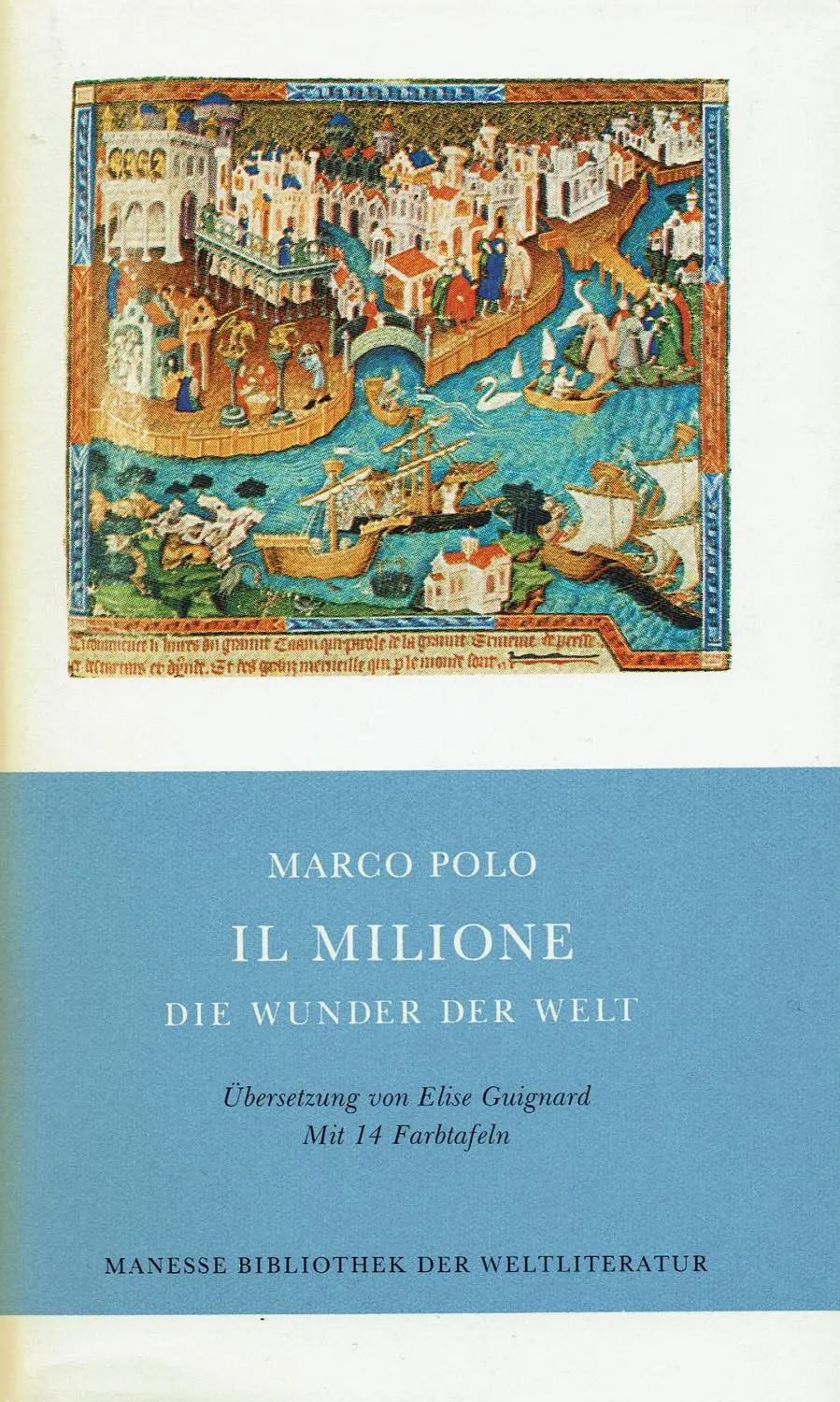


Marco Polo’s *The Wonders of the World* is one of the most influential travelogues in world literature. The 1983 Manesse edition makes this medieval classic accessible to a modern audience in a carefully edited form. Although the work is based on the travels of the Venetian merchant Marco Polo in the late 13th century, its significance extends far beyond the description of foreign lands. It tells of the encounter between different cultures, of trade and power, and of the curiosity that drives people to look beyond familiar boundaries.
In 1271, Marco Polo set out from Venice for Asia together with his father and his uncle. After a long journey, they reached the court of the Mongol ruler Kublai Khan, grandson of Genghis Khan and founder of the Yuan Dynasty in China. According to his own account, Marco Polo remained in the service of the Great Khan for about seventeen years and traveled through numerous regions of his empire. He did not return to Venice until 1295. During a later period of captivity, he dictated his memoirs to the writer Rustichello da Pisa. This gave rise to one of the most famous travel books in history.
The work is particularly fascinating for its extraordinary wealth of observations. Marco Polo describes cities, trading centers, rivers, deserts, and mountains, as well as religions, languages, and ways of life. He was particularly impressed by the size of Chinese cities, the efficiency of the administration, and the dense network of roads and post stations. To medieval European readers, these descriptions must have seemed like reports from another world.
Of particular interest is his description of trade. Marco Polo writes about silk, spices, gemstones, salt, and other valuable goods that were transported along the trade routes. He describes markets, caravans, and sea routes, making it clear just how closely Europe and Asia were already economically linked in the Middle Ages. Also noteworthy is his account of Chinese paper money. While gold and silver coins dominated in Europe, Marco Polo describes government-issued paper money whose value was based on trust in the ruler’s authority. For many European readers, this concept was almost unimaginable, yet it served as a fascinating indication of China’s economic innovation.
The credibility of the work has been the subject of controversy for centuries. Some contemporaries considered the descriptions exaggerated or fabricated. Indeed, the book contains inaccuracies, and some observations are likely based on reports from other travelers. Nevertheless, modern historical research has confirmed that many of its descriptions are astonishingly precise. Numerous details regarding the administration, infrastructure, and economy of the Mongol Empire correspond with Chinese sources.
The 1983 Manesse edition particularly highlights the text’s literary and historical value. It makes clear that *The Wonders of the World* is not merely a collection of exotic stories, but a document of early globalization. The work depicts a world in which merchants, diplomats, and travelers were already exchanging knowledge, goods, and ideas across continents. It serves as a reminder that cultural encounters took place long before the modern era and had a lasting impact on the course of history.
Even today, Marco Polo’s travelogue remains highly relevant. In a globally interconnected world, the willingness to get to know other cultures and learn from them remains of central importance. *The Wonders of the World* is therefore far more than a medieval adventure book. It is a plea for curiosity, openness, and the realization that economic exchange and cultural understanding are inextricably linked. It is precisely this connection that explains why Marco Polo’s work has been read for over seven centuries and has lost none of its fascination to this day.

