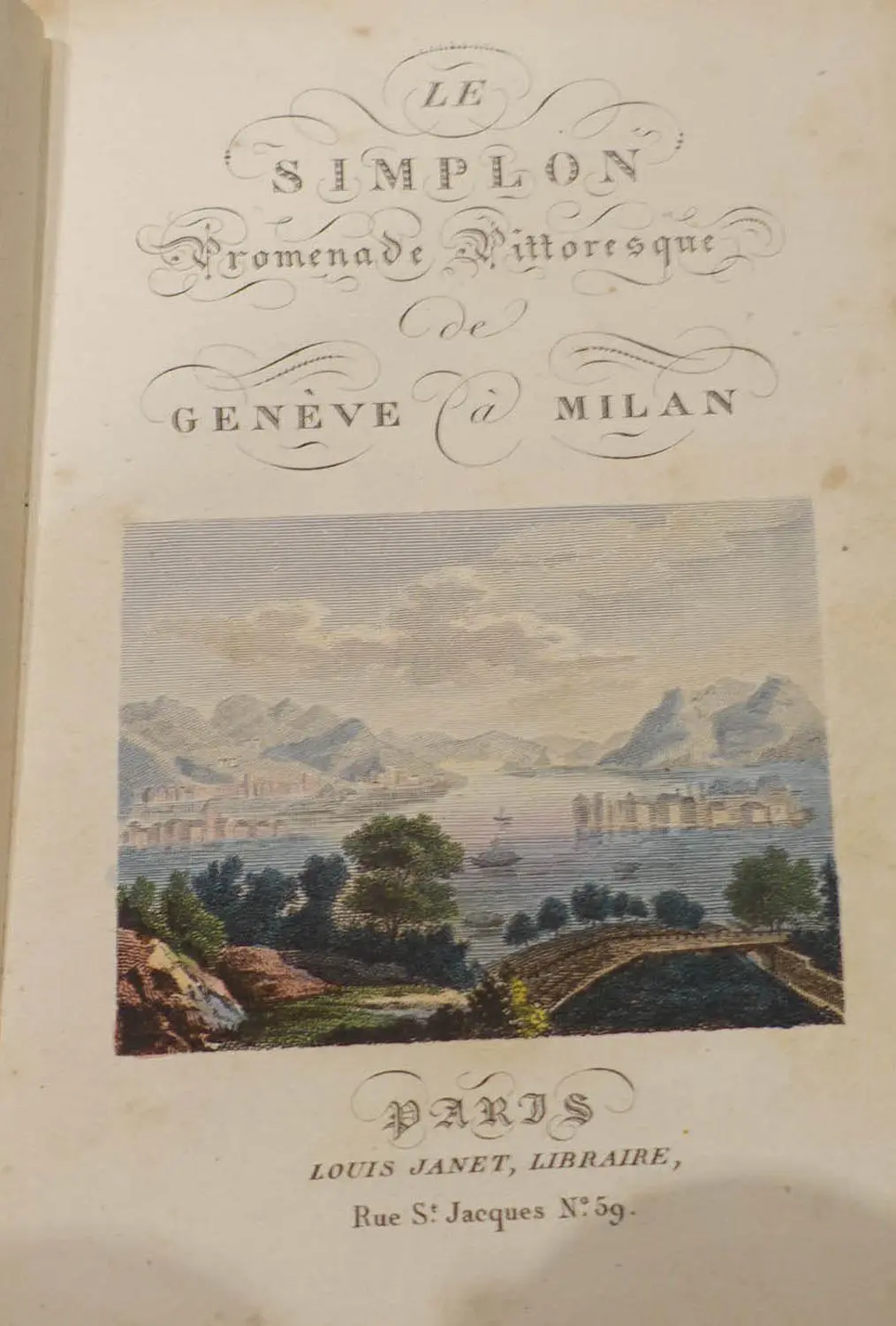


*Le Simplon: Promenade Pittoresque de Genève à Milan* was published in 1824 and is one of the most impressive travel books of the early Romantic period. This richly illustrated work describes the journey from Geneva to Milan via the Simplon Pass, combining descriptions of the landscape, cultural and historical observations, and technical admiration to create a comprehensive picture of the Alps. It is aimed at an educated audience that no longer wanted to learn about the world solely through accounts but sought to explore it with their own eyes. As such, the book stands at the threshold between the classical educational journey of the 18th century and the modern tourism of the 19th century.
The Simplon Pass had been an important link between Switzerland and northern Italy for centuries. However, it gained its true significance with the construction of the Simplon Road under Napoleon Bonaparte. Between 1801 and 1805, one of the most modern Alpine roads in Europe was built. It made it possible to transport goods, mail, and travelers across the Alps much more quickly and safely. The road was not only a military and economic project but also a symbol of technical progress. The 1824 travelogue repeatedly pays tribute to this extraordinary feat of engineering.
At the same time, the work reflects the spirit of Romanticism. The Alps are no longer portrayed as a threatening wilderness but as a landscape full of beauty and grandeur. Deep gorges, thundering waterfalls, snow-capped peaks, and quiet mountain villages are described with great enthusiasm. The reader is meant not only to be informed but also to be emotionally moved. Nature becomes the subject of aesthetic experience and personal self-discovery. This new perspective played a key role in making Switzerland one of Europe’s most popular travel destinations in the 19th century.
Particularly noteworthy are the numerous illustrations. The elaborately designed views of mountains, bridges, valleys, and cities convey the impression of a visual journey. Long before photography was possible, such images served the same function as today’s travel photographs or documentary films. They stirred a longing for distant lands and made landscapes visible to people who could never travel there themselves. The book is therefore as much a work of art as it is a travelogue.
In addition to nature, *Le Simplon* also describes the people along the route. Villages, inns, churches, and markets appear as stops along a cultural encounter between French-speaking Switzerland, Valais, and Lombardy. The crossing of the Alps is not viewed as a border, but as a connection between two cultural regions. Trade, language, and way of life change step by step, highlighting Europe’s diversity within a small area.
From an economic perspective, the book documents a decisive transformation. The new road significantly facilitated the movement of goods between northern and southern Europe. Merchants, traders, and travelers alike benefited from the improved transportation routes. Here, infrastructure is revealed as the foundation of economic development—a insight that remains valid to this day. Where roads are built, trade, exchange, and prosperity flourish.
Today, *Le Simplon: Promenade Pittoresque de Genève à Milan* holds primarily cultural and historical value. It preserves the perspective of an era in which travel was at once an education, an adventure, and an aesthetic experience. The work impressively demonstrates how technical innovation and a romantic enthusiasm for nature complemented one another. The Simplon is described not merely as a mountain pass, but as a symbol of the connection between landscape and civilization, between nature and human creativity. It is precisely this connection that makes the book a fascinating testament to European cultural and travel history to this day.

