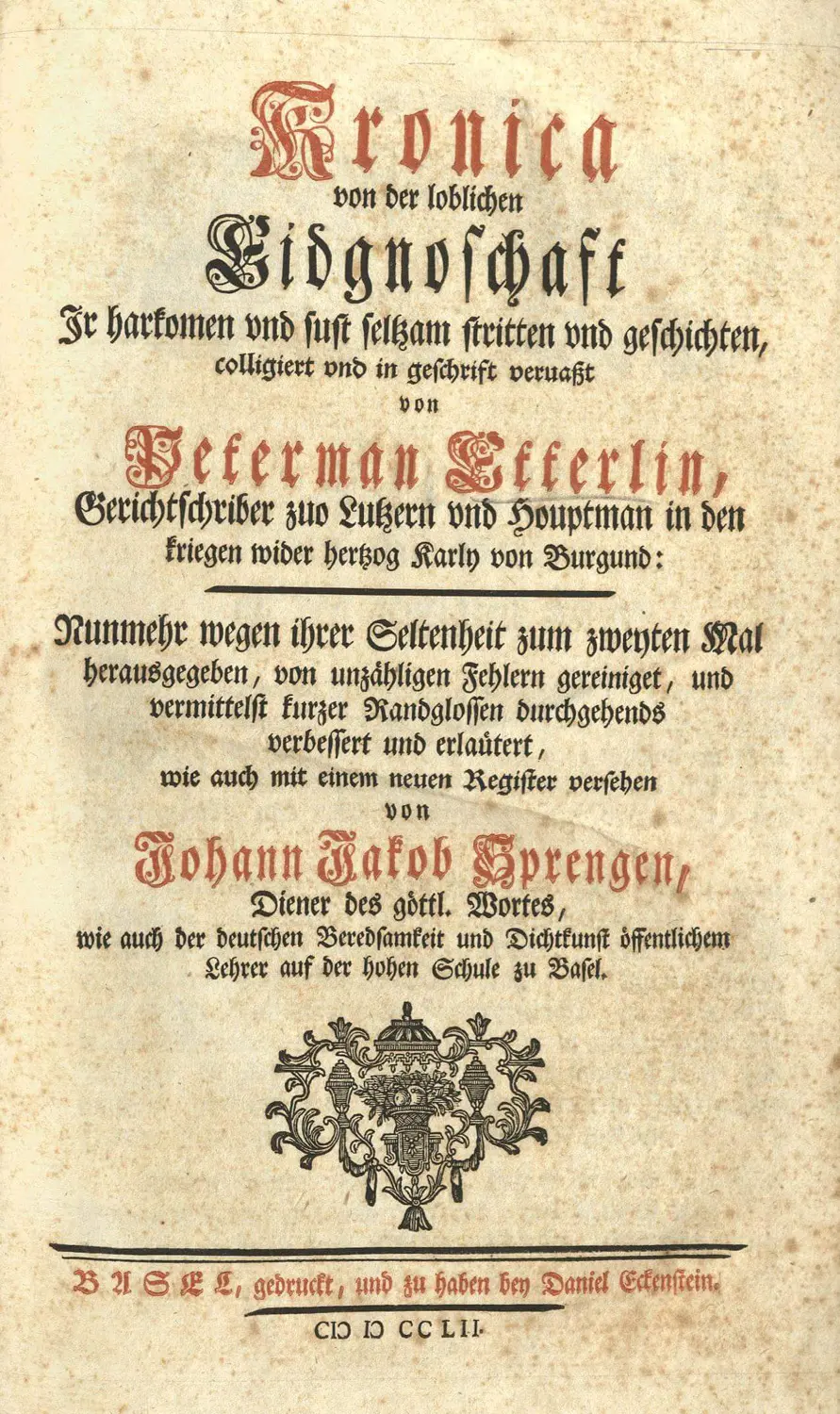


The *Kronica von der loblichen Eidgnoschaft* is one of the earliest printed historical works in Switzerland. It was originally written by Petermann Etterlin, a Lucerne city clerk, whose chronicle was first published in 1507 and is considered the first printed Swiss chronicle. The 1752 edition was revised by Johann Jakob Spreng and made accessible to a new readership. It bridges the medieval world of chronicles with the Enlightenment-era interest in an organized account of the past and demonstrates how the history of the Swiss Confederation has been narrated and reinterpreted over the centuries.
Petermann Etterlin wrote his chronicle at a time when the Old Swiss Confederacy had established itself as an independent political force following the Burgundian Wars. His goal was not merely to document historical events, but also to strengthen a shared Swiss identity. The chronicle recounts the origins of the Swiss Confederation, its legendary founding figures, the struggles for freedom against Habsburg rule, and the military successes of the cantons. Historical facts are interwoven with myths, legends, and moral tales. For the people of the early 16th century, these elements did not constitute a contradiction but together formed the truth of their history.
Johann Jakob Spreng’s 1752 edition reflects the changing nature of historical thought. During the Age of Enlightenment, the critical examination of sources became increasingly important. Spreng sought to adapt the language and presentation to the expectations of his time without destroying the character of the original work. This created a remarkable bridge between medieval chronicles and modern historiography.
Of particular interest is the chronicle’s role in the formation of a political identity. The Old Swiss Confederacy was not a nation-state, but a loose confederation of independent cantons with differing interests, languages, and religious denominations. A shared history therefore became an important means of fostering cohesion. The tales of William Tell, the Rütli Oath, and the battles of Morgarten and Sempach conveyed values such as freedom, loyalty, courage, and mutual support. Regardless of how historically accurate individual episodes were, they shaped Switzerland’s self-image for centuries.
At the same time, the chronicle shows how history always reflects the present. Each generation interprets the past through its own questions. While Etterlin emphasized above all the glory and divine guidance of the Swiss Confederation, the 18th century took a greater interest in historical order, political development, and critical analysis. History increasingly became a subject of scholarly inquiry, yet it remained a vehicle for shared memories.
The chronicle also provides valuable economic insights. It not only recounts wars and alliances but also describes cities, trade routes, markets, and political relations. This reveals that the rise of the Swiss Confederation was not based solely on military successes but equally on economic networks, regional trade, and the growing importance of cities. Political freedom and economic development were already closely intertwined at that time.
The 1752 edition is therefore of dual value. It preserves one of the most important records of early Swiss historiography and, at the same time, documents the evolution of historical consciousness. Readers today not only encounter the origins of Swiss myths but also recognize how historical narratives forge identity and shape political communities. The *Kronica von der loblichen Eidgnoschaft* is thus far more than a collection of old stories—it is a mirror reflecting how a society recounts its past in order to understand its present and shape its future.

