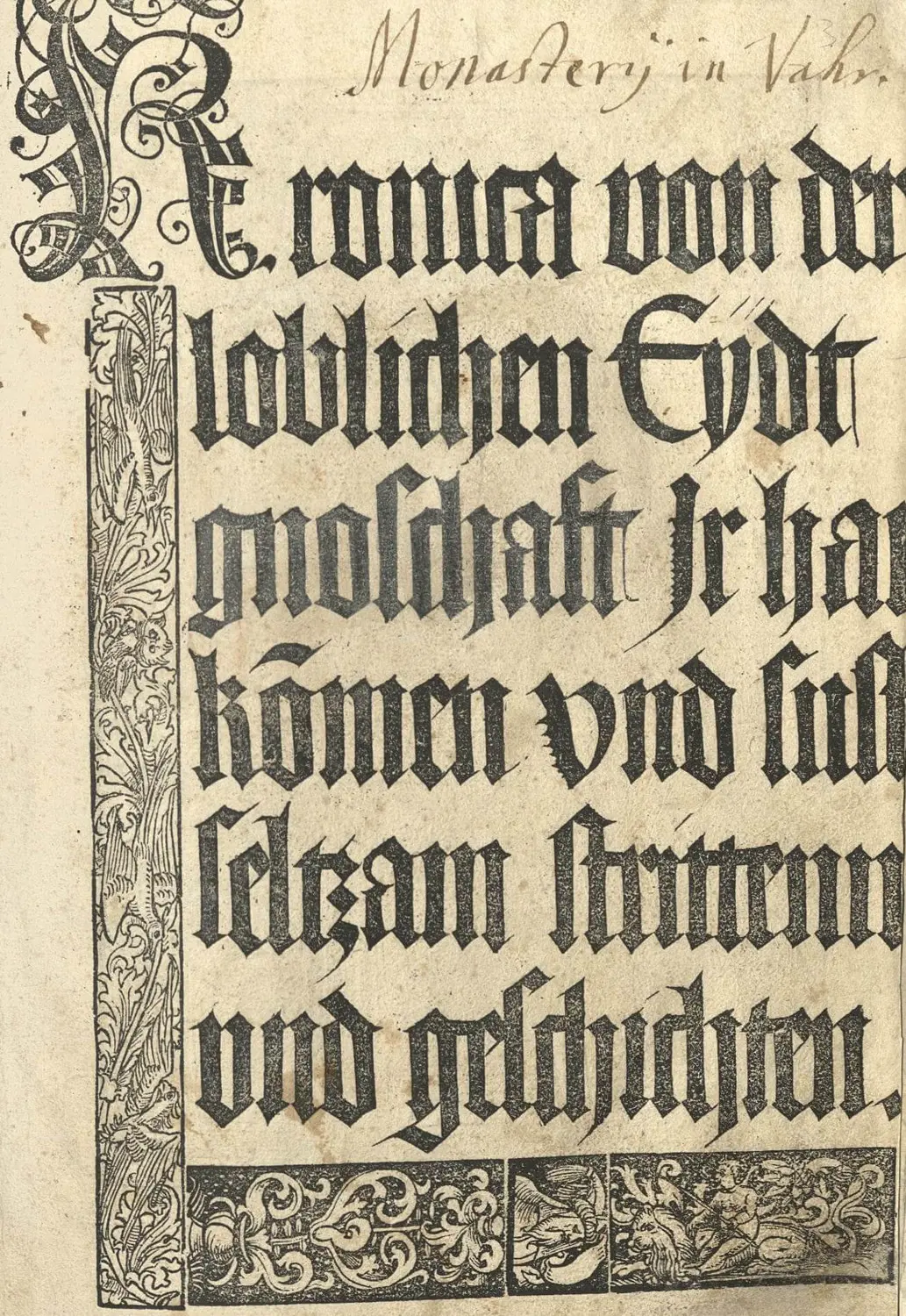


Kronica von der loblichen Eydtgnoschaft Ir har kom[m]en und sust seltzam strittenn und geschichten
Essay by
Jurg Conzett

The original *Kronica von der loblichen Eydtgnoschaft* by Petermann Etterlin, published in Basel in 1507, is considered the first printed chronicle of the Swiss Confederation. Its author, Petermann Etterlin, the town clerk of Lucerne, created a work that combines history, legend, and political self-affirmation. The chronicle was written during a time of upheaval: the printing press had begun to disseminate knowledge on an unprecedented scale, and the Swiss Confederation had emerged as a self-assured political force following the Burgundian Wars and the Swabian War. Etterlin’s chronicle gave this new sense of identity a narrative form.
The work begins with the origins of the Swiss Confederation and guides the reader through the most important events of its early history. It recounts the founding myths, the struggles against the Habsburgs, the heroic deeds of the Swiss Confederates, and the alliances and wars that shaped the Confederation’s development. In doing so, Etterlin draws on numerous older sources, supplements them with oral traditions, and weaves them into a coherent narrative. Historical accuracy in the modern sense is not the primary focus here. Rather, the goal is to reveal the meaning of history and to strengthen the cohesion of the Swiss Confederates.
Particularly striking is the close connection between history and morality. Victories are presented not merely as the result of military strength, but as an expression of divine justice. Bravery, loyalty, and a willingness to make sacrifices are portrayed as virtues that made the Swiss Confederation great. Defeats serve as a warning against pride or discord. History thus takes on an educational character: it is intended to provide guidance and influence contemporary political action.
However, the significance of the chronicle lies not only in its content but also in its form. As a printed book, it reached a far wider audience than handwritten chronicles. The printing press made history a universally accessible resource and helped create a shared historical consciousness that extended beyond the boundaries of individual towns. Around 1500, the Swiss Confederation consisted of largely autonomous cities and cantons. A shared past thus became an important bond that united these diverse communities.
At the same time, the chronicle reflects the mindset of its era. For Etterlin, legends and historical events form a single entity. Stories such as those surrounding William Tell or the Rütli Oath are not critically examined but are recounted as meaningful components of the Swiss Confederation’s past. From today’s perspective, historians carefully distinguish between myth and verifiable fact. Nevertheless, the cultural value of these narratives remains undisputed, as they shaped Switzerland’s political self-image for centuries.
Economic developments also emerge between the lines. Cities gain in importance, trade routes connect regions, and political stability creates the conditions for economic prosperity. The chronicle makes it clear that the Swiss Confederation was not created solely through battles, but equally through cooperation, alliances, and shared interests. Military freedom and economic development went hand in hand as early as the late Middle Ages.
The *Kronica von der loblichen Eydtgnoschaft* is therefore far more than a history book. It marks the beginning of printed Swiss historiography and demonstrates how memory shapes political communities. Anyone reading the work today encounters not so much an objective reconstruction of the past as the emergence of a collective memory. This is precisely where its enduring significance lies: The chronicle documents not only the history of the Swiss Confederation but also the beginnings of a shared historical identity that has shaped the country right up to the present day.

