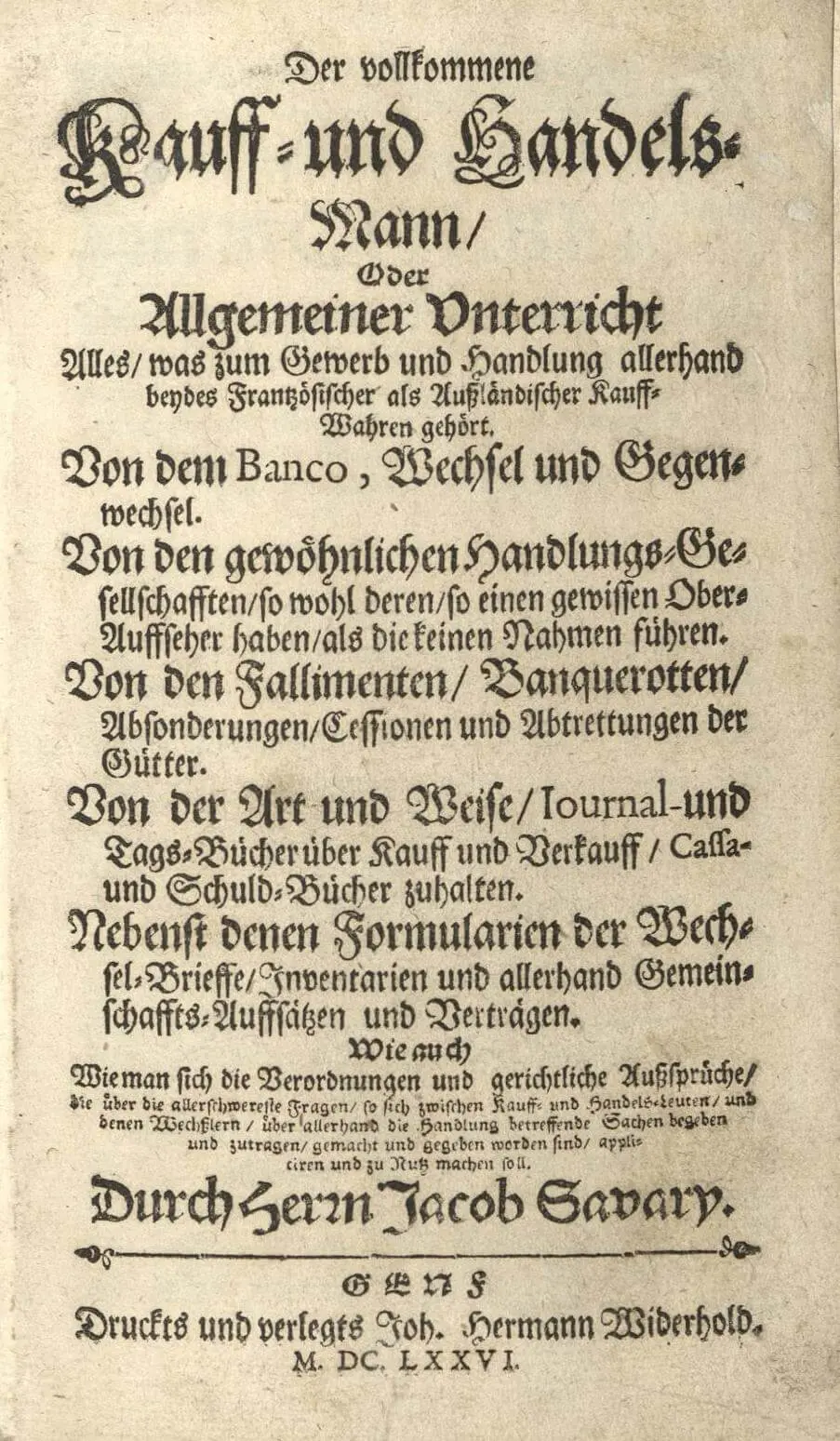


Jacques Savary: Der vollkommene Kauff- und Handels-Mann, Oder allgemeiner Unterricht Alles, was zum Gewerb und Handlung allerhand beydes Frantzösischer und Außländischer Kauff-Wahren gehört.
Essay by
Jurg Conzett

Jacques Savary’s work *The Perfect Merchant* is considered one of the most significant books on commerce of the early modern period. The German edition of 1676 is based on the French original, *Le Parfait Négociant*, and was written at a time when Europe was undergoing profound economic change. Long-distance trade was booming, colonial goods were arriving in Europe in ever-greater quantities, banks were developing new financial instruments, and merchants were becoming key figures in the emerging market economy. Savary’s book was far more than a practical reference work—it was a comprehensive guide to responsible economic conduct.
The work is aimed at merchants active in international trade. It covers nearly all areas of business life: accounting, contract law, bill of exchange transactions, insurance, transportation, customs issues, business correspondence, as well as the characteristics and origins of a wide variety of goods. At the same time, Savary explains the economic practices of different countries and trading centers. The result was one of the first systematic handbooks on modern trade.
Noteworthy is the combination of practical knowledge and moral responsibility. For Savary, it is not enough simply to conclude business deals successfully. A good merchant is also characterized by honesty, reliability, and trustworthiness. Credit is ultimately based on trust, and trust arises only through an impeccable reputation. This conviction was of vital importance in an era without central banks or comprehensive government oversight. Those who lost their good name often lost their economic livelihood as well.
Savary therefore describes the merchant as an educated person. He should be fluent in languages, familiar with foreign cultures, able to compare prices, assess risks, and follow political developments. Trade requires curiosity, discipline, and sound judgment. The successful merchant combines business acumen with a broad general education. This concept shaped the professional image of the merchant well into the 18th century.
The book was written in the France of Louis XIV under the influence of Finance Minister Jean-Baptiste Colbert. His economic policy—known as mercantilism—sought to increase the state’s prosperity through the promotion of exports, quality standards, and a strong merchant fleet. Savary’s work supports this policy by providing rules for efficient and internationally competitive trade. It impressively demonstrates how closely economic success and state order were linked at that time.
Today, some details of the book seem historical. Many of the goods, trade routes, and customs regulations described no longer exist. Nevertheless, numerous fundamental ideas remain surprisingly relevant. International supply chains, exchange rates, transportation costs, contract law, and the importance of reliable information continue to concern businesses even in the 21st century. Equally relevant is Savary’s emphasis on reputation and trust. In a globalized economy, credibility, transparency, and long-term relationships continue to determine success.
From the perspective of monetary and economic history, Savary’s work marks an important developmental step. It documents the transition from a local barter economy to a Europe-wide networked system of trade and credit. Money is no longer seen merely as a means of payment, but as the foundation of complex economic relationships. Bills of exchange, credit, and bookkeeping enable business transactions across great distances and over long periods of time. The merchant becomes the organizer of this new economic order.
*The Perfect Merchant* is therefore far more than a historical textbook. It conveys a view of humanity in which economic success, knowledge, and moral integrity are inextricably linked. Especially in an age of digital markets and global financial flows, Savary reminds us that functioning markets ultimately rest on trust—a resource that is, today as then, more precious than any commodity.

