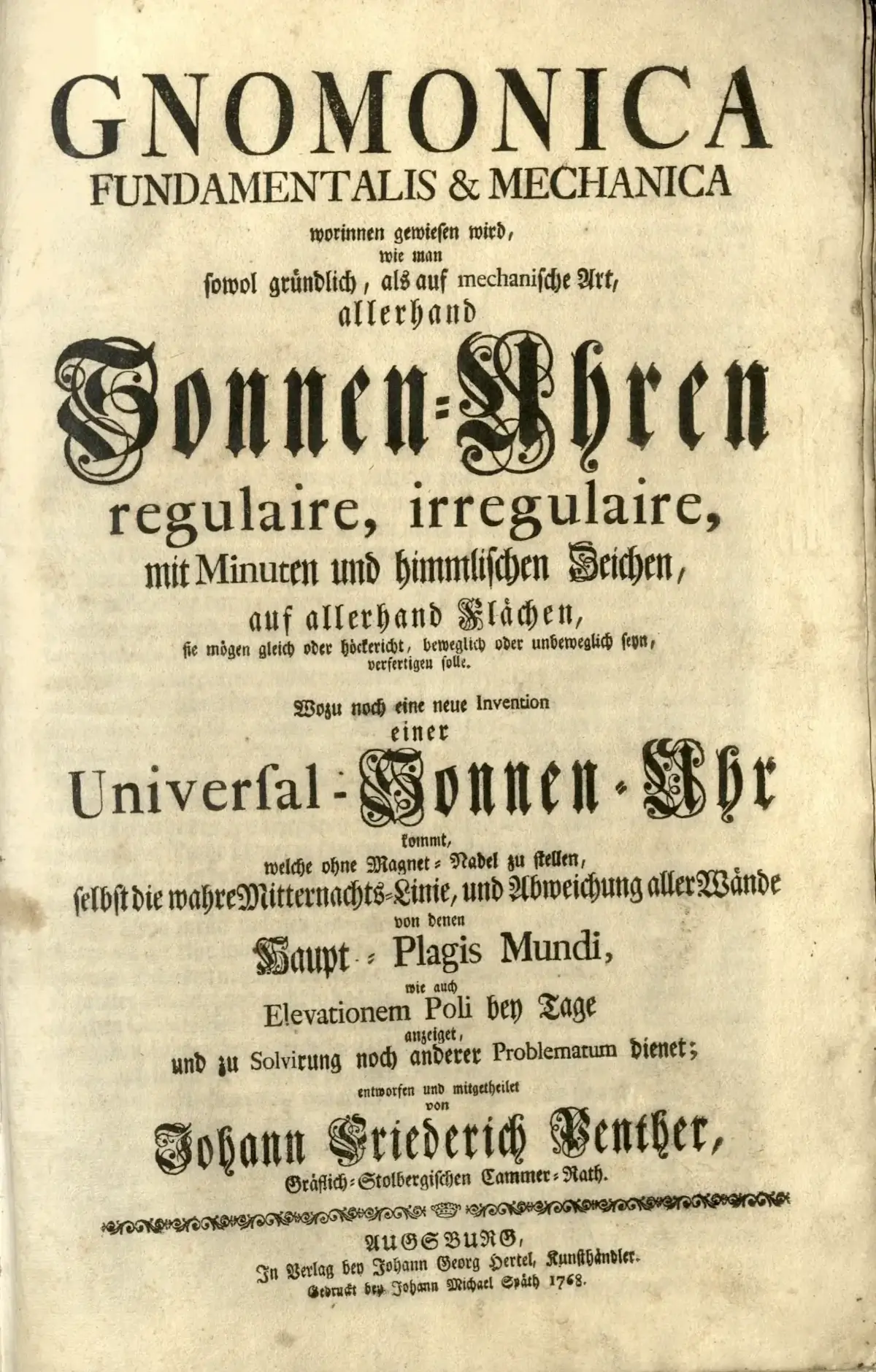


Gnomonica Fundamentalis & Mechanica worinnen gewiesen wird, wie man sowol gründlich, als auf mechanische Art, allerhand Sonnen-Uhren regulaire, irregulaire, mit Minuten und himmlischen Zeichen/ auf allerhand Flächen ... verfertigen solle
Essay by
Jurg Conzett

Gnomonica Fundamentalis & Mechanica by Johann Friedrich Penther, published in 1768, is one of the most significant German-language textbooks on the art of sundial construction. The comprehensive title already makes clear the author’s intent: he aims to demonstrate how sundials can be constructed both in a scientifically sound manner and using practical, mechanical methods. The work combines mathematics, astronomy, geometry, and craftsmanship and exemplifies the spirit of the Enlightenment, in which theoretical knowledge and practical application were closely intertwined.
Johann Friedrich Penther (1693–1749) was a mathematician, architect, and professor at the University of Göttingen. Although the book was not published until after his death, it summarizes his extensive knowledge of surveying, architecture, and mathematical instruments. Penther belonged to a generation of scholars who viewed science not as abstract theory, but as a tool for improving the world. His books were intended to serve engineers, master builders, clockmakers, and educated laypeople alike.
At the heart of the work is gnomonics—the science of sundials. At first glance, a sundial seems simple: a gnomon casts a shadow onto a scale and indicates the time. In reality, however, its construction is complex. The path of the shadow depends on the geographic latitude, the orientation of the building, the slope of the surface, and the movement of the sun across the sky. Each sundial must therefore be calculated individually.
Penther first explains the mathematical foundations of these calculations. He describes the Earth’s position relative to the sun, the movement of the celestial sphere, and the geometric relationships necessary for constructing a precise sundial. He then demonstrates, step by step, how these calculations can be put into practice. In doing so, he covers horizontal, vertical, and slanted sundials, as well as those on irregular surfaces. Even complicated designs are made easy to understand through drawings and clear explanations.
Noteworthy is the combination of exact science and practical mechanics. Penther does not address mathematicians exclusively, but also craftsmen who wish to build functioning instruments using his instructions. He describes tools, construction methods, and simplifications that enable precise execution even without complex mathematical calculations. In this way, the book bridges the gap between academic knowledge and practical craftsmanship.
At the same time, the work illustrates the significance of timekeeping in the 18th century. Although mechanical clocks were already widespread, sundials remained important reference instruments. They served to verify the accuracy of mechanical clocks and highlighted the close connection between time and astronomy. Unlike modern digital clocks, a sundial directly reveals the rhythm of nature. It serves as a reminder that time originally arose from the observation of the heavens.
Furthermore, the book meets high aesthetic standards. Sundials were not only measuring instruments but also decorative elements on churches, town halls, castles, and townhouses. Penther therefore also devotes attention to design and demonstrates how mathematical precision can be combined with artistic beauty. Science and art do not appear as opposites, but as two sides of the same culture.
Today, *Gnomonica Fundamentalis & Mechanica* is far more than a technical manual. It documents the high level of mathematical achievement during the Enlightenment and the desire to make the laws of nature understandable and practically applicable. The work serves as a reminder that the measurement of time was once directly linked to the observation of the heavens. In a world where time is now invisibly determined by atomic clocks and digital networks, Penther’s book offers a fascinating insight into an era in which science, craftsmanship, and the observation of nature formed an inseparable whole.

