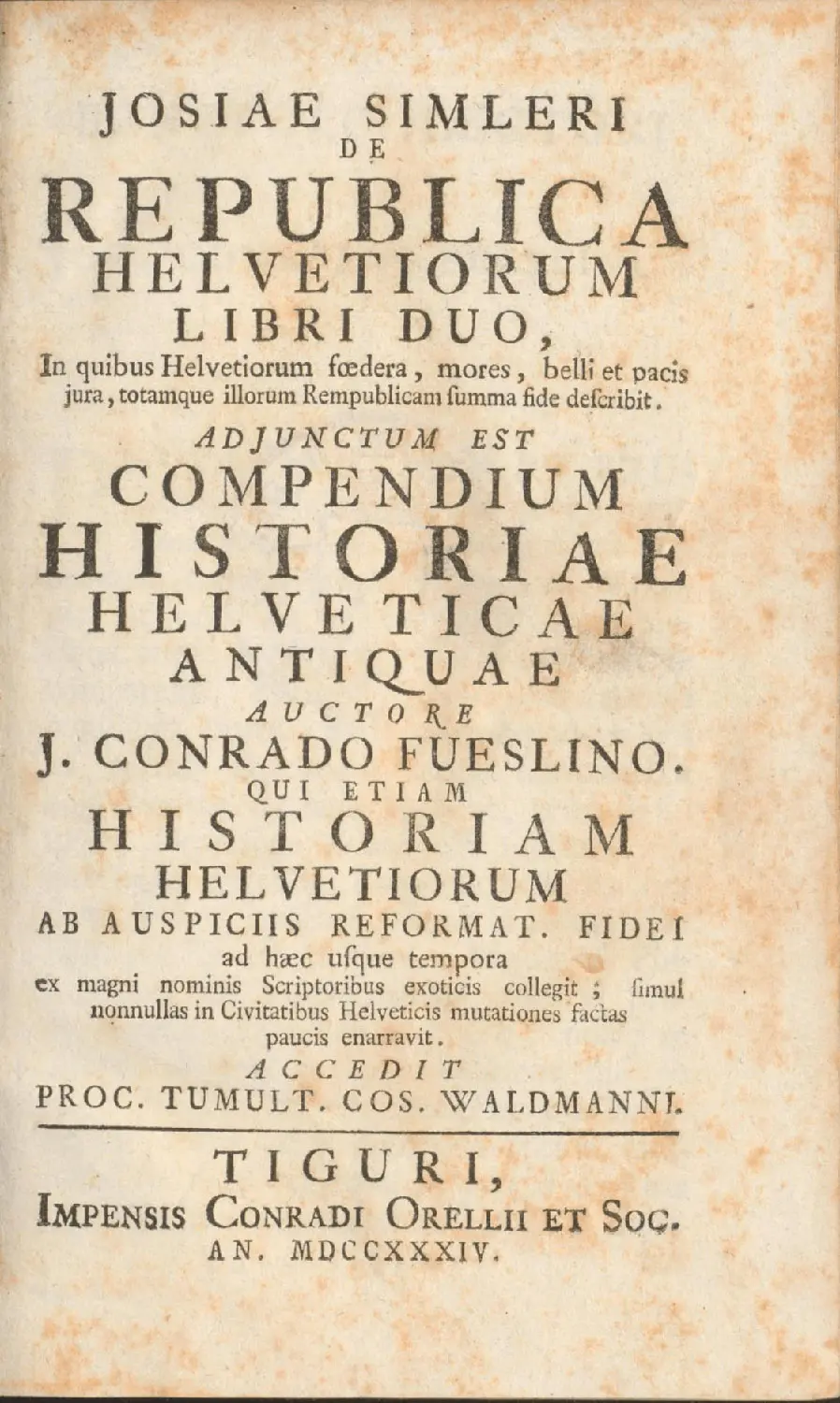


De re publica Helvetiorum libri duo (“Two Books on the State of the Swiss Confederates”) by Josias Simler is one of the most significant early accounts of the Old Swiss Confederacy. Although the work was first published as early as 1576, the 1734 edition shows that Simler’s analysis of the Swiss political system was still regarded as an authoritative reference work more than a century and a half later. The book combines historical description, political analysis, and constitutional commentary and is one of the most important sources for understanding Switzerland in the early modern period.
Josias Simler (1530–1576) was a Zurich theologian, humanist, and historian. As a professor at the Carolinum in Zurich, he followed in the tradition of Renaissance humanism, which combined classical education with careful observation of the present. His goal was to explain the political order of the Swiss Confederation in an accessible way—not only for the Swiss but also for a European audience. For this reason, he wrote the work in Latin, the common language of scholarship in his time.
At the heart of the work is the question of how the Swiss Confederation functioned. Unlike the centralized monarchies of Europe, Switzerland consisted of largely autonomous cantons linked by alliances. Simler describes the origins of this confederation, the rights and duties of the individual cantons, the Diet as a joint decision-making body, and the various forms of urban and rural governance. His account shows that the Swiss Confederation was not a unified state, but rather a complex network of political communities.
Simler’s sober perspective is particularly noteworthy. He does not idealize Switzerland but rather attempts to explain its institutions objectively. He describes both its strengths—such as local self-government and the strong cohesion among the cantons—and its weaknesses, particularly the difficulty of reaching decisions among the various members of the Confederation. This makes Simler one of the early proponents of an empirically oriented description of the state.
The work was written during a time of profound religious tensions. After the Reformation, the cantons of the Swiss Confederation were divided along confessional lines. Nevertheless, the Confederation managed to largely preserve its political unity. Simler demonstrates how shared interests, treaties, and political traditions could prove stronger than denominational differences. His analysis makes it clear that stability does not necessarily have to be based on central authority, but can also arise through negotiation, compromise, and mutual obligation.
The book was of particular interest to European scholars because Switzerland was regarded as an exceptional political model. While many states were ruled by princes, a republican order developed in the Swiss Confederation with comparatively strong participation by local elites and, to some extent, the general population. Simler’s work played a significant role in making this political system known abroad and in shaping the image of Switzerland as a freedom-loving republic.
The 1734 edition also holds great bibliophilic value. It was published at a time when classics of history and constitutional law were being reprinted to make them accessible to a growing readership. The meticulous typesetting, the Latin language, and the often high-quality bindings make such editions impressive testaments to 18th-century European book culture.

