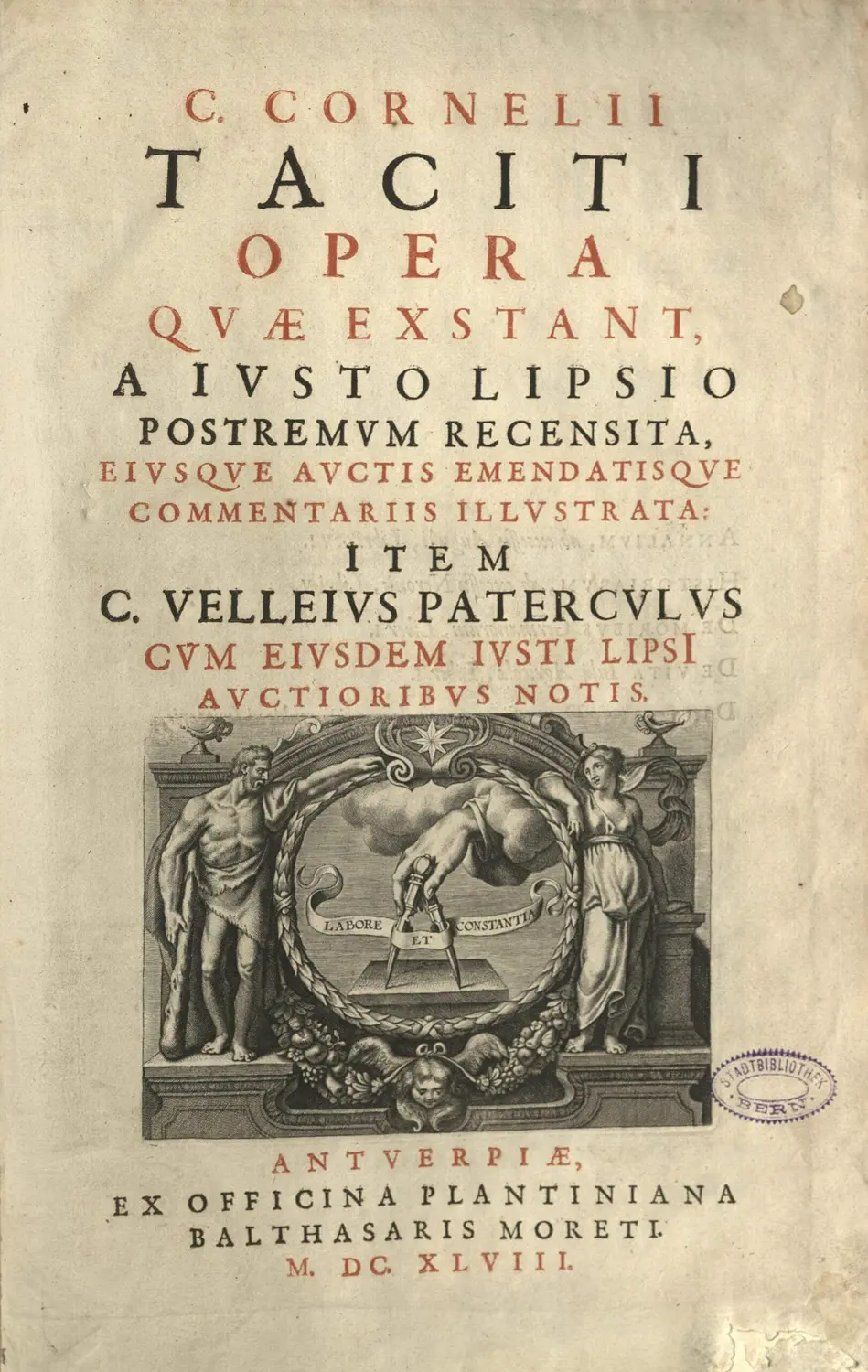


Cornelius Tacitus, Opera qvae exstant, a Ivsto Lipsio postremvm recensita eivsqve avctis emendatisqve commentariis illvstrata
Essay by
Jurg Conzett

The 1648 edition of Opera quae exstant by the Roman historian Cornelius Tacitus is one of the most significant scholarly editions of the early modern period. It brings together the surviving works of the great historian with the extensive commentaries of the humanist Justus Lipsius, whose philological work shaped the understanding of Tacitus for centuries. This edition is not only a testament to classical scholarship but also a reflection of the political and intellectual upheavals in 17th-century Europe.
Tacitus lived in the first and early second centuries A.D. and is considered one of the most astute historians of antiquity. His major works, the Annals and the Histories, chronicle the development of the Roman Empire from Emperor Tiberius to the Flavians. These are complemented by Germania, an ethnographic description of the Germanic tribes; the biography of his father-in-law, Agricola; and the Dialogus de oratoribus. Unlike many earlier historians, Tacitus is not interested solely in events. His focus is on power, character, fear, ambition, and corruption—the forces that shape or destroy political systems from within.
His style is exceptionally concise yet highly expressive. Tacitus distills complex political developments into pithy observations and psychological portraits. He describes rulers neither as heroes nor as demons, but shows how power changes people and how mistrust, opportunism, and personal interests can undermine even stable institutions. His works are therefore far more than historiography; they are studies of the nature of political rule.
The 1648 edition bears the distinct mark of the Flemish scholar Justus Lipsius. As early as the end of the 16th century, Lipsius had critically compared the available manuscripts, corrected errors in earlier prints, and written extensive annotations. His comments explain linguistic peculiarities, historical contexts, and difficult passages. For generations of European scholars, his edition became the authoritative basis for reading Tacitus. The 1648 edition documents the high standard of humanist textual criticism and reflects the aspiration to reconstruct ancient texts as reliably as possible.
Its year of publication also holds symbolic significance. In 1648, the Thirty Years’ War—one of Europe’s most devastating conflicts—came to an end with the Peace of Westphalia. Questions of power, the state, war, and political order were at the center of public debate. Tacitus offered no simple solutions to these issues, but he did provide a historical perspective. His analyses served as a reminder that political stability does not rest solely on military strength, but equally on law, trust, and responsible governance.
Tacitus’s influence extended far beyond the field of history. Political philosophers, diplomats, and rulers studied his works to better understand the mechanisms of government and power. Some read him as a warning against tyranny; others as a sober teacher of political reality. It was precisely this ambiguity that made him one of the most discussed authors of the early modern period.
The 1648 edition of the Opera quae exstant thus embodies the union of ancient wisdom and humanist scholarship. It not only preserves the writings of one of Rome’s greatest historians but also demonstrates how each era reinterprets the classics to find answers to its own questions. To this day, Tacitus reminds us that power is fleeting, human weaknesses are timeless, and history becomes instructive above all when it reveals the motives behind events.

