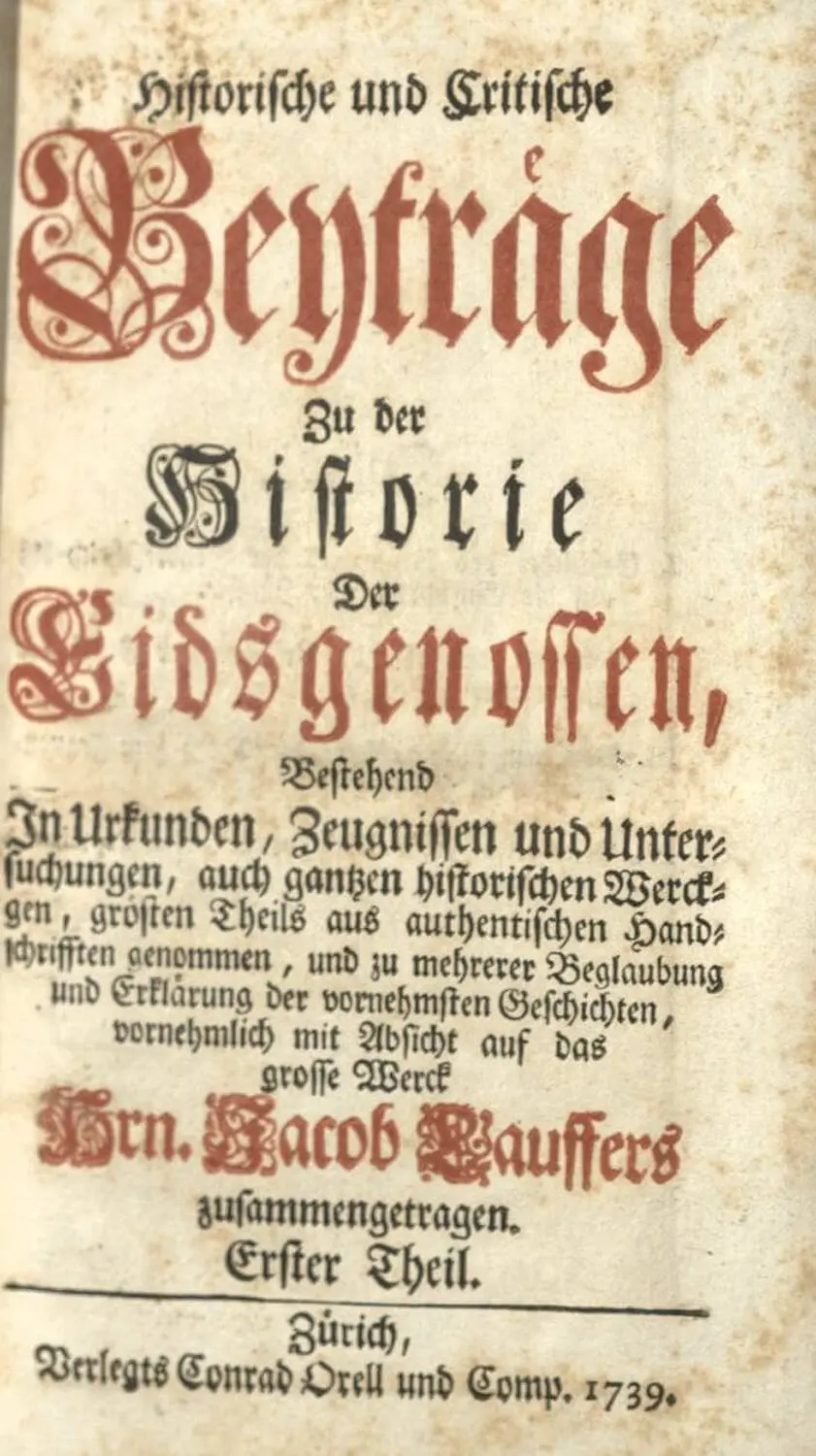


Diebold Schilling’s account of the Burgundian Wars is one of the most significant chronicles of the late Middle Ages. Written around 1483 at the request of the city of Bern, it describes the conflicts between the Old Swiss Confederacy and Duke Charles the Bold of Burgundy from 1474 to 1477. The work is not only a historical source of the highest order but also a striking testament to how history was written, remembered, and exploited for political ends. 1743 edition.
The Burgundian Wars mark a turning point in the history of the Swiss Confederation. With their victories at Grandson, Murten, and Nancy, the cantons of the Swiss Confederation succeeded in defeating one of the most powerful armies in Europe. These successes permanently bolstered the Swiss Confederates’ self-confidence and established their reputation as outstanding infantrymen. Schilling’s chronicle played a decisive role in anchoring this historical event in the collective memory.
The work is particularly famous for its magnificent illustrations. Hundreds of colored miniatures accompany the text and depict battles, cities, landscapes, weapons, clothing, and scenes of daily life with great attention to detail. They make the chronicle one of the most important visual sources of the late 15th century. Although the depictions lack photographic realism, they convey a vivid picture of how contemporaries perceived war, rule, and society.
Schilling, however, did not view his chronicle as neutral historiography. He wrote on behalf of Bern and portrayed the Swiss Confederates as brave, God-fearing, and just warriors. Charles the Bold, by contrast, frequently appears as an arrogant ruler whose quest for power ultimately fails. The chronicle thus also pursues a political goal: it legitimizes the Confederates’ success and strengthens the cohesion of the participating cantons. Here, history becomes a means of forging identity.
From an economic perspective, the Burgundian Wars also offer interesting insights. War was not only a military challenge but also a financial one. Armies had to be equipped, supplied, and paid. After the battles, the Swiss Confederates seized considerable quantities of weapons, precious metals, jewelry, and other valuables. Especially after the Battle of Grandson, the famous Burgundian treasure was captured, the wealth of which impressed all of Europe. The chronicle makes it clear how closely war, wealth, and political power were intertwined.
Furthermore, Schilling documents the transition from medieval chivalric warfare to new forms of warfare. Well-organized infantry units armed with halberds and long pikes were able to defeat heavily armored knightly armies. Discipline, cooperation, and tactical cohesion proved more important than courtly chivalric ideals. This development had a lasting impact on European military history.
Today, Diebold Schilling’s account of the Burgundian Wars is valued not only as a historical source but also as an outstanding work of art. Text and imagery complement each other to create a striking overall portrayal of an era in transition. The chronicle shows how closely history, politics, religion, economics, and memory were intertwined. At the same time, it serves as a reminder that historical events never consist solely of facts, but always also of the stories that people tell about them. This is precisely why Schilling’s work remains one of the most significant testimonies to Swiss history to this day.

