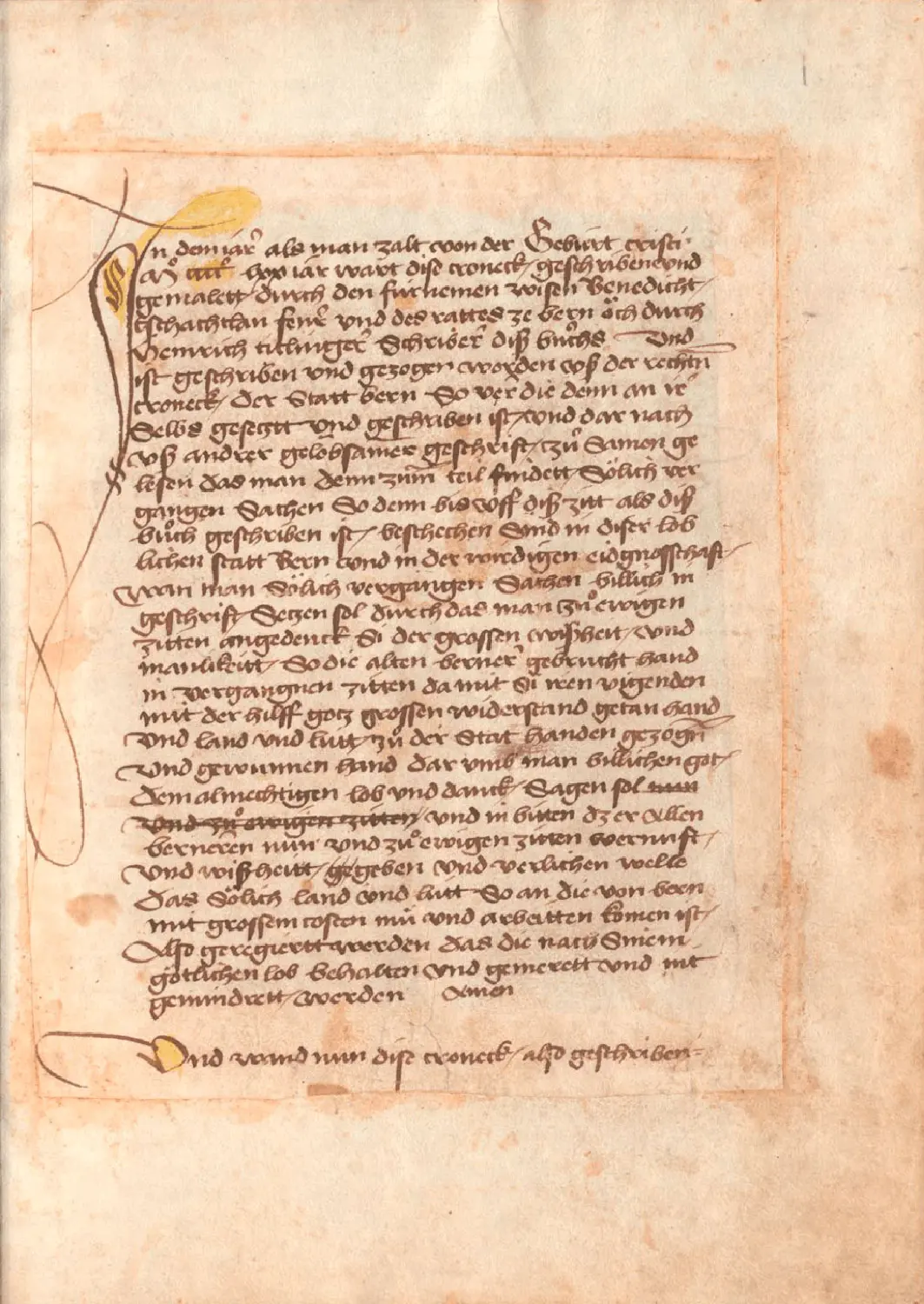


The “Chronicle” by Benedikt Tschachtlan and Heinrich Dittlinger, written around 1470, is one of the most significant historical manuscripts of the Old Swiss Confederacy. It was composed in Bern at a time when the Swiss Confederates were consolidating their political position following the successes of the 14th and 15th centuries and developing a growing need to record their shared past in writing. The chronicle combines history, memory, and political self-representation into an impressive body of work.
The Bernese councilor Benedikt Tschachtlan is considered the initiator and patron of the manuscript, while the city scribe Heinrich Dittlinger composed the text. The work recounts the history of the Swiss Confederates from their legendary origins up to the authors’ own time. It focuses not only on individual events but also on the emergence of a political community that stands its ground against external threats and defends its freedom.
The chronicle is particularly well-known for its extraordinary illustrations. More than two hundred colored miniatures depict battles, sieges, cities, castles, and historical figures. These images are far more than mere decorative embellishments; they convey a vivid picture of the past to the viewer and bring history to life. For many later generations, they shaped the idea of what the early Swiss Confederates might have looked like and how they might have behaved. Although the depictions can only claim partial historical accuracy, they possess inestimable cultural and historical value.
In terms of content, the chronicle follows the medieval understanding of history. Historical facts, oral traditions, and legends are naturally interwoven. The narrative begins with the founding myths of the Swiss Confederation and goes on to describe important events such as the conflicts with the Habsburgs and the expansion of the cantons. History is presented not as a sober reconstruction but as a moral narrative. Courage, loyalty, the fear of God, and a sense of community are highlighted as crucial virtues.
The chronicle thus also fulfills a political function. It strengthens the self-image of Bern and the Swiss Confederation by creating shared memories. In an era without nation-states, such chronicles served as an important means of forging identity. Those who recount the past also shape the understanding of the present. The chronicle vividly demonstrates how historical memory could be used to legitimize political order.
For modern historical scholarship, the work is a valuable source, though not primarily because of its factual accuracy. Far more important is that it provides insight into the 15th-century view of history. It reveals which events were considered worthy of remembrance, which values were meant to be conveyed, and how an urban elite understood itself. At the same time, the rich visual imagery offers insights into clothing, weapons, architecture, and conceptions of war, even if many scenes are idealized or symbolic.
The chronicle by Benedikt Tschachtlan and Heinrich Dittlinger thus stands at the threshold between medieval tradition and early modern historiography. It not only preserves memories of past events but also documents the desire of a young political community to tell its own story. It is precisely this combination of text, imagery, and the formation of political identity that makes the work a milestone in Swiss cultural and historical history to this day.

