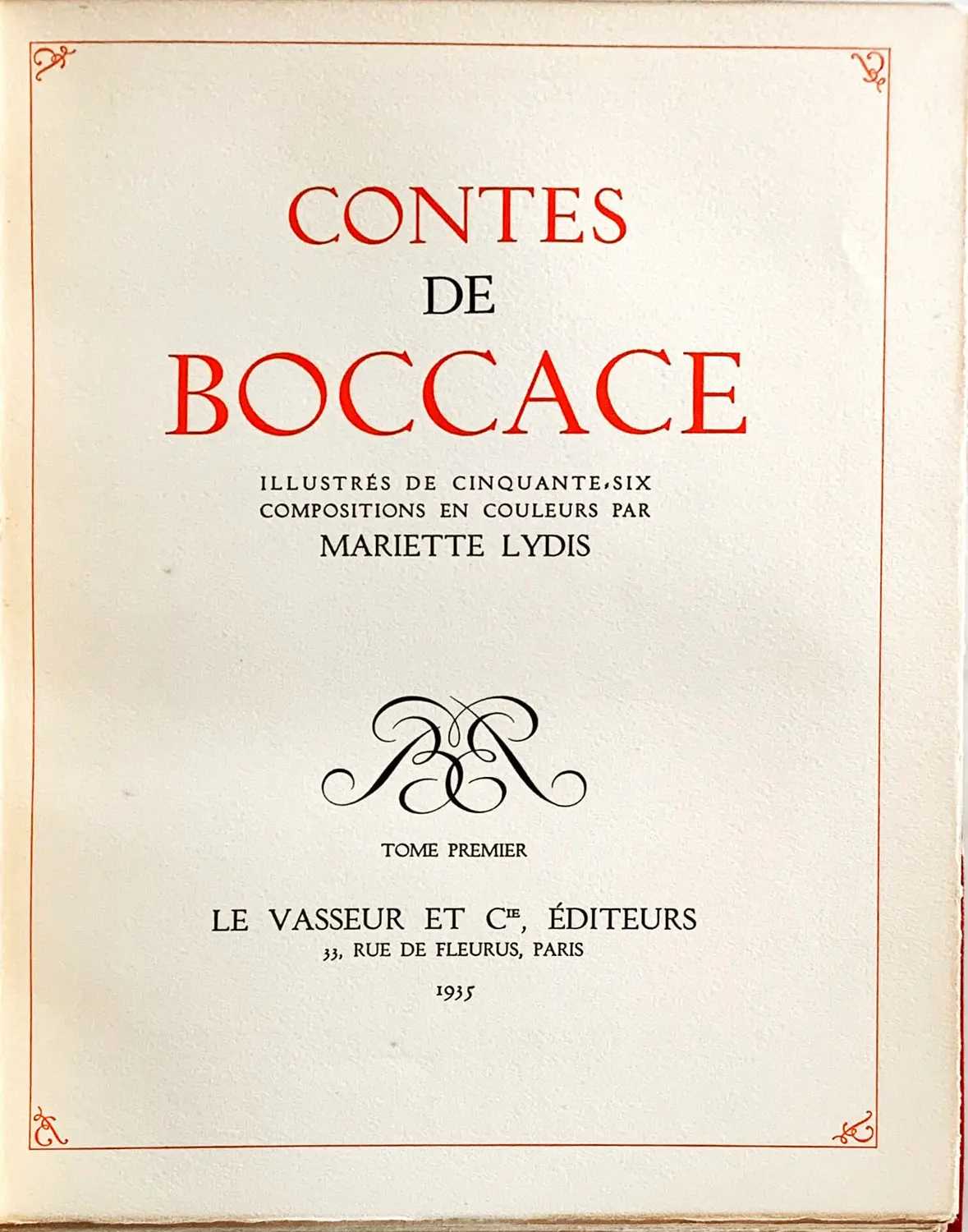


Contes de Boccace. Illustrés de Cinquante-Six Compositions en Couleur par Mariette Lydis.
Essay by
Jurg Conzett

The 1935 edition of Contes de Boccace, illustrated by Mariette Lydis, brings together one of the most significant storytellers in European literature and one of the most sensitive book artists of the 20th century. The work is far more than a luxurious bibliophile edition. It demonstrates how a literary classic can be reinterpreted through contemporary illustrations while retaining its relevance.
The stories are based on Giovanni Boccaccio’s *Decameron*, written between 1348 and 1353. Against the backdrop of the plague in Florence, ten young people flee to the countryside and tell each other a total of one hundred stories over the course of ten days. Love, deceit, happiness, cunning, power, desire, and human frailties form the core of these tales. Boccaccio focuses not on heroes or saints, but on ordinary people. With humor, irony, and a deep understanding of human nature, he depicts the contradictions of life and is thus regarded as one of the founders of European short story literature.
The 1935 edition focuses on selected stories and highlights their literary quality through exceptional design. Particularly striking are the fifty-six color compositions by the Austrian-Argentine artist Mariette Lydis. Her illustrations eschew dramatic effects or exaggerated sensuality. Instead, they are characterized by elegance, delicate lines, and psychological depth. The figures appear vulnerable, pensive, and at the same time imbued with a quiet sensuality. This creates images that do not merely illustrate the text but expand its emotional atmosphere.
The time of its creation lends the book additional significance. In 1935, Europe was in a phase of political tensions and ideological radicalization. While authoritarian regimes were increasingly co-opting art and restricting freedom, Boccaccio’s literature serves as a reminder of the diversity of human experience. His stories celebrate neither power nor dogma, but rather individuality, wit, and the human capacity to overcome difficult situations with imagination and wisdom. Precisely for this reason, they could also be understood as an expression of intellectual freedom in the 20th century.
Mariette Lydis herself embodied this openness. Her works often focus on the nuances of human relationships and the emotional worlds of her characters. She is less interested in external events than in people’s inner states. This perspective harmonizes remarkably well with Boccaccio, whose storytelling also thrives on keen observation and psychological insight. Image and text enter into a dialogue that invites the reader not only to read the stories, but also to contemplate and feel them.
Bibliophile editions like this one also demonstrate that books can be more than mere carriers of information. Typography, paper, printing techniques, and illustration together form a work of art. Especially in an era of increasing mass production, this gave rise to an alternative: the carefully designed book as an object of cultural appreciation. Such editions are aimed at readers who wish not only to consume literature but also to consciously experience it.
The 1935 “Contes de Boccace” thus stands at the intersection of the Renaissance and modernity. Boccaccio’s timeless tales of love, power, and human frailties meet Mariette Lydis’s sensitive visual language. The result is an edition that is compelling both literarily and artistically. It serves as a reminder that great stories can resonate anew in every era and that the union of word and image transforms a book into a lasting work of art.

