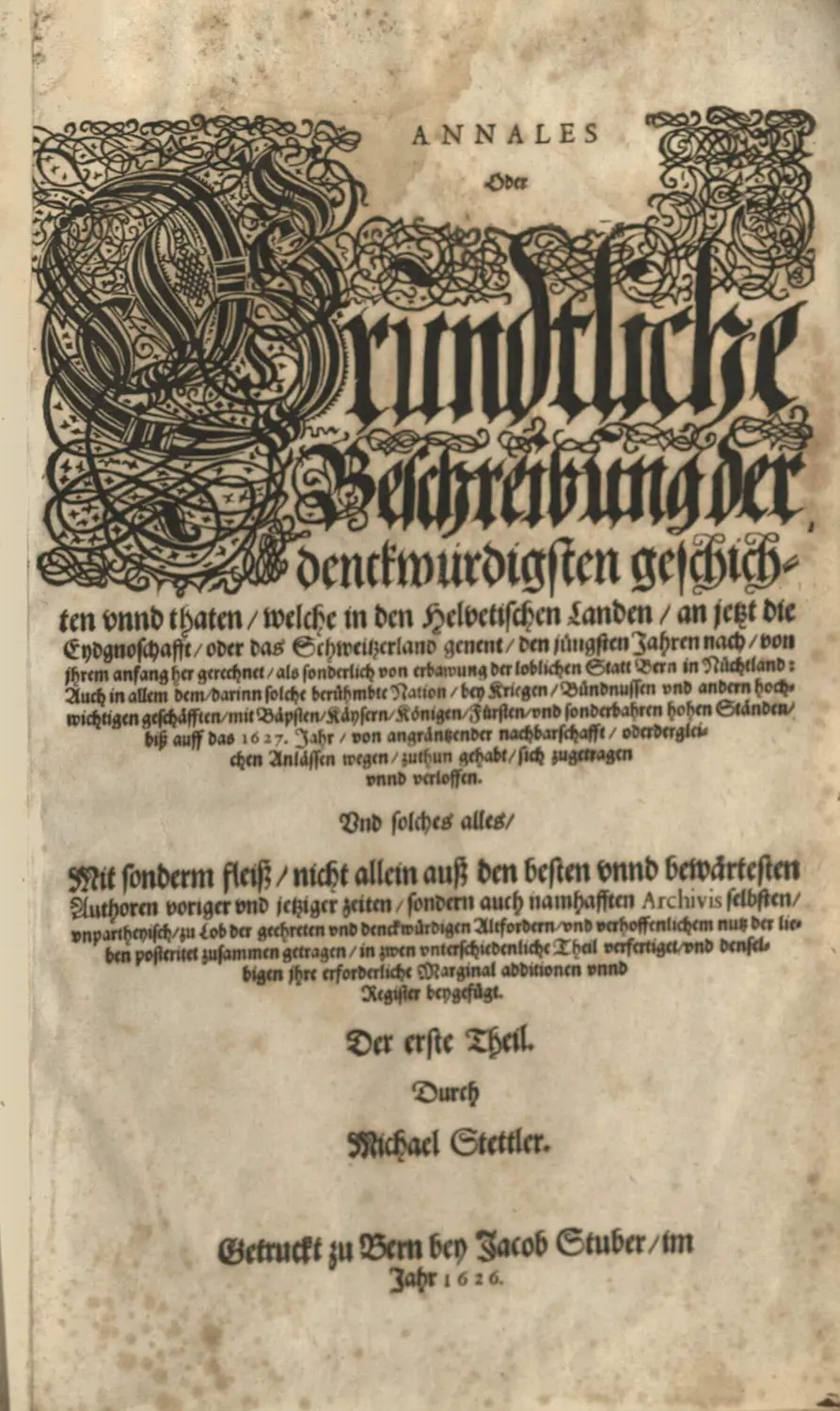


Gründliche Beschreibung der denkwürdigsten Geschichten und Thaten, welche in den Helvetischen Landen … bis auf das 1627. Jahr … sich zugetragen ….
Essay by
Jurg Conzett

Michael Stettler’s *Thorough Description of the Most Memorable Stories and Deeds That Took Place in the Helvetic Lands* is one of the most significant Swiss chronicles of the early 17th century. This extensive work was written during a time of great political and religious tensions in Europe. While the Thirty Years’ War ravaged large parts of the continent, the Swiss Confederation, though spared the worst of the fighting, was marked by confessional divisions between Reformed and Catholic cantons. Against this backdrop, Stettler sought to record the history of Switzerland as a shared memory and as the foundation of an independent political identity.
Michael Stettler (1580–1642) was a Bernese statesman, historian, and politician. As a member of the Bernese Council, he had access to archives and official documents, which he utilized for his historical work. His goal was not merely to continue earlier chronicles, but to provide as comprehensive an account as possible of the history of the Swiss Confederation up to his own time. In doing so, he drew on written sources, documents, and earlier chroniclers, but supplemented these with his own assessments and observations.
The work describes the origins of the Swiss Confederation, significant battles, alliances, political developments, and diplomatic relations. In addition to the well-known founding myths, the focus is on specific historical events. Stettler describes the conflicts with the Habsburgs, the expansion of the Swiss Confederation, the Burgundian Wars, and the conflicts of the Reformation era. His aim is to make the connections between events understandable and to narrate the development of the Swiss Confederation as an ongoing history.
A defining feature of Stettler’s account is the combination of historiography and political education. History is meant not only to inform but also to teach. Virtues such as bravery, loyalty, justice, and a sense of community are repeatedly emphasized. Successful governance is presented as the result of moderation, a sense of responsibility, and a willingness to cooperate. At the same time, Stettler warns against discord and internal divisions that could endanger the survival of the Swiss Confederation. This moral dimension corresponds to the understanding of history in the early modern period, when historical works also served as textbooks for political action.
From today’s perspective, it is particularly interesting to see how Stettler handles his sources. Compared to medieval chroniclers, he makes a greater effort to critically select the historical record and to organize events in a coherent manner. Nevertheless, he, too, combines historical facts with traditional narratives and evaluates many events from his own confessional and political perspective. His chronicle is therefore not only a source for historical events but also a reflection of 17th-century thought.
The language of the work impressively illustrates the transition from Early New High German to the modern written language. The style is detailed and often solemn, yet clearly structured. As a result, the book became an important reference work for scholars, politicians, and readers interested in history across generations. It played a significant role in fostering a shared sense of history within the Swiss Confederation.
Furthermore, the work illustrates the increasing professionalization of historiography. Archives, documents, and written evidence gained prominence over mere oral traditions. History gradually evolved from narrative chronicles to a more scholarly examination of past events. Stettler stands precisely at this threshold.
Today, the “Gründliche Beschreibung” holds value primarily in the context of cultural and intellectual history. It documents how the Swiss Confederation understood itself, which events were considered formative of its identity, and which political values were intended to shape communal life. Anyone seeking to understand the emergence of Swiss historical consciousness will find in Michael Stettler’s chronicle one of the most important records of the early modern period—a work that not only preserves the past but also helps shape the self-understanding of a political community.

