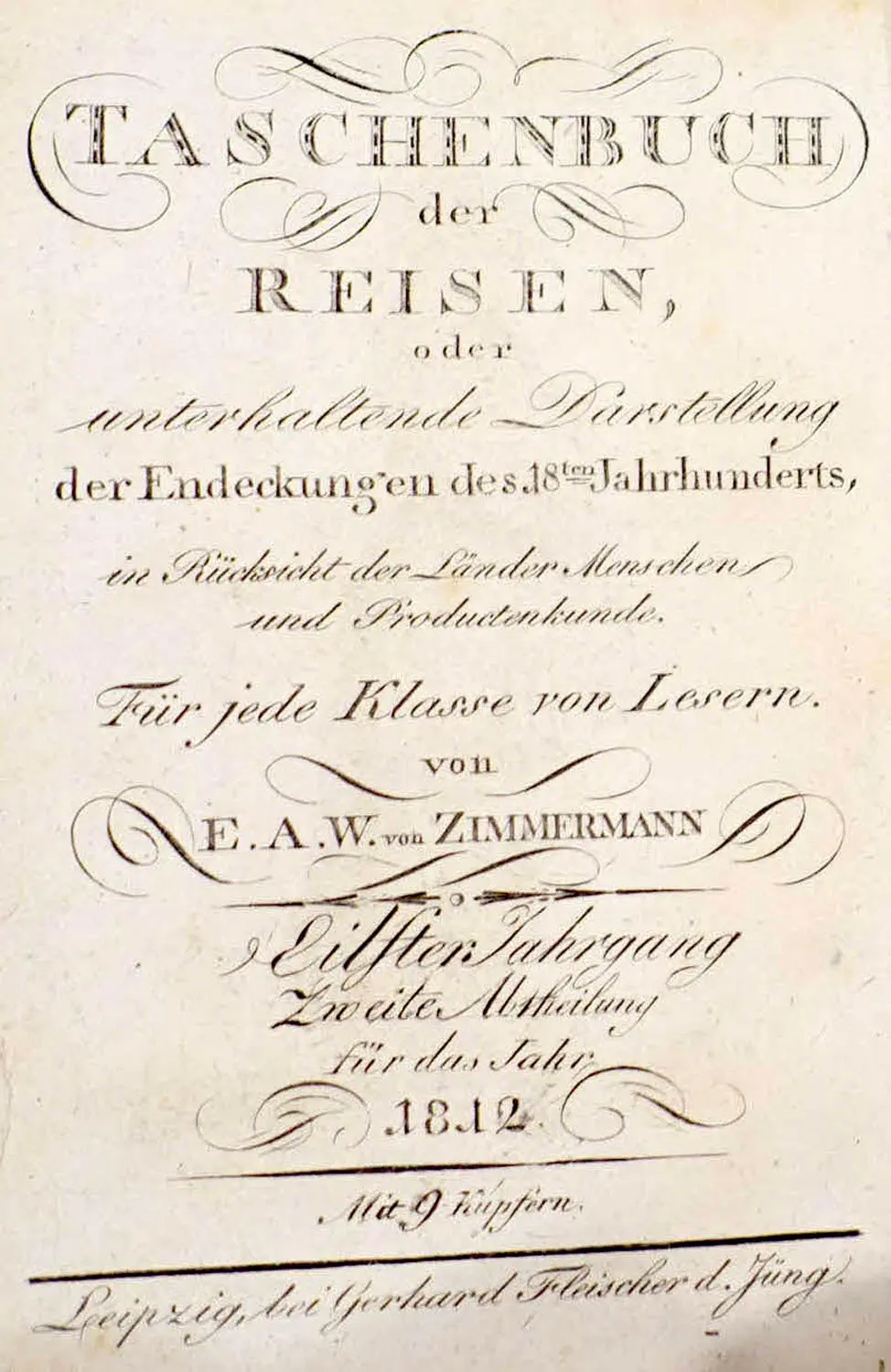


Taschenbuch der Reisen oder unterhaltende Darstellung der Entdeckungen des 18. Jahrhunderts. Für jede Klasse von Lesern.
Essay by
Jurg Conzett

Eberhard August Wilhelm von Zimmermann’s *Taschenbuch der Reisen* (*A Pocket Book of Travels*) or *An Entertaining Account of the Discoveries of the 18th Century: For Readers of All Levels*, published in 1812, is a quintessential work of the Enlightenment and the early 19th-century educational movement. It was written at a time when the great voyages of discovery had fundamentally transformed Europe’s worldview. Expeditions to the Americas, Africa, Asia, and the Pacific had opened up new continents, described unknown plants and animals, and expanded knowledge of foreign cultures. Zimmermann’s book makes these insights accessible to a broad audience and reflects the growing desire to present knowledge not only to scholars but to all interested readers.
The title itself reveals the work’s educational goal. It is not a scientific research report, but a handy reader intended to both entertain and educate. “For every class of readers” means that even people without an academic education can share in the great discoveries of their time. This democratization of knowledge is one of the most important achievements of the Enlightenment. Education is no longer seen as the privilege of a few, but as a prerequisite for an enlightened society.
To this end, Zimmermann adopts a vivid narrative style. Instead of stringing together dry facts, he portrays the voyages as thrilling stories. Readers encounter unfamiliar landscapes, foreign peoples, extraordinary animals, and impressive natural phenomena. The world appears as a realm of discovery, curiosity, and learning. At the same time, the book imparts knowledge of geography, natural history, and history, combining entertainment with the transmission of knowledge.
A major focus is on the great exploratory voyages of the 18th century. Expeditions took scientists and seafarers to regions of the world that had been virtually unknown until then. James Cook’s voyages, in particular, opened up new knowledge for Europe about the Pacific, Australia, and numerous island worlds. Other explorers and naturalists also significantly expanded our understanding of geography, climate, flora, and fauna. Zimmermann places these findings within a broader context and shows how our view of the Earth changed fundamentally within just a few decades.
At the same time, the book reflects the ambivalence of its era. These voyages of discovery were not undertaken solely for the sake of science. They were often linked to trade, colonial policy, and competition among the major European powers. New sea routes opened up markets for spices, tea, coffee, cotton, and precious metals. Geographical knowledge became an important economic factor. Those who knew the coasts, ports, and trade routes gained political and economic advantages. Zimmermann mentions these connections but views them primarily from the perspective of European progress, as was typical of his era.
From today’s perspective, it is clear that many voyages of discovery not only generated knowledge but also paved the way for colonial rule. Encounters with indigenous societies frequently took place under unequal power dynamics. Modern readers therefore supplement Zimmermann’s optimistic account with the perspectives of the people whose lives were profoundly altered by European expansion. It is precisely this critical perspective that makes historical travel accounts particularly interesting today.
*The Pocket Book of Travel* is far more than a collection of exciting stories. It documents the transition from a world of limited horizons to a globally interconnected society. Knowledge becomes mobile, books make distant continents accessible to a broad audience, and travel becomes a symbol of human curiosity. Zimmermann conveys the conviction that education grows through learning about other countries and cultures. This idea remains highly relevant today. In a globalized world, the willingness to broaden one’s horizons and understand other ways of life remains one of the most important prerequisites for mutual understanding and peaceful cooperation.

