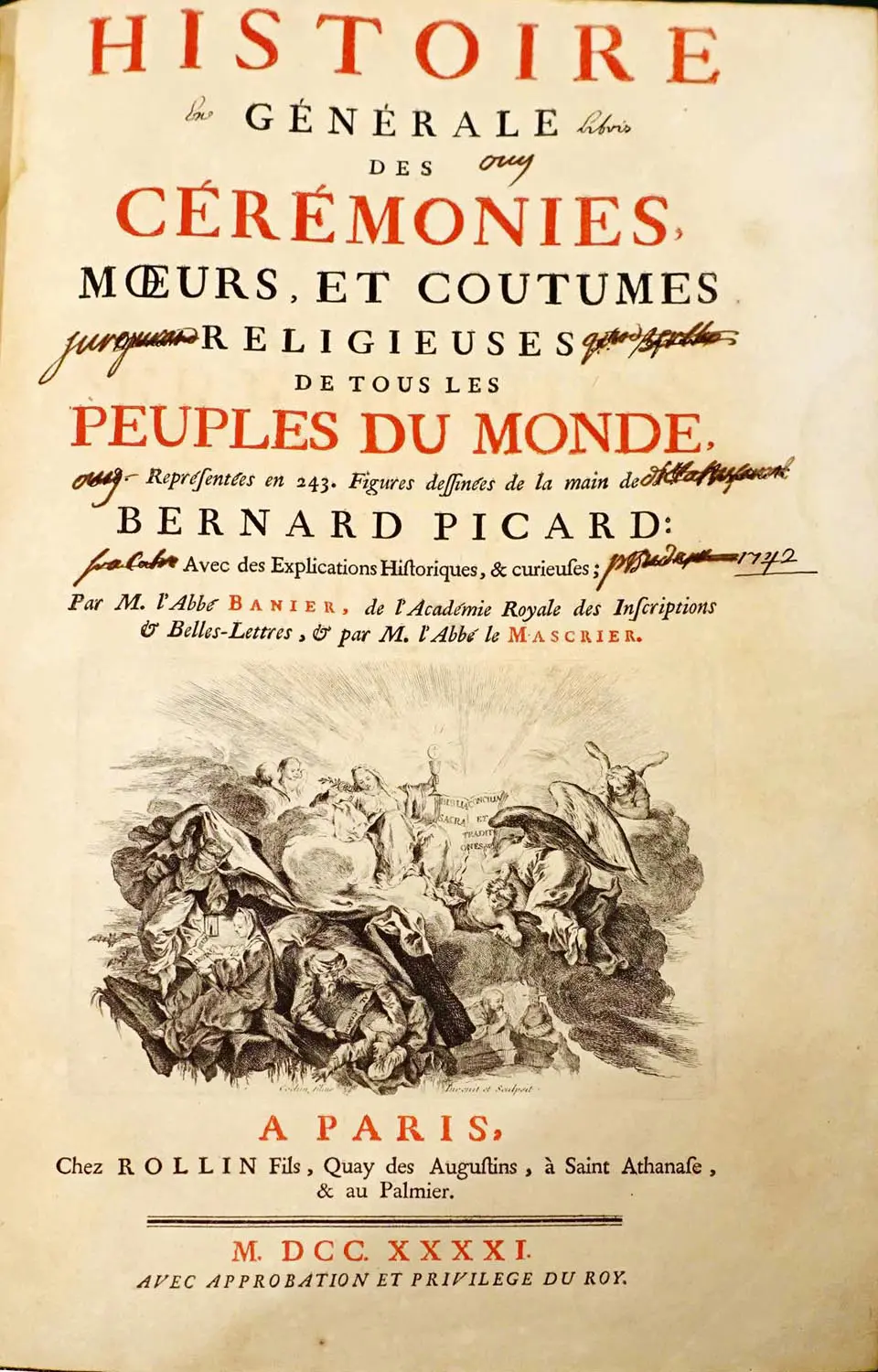


Histoire générale des cérémonies, moeurs, et coutumes religieuses de tous les peuples du monde
Essay by
Jurg Conzett

The *Histoire générale des cérémonies, moeurs, et coutumes religieuses de tous les peuples du monde*, edited by Antoine Banier and Jean-Baptiste Mascrier and published in several volumes beginning in 1741, is one of the most ambitious works of cultural history of the 18th century. The aim of this extensive work was to describe and compare the religious customs, ceremonies, and ways of life of the world’s peoples as comprehensively as possible. At a time of growing global contact through trade, missionary work, and voyages of discovery, it thus became an early encyclopedia of religions and cultures.
The work is a typical product of the European Enlightenment. The authors did not wish to judge religious practices exclusively from the perspective of a single faith tradition, but rather to examine them as historical and cultural phenomena. In doing so, they drew upon travelogues, missionary reports, ancient sources, and contemporary scholarly literature. Their aim was to gather knowledge, organize it, and make it accessible to an educated audience.
The volumes cover the religions of Europe as well as those of Asia, Africa, and the Americas. They describe rituals, festivals, sacrificial rites, priesthoods, temples, clothing, funeral rites, and religious symbols. The authors are interested not only in the faith itself but also in its social expressions. Religion is presented as an integral part of everyday life and shapes law, morality, politics, and social order.
Particularly noteworthy is the rich collection of copperplate engravings. Numerous detailed illustrations depict temples, religious objects, processions, religious vestments, and ceremonies from around the world. These images made the work especially appealing to European readers and, for the first time, conveyed a visual impression of cultures that were completely unknown to most. At the same time, they demonstrate how strongly the European perception of foreign religions was shaped by the perspective of observers at that time.
The “Histoire générale” marks a turning point in the history of ideas. On the one hand, the authors strive for comparison and description rather than mere condemnation of foreign religions. On the other hand, they remain children of their time. Many depictions reflect European prejudices or implicitly subordinate other forms of belief to a Christian worldview. Modern ethnology and the study of religion did not yet exist; the work therefore combines scholarly curiosity with the limitations of knowledge at the time.
This is precisely why the book holds special historical value today. It not only shows how Europeans in the 18th century perceived other cultures, but also documents numerous customs and traditions that have since changed or disappeared. For historians of religion, ethnologists, and cultural studies scholars, the work is therefore a source not only on the societies described but also on European thought during the Enlightenment.
Furthermore, the collection makes it clear that religion is far more than a system of beliefs. All over the world, rituals structure the course of the year, foster community, accompany life transitions such as birth, marriage, or death, and lend legitimacy to political orders. Despite all differences, the authors recognize recurring fundamental human questions about origin, meaning, order, and cohesion. This gives rise to an early form of comparative religious studies.
From today’s perspective, the work can also be read as an expression of the dawn of globalization. Europe’s growing trade and colonial expansion led to an unprecedented encounter with foreign cultures. Knowledge about other peoples became an important component of the educated public sphere. The *Histoire générale des cérémonies, moeurs, et coutumes religieuses* sought to systematically document this new world.
As such, the work remains an impressive testament to the Enlightenment. It combines a thirst for knowledge, encyclopedic ambition, and an attempt to make the diversity of human cultures comprehensible. Despite its limitations due to the era in which it was written, it marks an important step toward a comparative study of religions and a better understanding of the world’s cultural diversity.

