
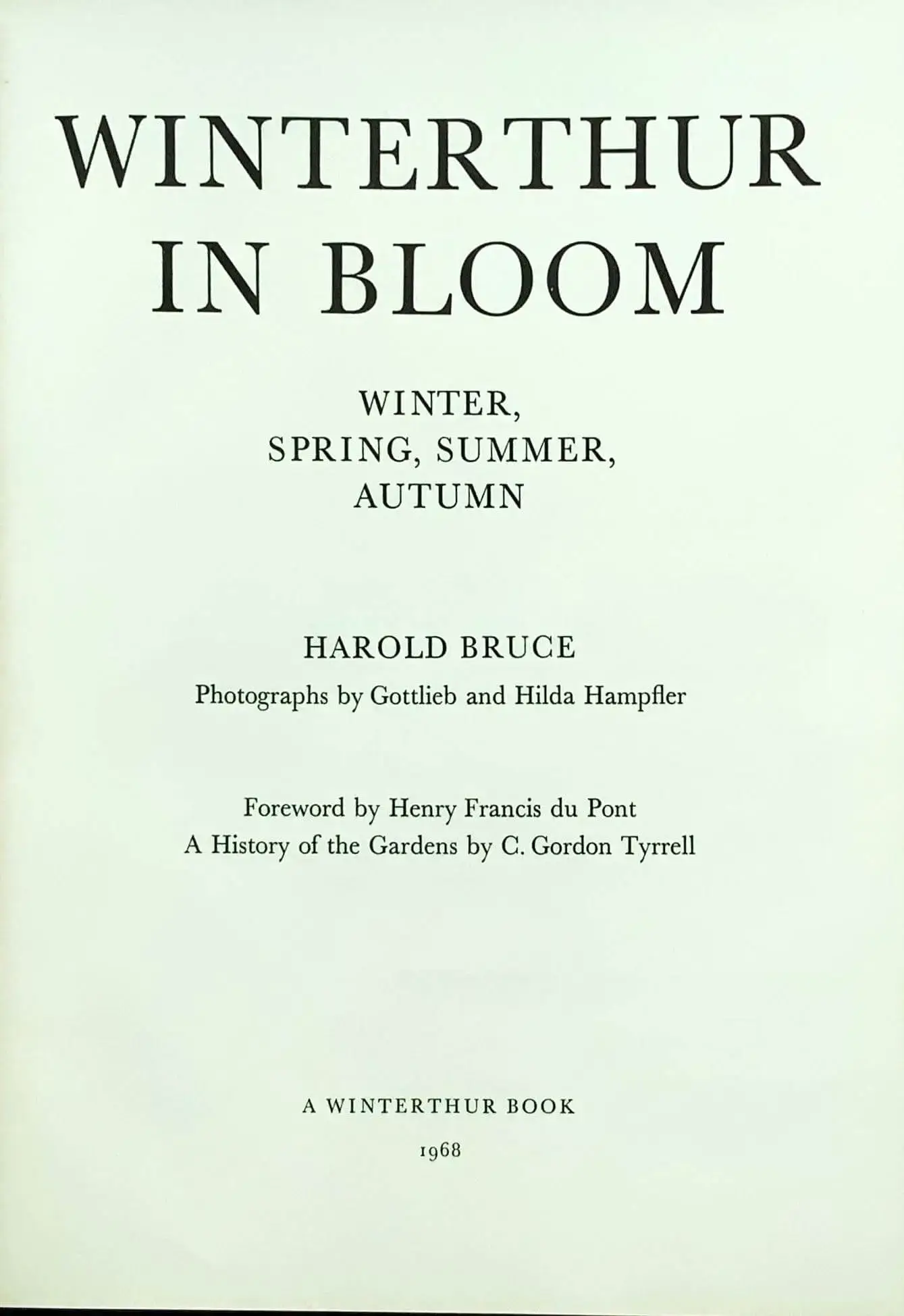


It is a beautiful book whose photographs were taken by one of the most famous garden photographers in the United States. The images by Gottlieb Hampfler are enchanting -- so enchanting that the negatives are today preserved as treasures at the Smithsonian Institution. Gottlieb Hampfler photographed the gardens of Winterthur in the 1960s. He did not even have to cross the great ocean to do so: for Winterthur is in Delaware.
Why Winterthur Is in Delaware
But let us begin at the beginning. For that we must go back to the year 1811. At that time Jacques Bidermann was puzzling over why a promising gunpowder factory in Delaware was not turning a profit. Bidermann made his living by asking such questions. He was a Parisian investor with French-Swiss roots. He owned 30% of the factory in question because he had lent a Huguenot business friend 12,000 dollars for a fresh start after the latter had fled the Jacobins. The financier Bidermann could afford it. He also helped the French Republic financially, with six million francs. Jacques Bidermann had a son whom he preferred not to have grow up in the turmoil of the French Revolution. He sent him to his Swiss homeland in Winterthur. There young Antoine spent an idyllic childhood. Winterthur was at that time a promising city just preparing to become an industrial town. In 1800 the fortifications were demolished. Young Antoine witnessed how rapidly the factory halls displaced the peaceful meadows of his childhood.
When Papa Bidermann was pondering the gunpowder factory in 1811, Antoine had long since returned to Paris and completed a training as a merchant. His father sent him to Delaware to assess the situation on the ground. Antoine realised that another co-owner wished to push out his father's old friend Eleuthère Irenée du Pont. Antoine bought out the schemer, instead joining the management himself, and married the charming daughter of Eleuthère du Pont.
Together with his father-in-law Antoine Bidermann built the gunpowder factory over the following decades into the largest American manufacturer of gunpowder. It supplied the US government with the powder that American troops fired in the war against Mexico. The Crimean War brought powerful customers throughout Europe. And in the American Civil War, one third of the powder used by the Union forces came from du Pont & Co.
By that point Antoine had long since retired. For this purpose he had purchased a large tract of land in north-western Delaware. There he erected not only an enormous villa but also laid out an impressive garden with a model farm. In memory of carefree days of childhood he named his estate Winterthur.
How Winterthur Became a Museum
In 1865 Antoine Bidermann died. His business partner du Pont acquired the property from the heirs. Villa and garden remained in family ownership for more than a century, until Henry Francis du Pont, who had built up an enormous collection of early American furniture and paintings, turned it into a museum. The splendid garden became part of the museum and is today the highlight of every visit. It covers more than 28 hectares, or just under 40 football pitches. In twelve greenhouses one can experience the various climate zones and their plants. Last but not least, there is still the model farm laid out by Antoine Bidermann at Winterthur. It has since become famous for its breeding of prize-winning Holstein cattle.

The Garden, the Book, and a Swiss Printing House
Capturing the beauty of this incomparable garden was the goal of gardener and photographer Gottlieb Hampfler. His photographs became the starting point for a picture book whose texts were supplied by authors closely connected with the gardens of Winterthur Museum: Gordon Tyrrell and Harold Bruce. They found a publisher in Chanticleer Press, a house specialising in illustrated books on art and nature. For this the publisher needed a printing house that could produce the planned picture books in excellent quality even in large print runs. The technical expertise of Conzett & Huber, whose modern offset presses allowed high-quality, fast, and cost-effective printing in large runs, had spread to America. And so Conzett & Huber became a business partner of Chanticleer Press, producing several books on its behalf. And so it came about that an American book about an American garden bearing the name of the Swiss city of Winterthur was printed in Zurich. The cosmopolitan Antoine Bidermann would certainly have been delighted by that.


