
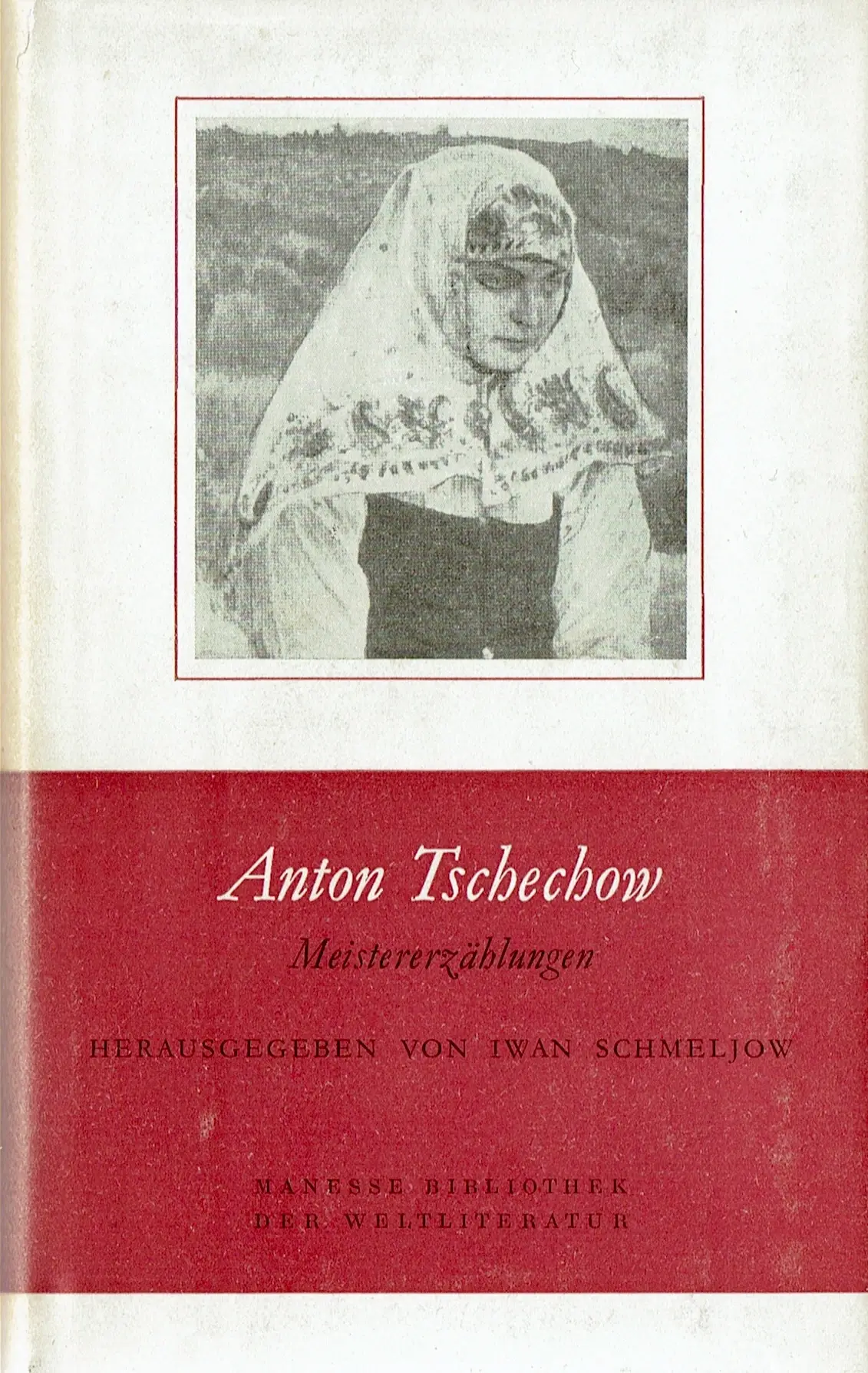


Books are not toys but real friends who can comfort us through difficult times. That is why one treats them carefully -- so my mother taught me. She had reason to know. She loved reading dearly and had experienced difficult times: the Second World War, flight from her homeland, building a new existence in a foreign land. In 1947 she was a little younger than the birthday child who received the Master Stories of Anton Chekhov as a gift from a certain Emmely in 1947.
For this article, let us for once focus not on the content of the little book but on its price. For when I bought the perfectly preserved little volume at the Troger antiquarian bookshop, I found in it not only Emmely's dedication but also the publisher's prospectus of the Manesse Library of World Literature. From it I learned what Emmely paid for the gift.
What Did 7.70 CHF Mean in 1947?
In 1947 this Manesse volume with its 610 pages cost 7.70 CHF. And this raises the question: what did 7.70 CHF mean shortly after the Second World War?
It meant first of all that a Swiss publisher could only sell books on the home market. In Germany people had quite other worries before the currency reform and after the hunger winter. Even in Switzerland, daily bread was the central concern. The largest part of income still went on food, if one could get it at all. Flour, sugar, and some other foodstuffs were rationed. But Swiss politicians could be proud that they supplied almost the entire population -- which at that time performed considerably more physically demanding work than we do today -- with 2,160 calories daily.
Let us look more closely at what an average Swiss family bought with its monthly income. The Federal Statistical Office provides enough material for this. In 1947 a family earned 8,204 francs per year(!). By comparison: today the median wage is 6,788 francs per month(!); an average household income is 117,456 francs. Families with children have somewhat more, namely 157,008 francs. If we put this in proportion, 1 franc of 1947 corresponds to 19.13 francs today -- the 7.70 francs for the Chekhov would thus correspond to 147.36 francs.
In other words: when Emmely wrote her dedication in the Master Stories of Anton Chekhov on 18 March 1947, she had made not a small but a very large gift. We may assume that Emmely had her own income, went to work herself, and probably held a (relatively) well-paid position, perhaps in administration. If that was so, then at an hourly wage of 1.33 to 1.73 francs she would have had to work four and a half to six hours to have earned the equivalent of the book's price.
Cinema in the Mind
Emmely thus probably did not simply reach for the nearest object when choosing the book, but thought carefully about what would bring the most and the longest pleasure. She chose the Master Stories of Anton Chekhov, who is famous for depicting Russian life in detailed and nuanced fashion. Emmely gave the gift of cinema in the mind, at a time when hardly anyone knew what the Russian steppes looked like. Nobody travelled that far in those days; the newsreels were short and focused on spectacular events. Who knew at the time what 'the Russian' was like? That 'Russian' who after the Second World War was preparing to take possession of Eastern Europe and stir up the Cold War.
I would dearly love to know what the little room looked like in which this little book was read. Was its reader full or hungry? Was the room warm and comfortable? Or was this little book read in a cafe, long hours beside a single cup of coffee, but in a heated room?
We shall never know. What I do know is that the owner heeded my mother's advice and took very good care of this little book. Its dust jacket is perfectly preserved, only rather yellowed, because the first Manesse volumes were produced with very poor paper. We must not forget: the war had just ended and paper was a scarce raw material.
I too will handle the Master Stories of Chekhov carefully. And at some point this book will pass on to a new generation of readers -- if they are still interested at all in a book from the year 1947. Emmely had to invest a large part of a day's earnings; it cost me barely the equivalent of an espresso. My successors may not even be willing to pay anything at all for this book.


