
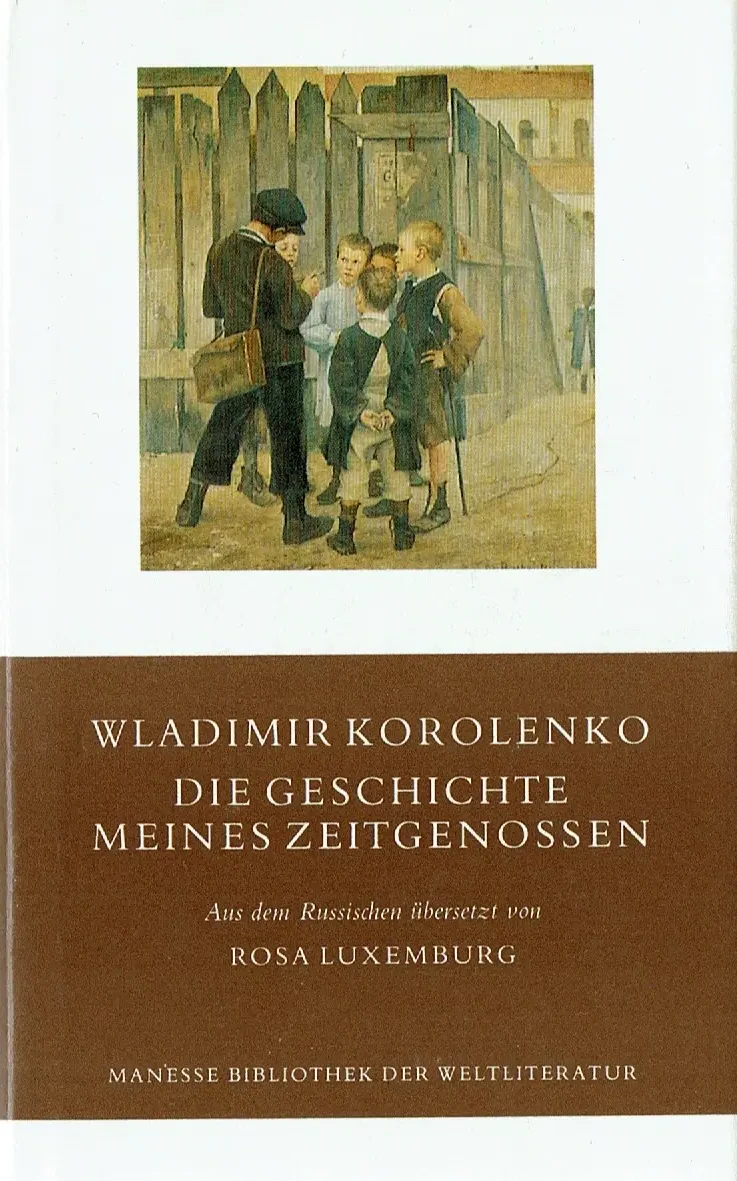


What Dictatorship Feels Like: The Story of My Contemporary by Vladimir Korolenko
by
Ursula Kampmann

How do people actually endure living in a totalitarian system? This question confronts anyone who consumes the news today. And why are all the totalitarian systems in our world not swept away by the massed power of the people? Those seeking answers should read Vladimir Korolenko (1853-1921). In his today probably best-known book, 'The Story of My Contemporary,' he tells what dictatorship feels like for those who are oppressed. To do so he draws on his own past.
The first volume of his autobiography appeared in 1985 in the Manesse Library of World Literature series. It immediately captivates the reader. Korolenko fascinates with his blend of the loving gaze at a harmless childhood and a minutely precise description of the living conditions of his time. And very gradually, almost subconsciously, the reader comes to the realisation that one can wonderfully ignore injustices as long as one does not think about them. But as soon as the mind awakens, one realises that for an upright person there is no alternative but resistance. What form that takes depends on the courage and intelligence of the individual.
Vladimir Korolenko comes into the world in 1853, in Zhytomyr. Today this city lies in Ukraine. In Korolenko's time it was ruled by Russia, and that was a problem for him and his family. Not that the family had anything against Russians -- no, the father, although actually a Ukrainian Cossack, served as a faithful judge for the authorities. But little Vladimir's mother is Polish and furthermore Catholic, a fact disparagingly assessed by the religious teacher, otherwise a pleasant enough man. For him, all Catholics are damned to hell. And the boy simply cannot understand this. Nor can he understand his father's fear of the Tsar's inspector. After all, Vladimir does not know a single official who is less corrupt and more honest than his papa! The little fellow explains this to himself somehow by concluding that the world is as it is; and the will of God is as inscrutable to him as the will of the Tsar.
Not that Vladimir would be unfamiliar with tyrants! He knows many -- from school. There too his first doubts about the goodness of the Tsar arise. The Tsar's laws state that all sons of civil servants must attend school in the place where the father holds his post. Now in Rovno, to which the judge is transferred in 1868, there is only a mathematics gymnasium. And mathematics is a horror to the linguistically gifted Vladimir. He becomes frightened and wonders: why does the Tsar not let him study what he loves and what he excels at? Naturally the child is not concerned about future career prospects. He is concerned with the immediate prospect of the caning that threatens all those who cannot follow the lessons.
And thus we arrive at the everyday school life of the provinces. There, beatings and the lock-up are an uncontested pedagogical tool, employed frequently and freely. Not only when disciplinary offences must be punished. Beatings are above all for those who do not learn quickly enough. And there are many of them. For no teacher makes any effort to make his lessons interesting. This is not out of malice or stupidity, but because the teachers are burned out and weary. They have been reduced to automata by the constant repetition of the same meaningless material, and dispense content randomly, which their pupils reproduce just as randomly.
Vladimir is fortunate. He is gifted. The beatings in the dark lock-up are spared him. But he feels a deep sympathy for all those who are beaten. And so he sides with them -- as everyone else does. The pupils develop into a tightly knit community that knows only one enemy: the school authority. When it comes to settling scores with teachers and school servants, inspectors and caretakers, every means is justified. Woe betide the teacher who shows a weakness! It is mercilessly exploited to harm him! And the teachers strike back with what is at their disposal. Even the slightest show of disrespect is punished with merciless beatings.
Now when, at the end of the 1860s, a new generation of teachers arrives at the gymnasium, the pupils at first cannot cope with their friendliness. They are not accustomed to a teacher being fair and just, to his loving his subject and wishing to convey it to them. They are constantly looking for ulterior motives! It is shocking how mistrustful the perhaps fifteen-year-olds have become. But slowly things develop for the better.
Thus Awdiyev, Korolenko's new teacher of Russian literature, gives his life its decisive turn. This Awdiyev is so entirely different from all the teachers Korolenko knows. He gets drunk and tells jokes that are unspeakably funny but hold the town's worthies up to ridicule. Naturally Awdiyev can hold out for only a few months, but his teaching shows the young lads what literature can actually do: Awdiyev reads to them the new, the exciting, the critical authors of the present and thereby stimulates thought. Vladimir Korolenko will never forget the impression made on him by an episode from Turgenev's 'Notes of a Hunter.' It concerns a master, his serf, and the beating the master administers to the serf. What is remarkable about it is that both -- master and serf -- find the beating completely normal. And then young Vladimir Korolenko understands that neither master nor serf, but the system in which they live, is wrong.
The system! It appears to be the solution to everything. Suddenly he understands how wrong it is that the father toils his whole life and the mother receives so little pension, because the father died a few months too early. He can suddenly fit into the picture the fact that his Uncle the Captain is so kind to him personally and yet forces a servant to stand for hours in the cold water in the middle of winter for a minor offence. Vladimir understands that the teachers too once set out with ambition to give good lessons, and that the system has made them what they are today. It is -- this insight is fundamental to Vladimir Korolenko -- not the fault of the individual but of the system. It is therefore pointless to combat the symptoms. The system must be changed to give individuals the possibility of behaving morally.
All well and good, but how can a small boy make an effective act of resistance? Korolenko tells us this too. When the malicious school servant is, as usual, spying through the keyhole on the class during the lesson, Vladimir hears him and quietly asks the teacher for permission to leave. The teacher nods; Vladimir goes unseen to the door and suddenly flings it open. There stands the informer, bent over the keyhole, exposed before the entire class. The school servant fumes with rage, wants to have Korolenko seriously punished, but is set right by the headmaster: the boy has done nothing forbidden, he simply went to the toilet...
Many years later, the celebrated author and writer Vladimir Korolenko would repeatedly expose those who made themselves into the servile minions of the system. He did so during the great famine of 1891-2. Or in the case of the death sentence against those Udmurts whom a superstitious populace had accused of ritual murder. Korolenko fought against antisemitism, against the military code, and against the death penalty. He did not thereby become an agitator, but a voice of reason that appealed to the best in people -- to compassion and at the same time to their intellect. Vladimir Korolenko developed into a man whose pen even the authorities feared. He was regarded as an incorruptible moral compass, intimidated by neither threats nor punishments. Korolenko denounced injustice, whether committed by tsarist, socialist, or communist hands -- which Lenin, incidentally, took very badly.
It is easy to admire Korolenko; and Rosa Luxemburg did so too. It was her concern to translate the first volume of his 'Story of My Contemporary,' published in 1914, promptly into German and make it accessible to German intellectuals. She translated the text during a prison stay and completed her work on it only a few weeks before her murder.
Whether you admire or reject Rosa Luxemburg; regardless of your political persuasion: 'The Story of My Contemporary' is worth reading. For it is far more than a biography; it is a book that without any form of agitation shows how systems function and that one can change them; that one must change them when a system has degenerated into dictatorship.


