


Three Approaches to David Copperfield Part 1: Choose Wisely Who You Bind Yourself to Forever
by
Ursula Kampmann

Good stories can influence our behaviour. Whoever identifies with a hero will seek to emulate him. The misbehaviour of literary villains, on the other hand, repels us and leads us to keep our distance from similar actions in real life. In the 19th century, therefore, a book was considered good literature when it offered guidance for leading a good life. Charles Dickens was supremely suited to this purpose. His stories read like a manual for finding bourgeois happiness. David Copperfield is a fine example of this.
Artikeltext:
What Happens in David Copperfield?
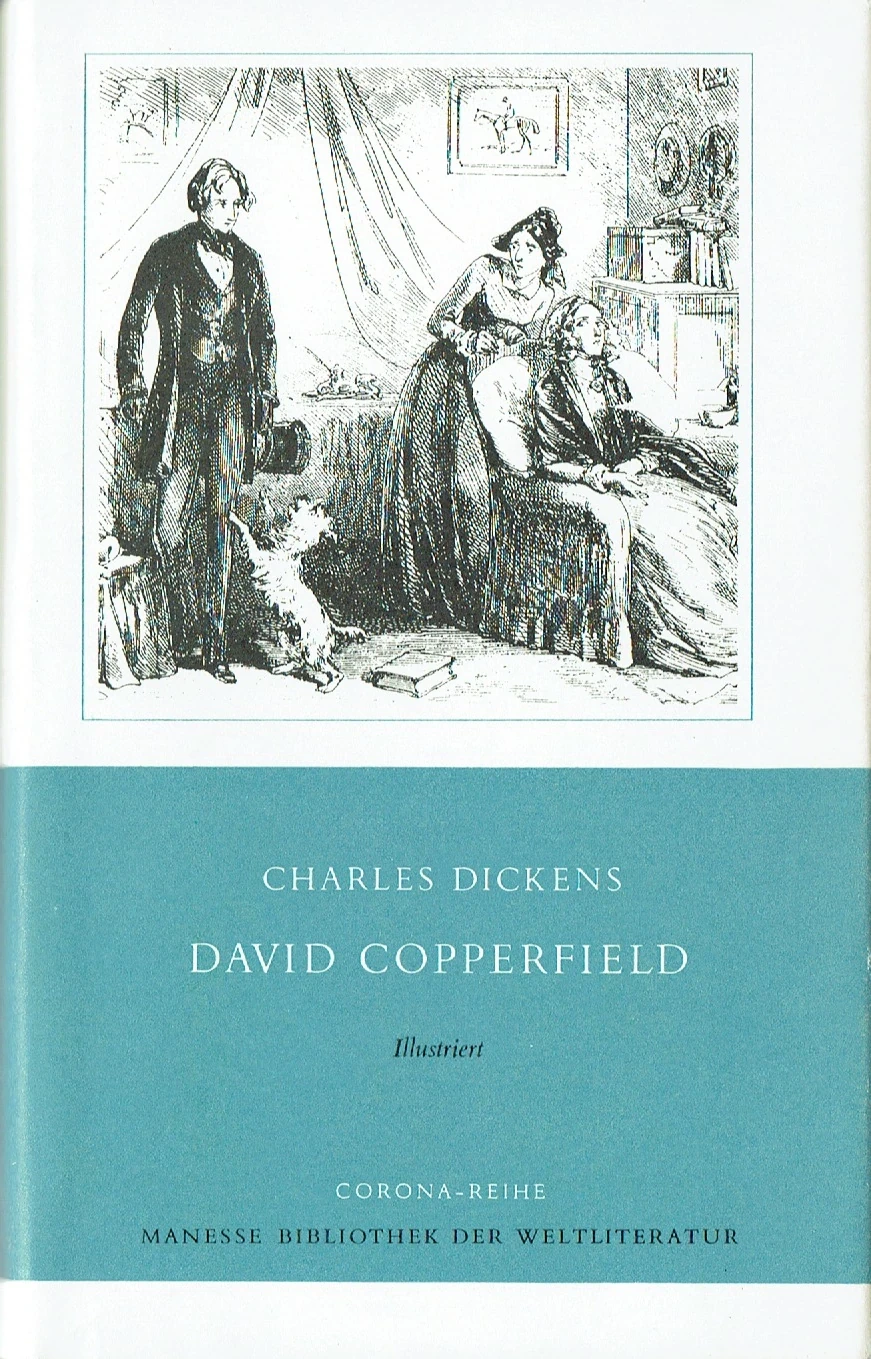
The German translation of the 1849/50 novel consulted for this text runs to 1,179 pages. It was published by the Manesse Library of World Literature in 1961 in its Corona series. This series, with its larger format, was created in 1959 expressly for novels that seemed too extensive for the small Manesse volumes. 1,179 pages, then, packed full of plot and protagonists! It is obvious that one must summarise the events of such a work in either five sentences or twenty pages. We have opted for the five-sentence version: David Copperfield is a small boy whose mother makes the mistake of marrying the wrong man after her husband's death. This costs the mother her property and David Copperfield his inheritance. But the little boy does not give up. Thanks to the generous help of a relative, he manages to obtain the education necessary for social advancement. Through diligence and commitment he lays the foundation for a secure existence, whose happiness is sealed by his marriage to the ideal woman.
The secondary literature on David Copperfield is far more extensive even than the novel itself. Scholars have minutely reconstructed to what extent Charles Dickens drew on his own experiences. We know everything about narrative perspective, publication history, the significance of the illustrations, and much more. All of this is interesting and yet goes far beyond the scope of this text. In our approach we shall confine ourselves to a single theme: what bourgeois ideals does Charles Dickens champion in his David Copperfield? We illustrate this through three examples: marriage, education, and the handling of money. While this part is devoted to marriage and the correct choice of partner, two forthcoming chapters will deal with education and money.
For Context: The Foundations of English Marriage Law
Let us begin with the ideal of bourgeois marriage that Dickens promotes in his book. And for that we must first engage with its legal foundations, for one does not understand the plot of David Copperfield if one does not know that in England before 1870, the full control of a married woman's property lay with her husband. Whether real estate, cash, annuities, or shares — a woman who married transferred to her husband the sole right to use her property. The husband alone decided whether and how he provided for his wife and children. A woman who married thus placed her fate completely and irrevocably in her husband's hands. A considerable risk, which could take a terrible turn with an unwise choice of partner!
In David Copperfield, Charles Dickens practically conjugates through all the possible errors in choosing a partner — and of course shows what a wise approach looks like.
The Mother's Mistake
David Copperfield begins with a family idyll: little David lives in rural Suffolk, lovingly cared for by his mother Clara and the housekeeper Peggotty. The world lies open to him, for his prematurely deceased father made financial provision: the mother need not worry about her livelihood. This is just as well, for the loveable but rather immature woman would not be capable of it in any case. Unfortunately, the serpent slithers into this paradise in the form of a fortune hunter. Edward Murdstone enchants the mother, courts her, flatters her, and despite all well-meant warnings, Clara Copperfield becomes Mrs. Edward Murdstone. With this, laughter and plenty disappear. Money is spent only on the needs of the head of the household. Little David must adapt: instead of merry games and treats, there are now harsh words and beatings. When he resists, Murdstone packs him off to a boarding school. An inexpensive one, naturally.
Lack of love, lack of joy, a difficult birth, and the despair of having plunged her son into misfortune — all this leads mother Clara to waste away and die prematurely. This seems to seal her son's fate. For Murdstone even saves the school fees and sends the ten-year-old to a London factory. There the boy must earn his meagre subsistence himself. But David rebels! He wants more from life. He wants education so as not to sink into the working class. And so he flees to an aunt. But although she wishes to take him in, she must obtain the consent of the guardian for this. Dickens writes a magnificent scene in which the spirited woman manages to persuade Mr. Murdstone to consent — at least as long as he need bear no more costs.
The Friend's Mistake
If the fate of the Copperfields is already bad, it is still better than that of Emily, David's beautiful and talented childhood friend. The young woman dreams of the wide world. The loving, good-hearted, capable fiancé her father has chosen for her is too provincial, too ordinary, too dull for her taste. Her dreams make it easy for the unscrupulous James Steerforth to seduce her. Emily believes his promise of marriage and secretly runs away with him. But Steerforth has no intention of marrying her. After a few pleasurable months he abandons her, so far beneath him socially. If Emily is not to starve, prostitution is her only remaining option. But rescue comes in the form of her loving father. He finds his daughter, forgives her, and goes with her to America to begin a new life.
The Sacrifice for the Family
Things could have turned out even worse for another childhood friend of David Copperfield's: Agnes Wickfield is the daughter of an honourable solicitor whom grief over his deceased wife has made into an alcoholic. Ever deeper he slides into addiction and seeks help from the wrong person — his scheming clerk Uriah Heep, whom he makes his partner. Heep exploits Wickfield's moments of weakness to make him sign unsecured promissory notes. Debtors' prison seems inevitable if Wickfield refuses to fulfil Heep's demand: settlement of the debts in exchange for the hand of the beautiful Agnes (and — what is more important — her inheritance). What this would have meant for the young woman, every female reader in the middle of the 19th century could vividly imagine! It cannot have been uncommon in those times for a daughter to pay for her father's foolishness with her own happiness in life. But Agnes, like Emily, has a stroke of luck in misfortune: David Copperfield, together with his friends, manages to thwart Uriah Heep's machinations before the marriage can take place.
The Men's Mistakes
But it is not only women who make mistakes in choosing a partner. Men too should weigh the alternatives carefully. David Copperfield does not do so. He loves the capricious Dora Spenlow above all else, and she loves him, and yet their marriage is a disaster. For Dora is utterly clueless when it comes to running a household. David may have thought this could be learned, but it cannot. Dora fails at everything. At supervising the servants, at managing the meagre household budget, at preparing a wholesome meal at the right time from provisions bought too expensively. Dora is wonderful but incompetent; she is nothing but a pretty ornament who does not relieve David of any task but only burdens him with additional ones. What worked while Dora bore no responsibility becomes a nightmare in daily life. Only Dora's early death prevents the couple from learning to hate each other.
The Family Factor
Did Dr. Strong also make a mistake with his choice of partner? The already somewhat elderly scholar has married Annie — a very young, very poor, but supremely capable woman. While her husband teaches and in his free time writes his interminable dictionary, Annie admirably manages the large household for him. It could be the perfect marital happiness, if not for Annie's mother and cousin. The two know precisely how to use Annie to extract financial advantage from Dr. Strong at every opportunity. The crisis comes when Annie is accused of deceiving Dr. Strong with her cousin. This could have gone badly for Annie, had the scholar not been such a good-hearted man! But instead of sending Annie away, he reproaches himself: he had bound a young woman to him too early and thereby destroyed her happiness in life. He had made use of the selfishness of the mother and cousin. Out of pure self-interest they had persuaded Annie to marry him, although she could have found her happiness with a younger man. Naturally it then emerges that Annie loves Dr. Strong sincerely. And as a bonus, the machinations of the mother and cousin are brought to a stop. Henceforth the couple speak with each other, instead of constantly trying to guess each other's wishes and thoughts. And with that this marriage is saved.
An Essential Economic Community
Charles Dickens provides in David Copperfield a wide selection of examples of successful marriages. A frequent prerequisite is that reason played a role in the choice of partner. Love? Well, a pleasant addition, but not necessary for a marriage's success. In Charles Dickens, marriages work even without romance. A good example is the marriage between Peggotty the nanny and Barkis the carrier. 'Barkis is willin'' — this is the message the taciturn coachman sends to the capable Peggotty. And yes, Peggotty is willing too. So the two marry — without any fuss or ceremony. Nonetheless they get along wonderfully together, until old Barkis dies and leaves his deeply grieving widow well provided for.
Barkis and Peggotty show us what bourgeois marriage really is: an economic community with a division of labour. The man goes out into the world to earn money. The woman stays home to organise daily life. In the 19th century, still a full-time occupation! His income is as important for the comfort of both as her skills in cooking, cleaning, and overseeing servants and suppliers.
Not the Most Beautiful, but the Most Capable
So one must choose carefully to find the ideal partner. How this is done, David Copperfield learns from his schoolfriend Tommy Traddles. He waits many years until his income finally suffices to offer his bride a secure existence. Fortunately she is patient. Her parents do not press for the wedding. Their fourth daughter may perhaps not be as pretty as the eldest, but she is supremely capable and organises the entire household for them. There is great lamentation, therefore, when Traddles finally marries her. But his newly made wife is assertive enough to draw firm limits with her intrusive family, while Traddles has the tolerance to bear the compromises that entails. The two become very happy together, just as David Copperfield does when he finally, at the very end of the story, realises that he and Agnes Wickfield belong together. She too is an experienced housekeeper, possesses an exemplary character, and has long loved her David.
And so David Copperfield, at the end of his adventures, finds true happiness at last in a bourgeois marriage.


