


The Saint's Sacrifice: Sofya Tolstaya and Leo Tolstoy
by
Ursula Kampmann

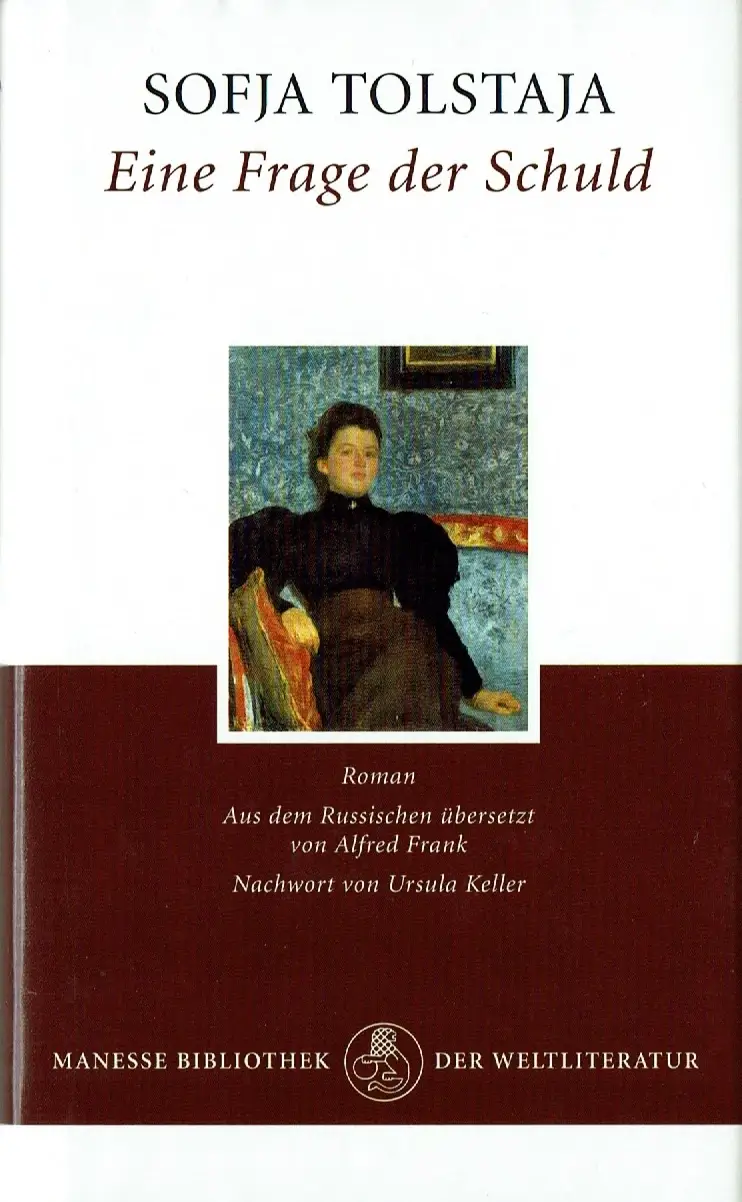
Actually, the novella 'A Question of Guilt' is completely out of its time. A young girl agrees to marry a man considerably older than herself. The man desires her firm body. The girl dreams of -- well, of what exactly does she dream? Of a great harmony of souls? That, one suspects, quickly proved unrealistic. The wedding night, which is actually addressed in the novella, is entirely disillusioning. And so the young woman hopes for the exciting duties of a housewife. She takes pride in carefully raising the children. She manages her husband's household perfectly, hoping at least to be appreciated and honoured for this. But her husband is not interested. The children are a matter of indifference to him. He does not notice her domestic achievements. He only registers when something is lacking in his comfort. And when another man pays her a little attention -- entirely innocently, of course -- her husband becomes jealous to the point of madness. As a modern reader one is repeatedly tempted to put the book down. 'Oh come on!' one wants to call out to the protagonist, 'Leave the idiot at last, and be done with it. Let the other man provide for you. Move to a distant land and be happy. Stop making yourself a victim!' But no; relentlessly the story moves toward its bad end: at some point the jealous husband loses control so completely that he kills his wife in a fit of rage with a paperweight.
Phew, the story is finally over. One has survived it. Only the afterword, which the editors of the Manesse Library of World Literature add to every volume. And suddenly one sees the narrative in an entirely different light.
For it was written by the wife of Leo Tolstoy and is actually the response to another story that her husband published in 1890/91. In the original, Sofya's work is titled 'Whose Fault? A Woman's Story. (On the Occasion of Leo Tolstoy's Kreutzer Sonata).' The counter-narrative lay in a desk drawer for decades before being published in Russian in 1984 and in German in 2008. The Kreutzer Sonata, by contrast, has found its place in literary history -- even though when it was written it was so scandalous that it took two years before the tsarist censors permitted its printing, and even then only because handwritten copies had spread throughout the entire intellectual class anyway.
With his story, Tolstoy called into question the basis of every social order. In it he circles around the themes of man, woman, and marriage. The novella tells essentially the same story as his wife's, but this time from the man's perspective: he himself knows that he married the girl only for her youthful body. All her efforts to please him leave him cold. But jealousy repeatedly overtakes him when his pretty wife practises Beethoven's Kreutzer Sonata with a young violinist. Outstanding in its psychological portrait of gradually escalating madness, Leo Tolstoy describes the man's attempts to control his rage. But the situation increasingly spirals out of control until he finally kills his wife. The social dynamite of this story is concealed in its frame narrative. For Tolstoy has the murderer -- acquitted by the courts -- narrate his own fate himself. His listeners are a few train passengers who shorten the long journey by discussing marriage. While they contrast the modern demands of an already-existing feminism with the classic Russian model of marriage, Tolstoy pleads with his tragic story for the fundamental incompatibility of the desires of man and woman.
When Tolstoy published this story, he was, as the celebrated Russian national poet, a person of public interest. Everyone who took an interest in literature knew of the bad marriage that Lev and Sofya endured with each other. Many must have personally witnessed Sofya reproaching Lev for his behaviour. It was thus natural to assume that Tolstoy had processed his own biography in the Kreutzer Sonata. After all, many details of the story corresponded with reality. Sofya too had said yes to Lev at the tender age of 18, borne him a large brood of children, and all the while organised his daily life. It was she who managed the household, negotiated with publishers, copied out the manuscripts -- War and Peace alone seven times. Sofya had given up her own life to share that of her husband, and he refused her every form of love and recognition in return.

In a postscript to the Kreutzer Sonata published in 1890, Leo Tolstoy explained why: he preached abstinence -- and this after fathering 17 children -- to his 13 surviving descendants, to which were added Sofya's three miscarriages and an illegitimate offspring from an affair with a peasant woman. Suddenly Tolstoy rejected marriage in principle, and on the grounds that everything sexual is bestial. Even the emancipation of women thus remained a farce, at least as long as they possessed a desirable body with which they could subjugate men and impose their will upon them. The only honourable way out for any man was to lead a completely asexual life.
Tolstoy actually believed this nonsense. After fame had grown stale for him, he sought new horizons and found them in asceticism: a frugal lifestyle, hard physical labour, vegetarian food, the rejection of all forms of government and established churches... Even the Desert Fathers could have learned abstinence from Tolstoy! He planned to give away his own possessions, just as Christ had commanded: 'Go, sell everything you have... and follow me!'
The saintly Tolstoy found his prophet in the wealthy nobleman Vladimir Grigoryevich Chertkov. He became the founder of the Tolstoyans, who lived in rural communes in the spirit of their master and followed his teachings. Chertkov persuaded Tolstoy to write a new will in which he stripped his wife Sofya -- who had until then managed his literary estate -- of all rights to it and transferred them to himself, Chertkov. Tolstoy did this, because his unconditional love of neighbour extended to everyone except his wife. He forced Sofya into the role of the Xanthippe who vainly tried to compel her saintly husband to secure the livelihood of his own family. The conflict culminated in the dying Tolstoy leaving his home and his disciples refusing Sofya reconciliation and farewell before his death.
Sofya was at least permitted to remain on her husband's estate until her death in 1919. After that, a collective of Tolstoyans took it over with the agreement of the Soviet government.
I confess that I should have known all this before reading Sofya's novel. Then I could have done her more justice. The protagonist's submissiveness, which I found unbearable, was what society had expected of Sofya. Honestly, I am glad she did not live up to those expectations and read Leo Tolstoy the riot act loudly and repeatedly. It is a disgrace that she, who against her will had to bear the consequences of Tolstoy's conversion, is still denied fair judgment to this day. Even if I cannot rank her novel among the great literature, for all that.


