
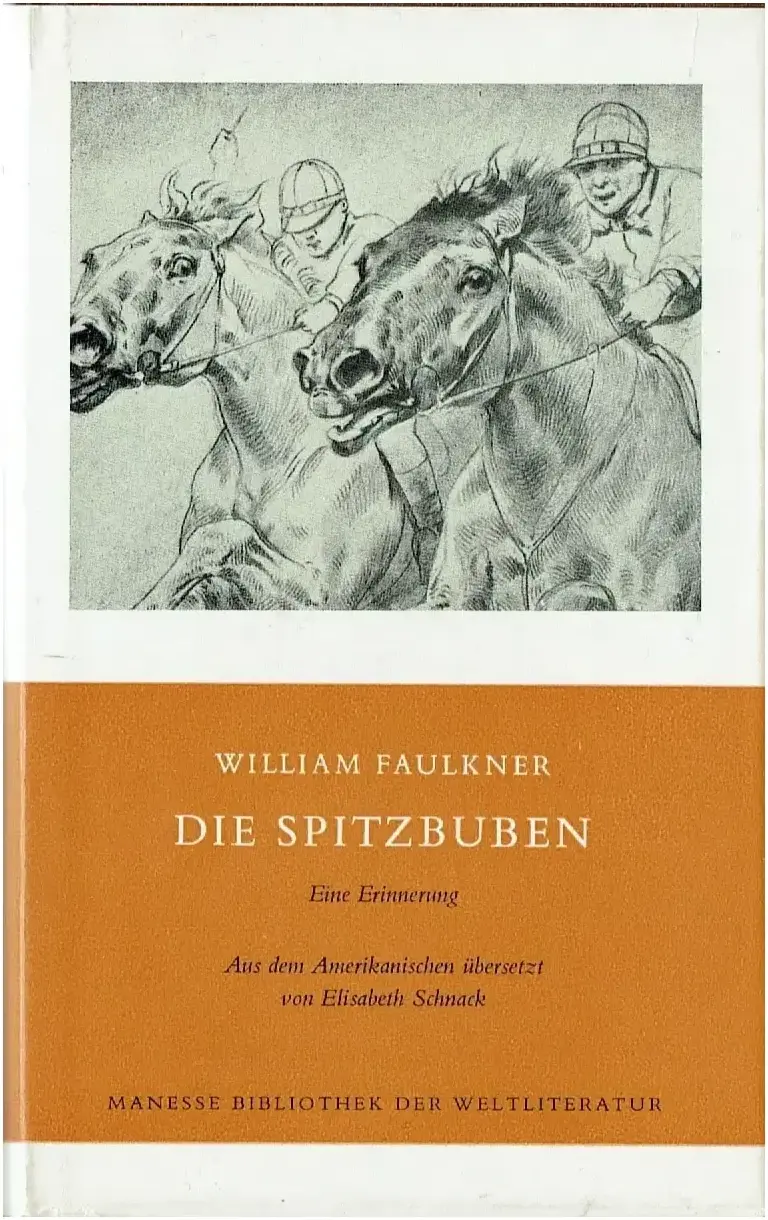


It is a somewhat complicated story in which one of the first automobiles, a racehorse, a sardine, and three entirely different men play the lead roles. The Reivers was written by Nobel laureate William Faulkner as his 'Golden Book' -- the book with which he intended to crown his life's work. He succeeded in this in the eyes of his contemporaries. He received the Pulitzer Prize for Literature for it. Today this story has, however, fallen into obscurity. Perhaps because it resembles at first glance a children's book in the manner of Tom Sawyer and Huckleberry Finn, which admirers of the Nobel laureate found too trivial. And indeed the hero of the story is an eleven-year-old boy named Lucius Priest. Egged on by the somewhat dim-witted chauffeur Boon, he steals his grandfather's car, in which horse trainer Ned happens to be taking a nap. Now Ned is forced to come along for the joyride to Memphis. But things get out of hand. To help his nephew, Ned exchanges the car for a stolen racehorse. Hence the book's title 'The Reivers' -- correctly translated as 'the cattle thieves.' To get the car back and be able to show their faces at home again, the stolen horse absolutely must win a race.
So much for the actual plot. And of course everything is even far more complicated. With 'The Reivers' Faulkner has created a typical coming-of-age novel -- as literary scholars call it when an innocent child loses its illusions through an encounter with the real world. And money plays a decisive role in this, or rather what people are willing to do to get their hands on big money.
From the start, little Lucius Priest knows what money is worth. He already works in his grandfather's business and earns a few cents a week. At the end of the year, his grandfather regularly doubles the sum Lucius has saved from this. And he saves diligently, for the great goal of his childish life is to acquire two hunting dogs. He would need to spend twelve dollars for that, making it an attainable goal with eight dollars already in his piggy bank.
So Lucius knows the value of money, and in view of his painstakingly saved treasure, the minor obstacle that our three heroes must overcome before the great journey begins reads doubly painfully. As mentioned, one of the first automobiles in the USA plays the main role. And it lacks the necessary horsepower to overcome a particularly muddy stretch of road that must be crossed before the good road to Memphis begins.
This little swamp, however, is not God-given but man-made. A farmer has developed a business model out of it, waiting with his mule team until a car becomes stuck in his muddy trap, then pulling the vehicle out of the mire for payment. Chauffeur Boon knows this and has come prepared. He has brought ropes with which he and Ned attempt to pull the car through the swamp. No chance. The farmer has churned up too much mud. And so Boon has only to wait until he finally grasps that he has no alternative. Only the mules are capable of overcoming the obstacle. And the farmer exploits the predicament. The rich and powerful grandfather had to pay two dollars. The three penniless travellers, on the other hand, six. This is what one calls a monopoly. And against this, the poorest of the poor can do nothing.
So Boon pays. He has a good reason to drive to Memphis. There, the woman he loves works in a brothel. Being with his Corrie is for him a rare pleasure. On his salary he must save for months to afford it. The little party arrives in Memphis, and Lucius Priest quickly grasps how things stand. Corrie's relative, an unpleasant boy named Otis, personally fills him in -- partly because he so enjoys boasting of his business acumen: his first money Otis earned by drilling a hole in Corrie's bedroom wall and renting out the spot in front of it for ten cents. Lucius Priest is outraged. So is the reader. He can understand Corrie. She believed she had no other choice but prostitution. But to profit from her predicament without any effort of one's own seems to us a wretched business model. Lucius cannot help himself -- he attacks Otis and is injured when the latter defends himself against the eleven-year-old's fists with a pocketknife. When Corrie hears why the eleven-year-old defended her, something becomes clear to her: she no longer wants others to profit from her. She gives up prostitution on the spot, much to Boon's annoyance, who now suddenly no longer gets what he believed he had already paid for.
How angry he is when she then gives freely to another man what she withholds from him -- a deputy of the worst sort. What Boon does not know: the officer is blackmailing Corrie. He has confiscated the racehorse and threatens to put Boon in jail unless she complies with him. We observe another dirty side of economic life: corruption, extortion, and abuse of office. Corrie plays along and is beaten up by Boon. And somehow the reader can understand not only Corrie but also Boon, who in his desperation needs a culprit on whom to vent his rage.
Oh, and of course there is also the story of the gold tooth -- the treasure of a colleague of Corrie's who has saved for years to afford this golden ornament. When she eats, she places her tooth on a small plate. She does not want to dirty it, after all. And from there Otis steals it, to sell it for its gold value. This could be so funny, were it not for the parade of naive people before our mind's eye -- people who save so hard and then become easy prey for swindlers.
Of course there is a happy ending. With exactly 495.75 dollars the grandfather sets everything right. He gets his car back and the racehorse owner gets his horse back. Otis must surrender the gold tooth, and Boon marries his Corrie.
The only one who is not satisfied is Lucius. He is still an innocent child, feels bad about having done wrong. He practically begs for a thrashing, but his grandfather does not give him one. Instead Lucius learns from the wise old man something for life: sometimes one does things that are not right. And one must live with them for the rest of one's life. That is punishment enough.
But to be able to still experience that as punishment, one probably needs to possess an intact conscience and a clear moral compass -- something that so many people lose in the course of their lives. Or as the New Testament puts it: unless you turn and become like children, you will never enter the kingdom of heaven.


