


The Philosophy of Money: Money as the Symbol of Modernity?
by
Teresa Teklić

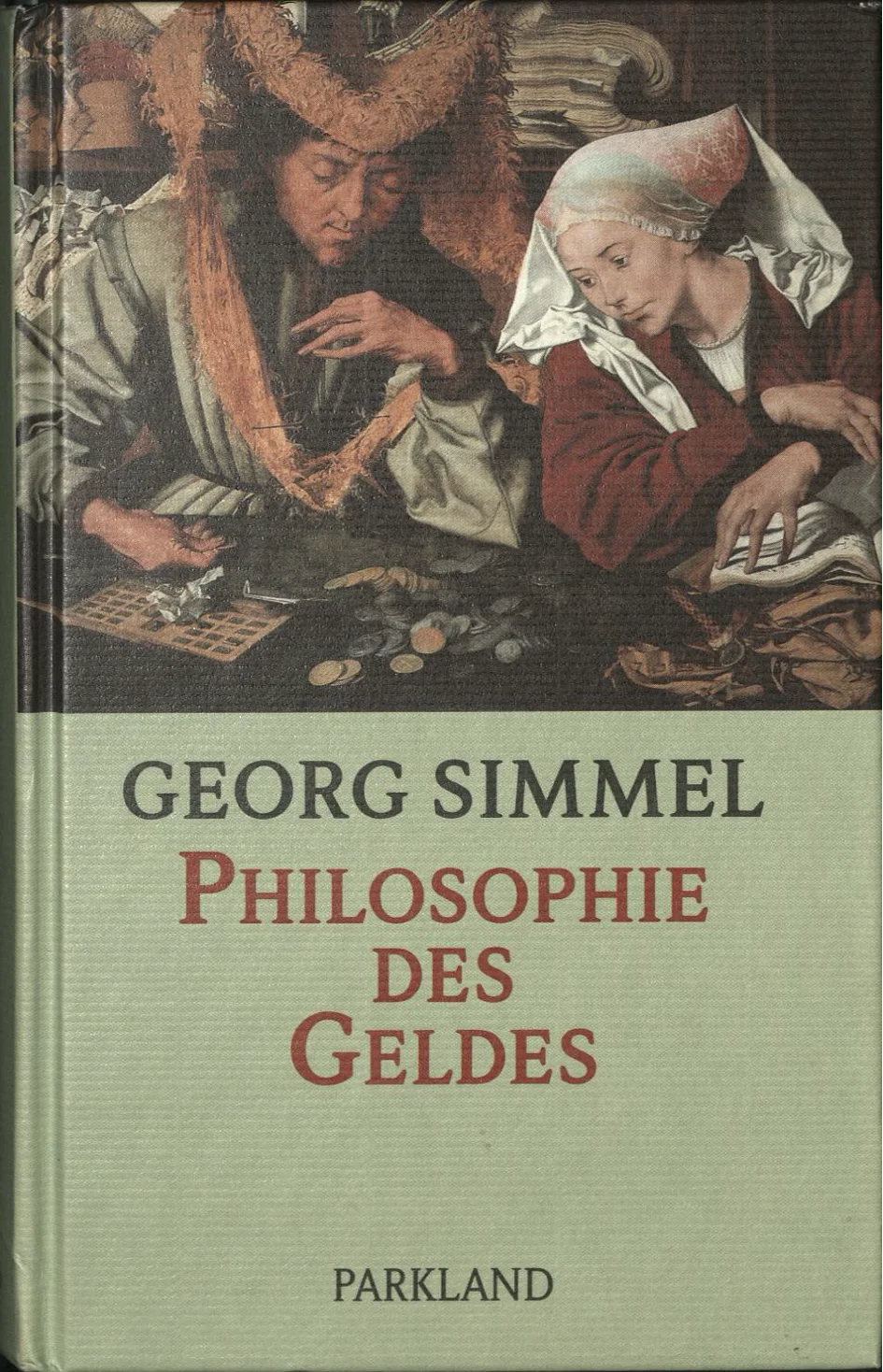
The year is 1900. Industrial progress is racing, cities are growing ever fuller, life is becoming faster. The banking business too experienced strong growth in the late 19th century, seeing numerous new foundations and consolidations. At the turn of the century the major banks -- Deutsche Bank, Commerzbank, and Dresdner Bank -- are located in Berlin and make the city the largest stock exchange centre in Germany. This big-city hustle and bustle is for the German philosopher and sociologist Georg Simmel (1858-1918) the epitome of modern society. As a sociologist he is interested in the interactions of social relationships. In particular he wishes to understand how these relationships are constituted in the era in which he lives. With The Philosophy of Money, an 800-page tome, he offers one possible answer. Money becomes the central symbol of the new century just beginning. For Simmel believes: if we wish to understand how the present functions, we must first understand how money functions.
Simmel's approach to the subject is new at the time. To be sure, many influential economic theoretical works were written in the 18th and 19th centuries, but as a rule from the viewpoint of political economy. Thinkers like Adam Smith, David Ricardo, or Thomas Malthus wrote about how prices come about, how markets are regulated, and how goods circulate in a system. Simmel, however, consciously adopts a philosophical standpoint. He wants to trace the nature of money, to know what quality characterises money at its core and how this quality affects the people who deal with it every day.
Artikeltext:
Money as a Social Medium
Three essential properties of money should be named here. First: money has no value in itself. Second: money is sociological. And third: money is in a certain sense neutral, without qualities. The first statement can be understood in more or less abstract terms. On one hand it means that monetary values are always only relational, that is, they are expressed through other values. For example, 100 US dollars today are worth 94 euros. One monetary value is determined by the other monetary value. It becomes more concrete when we go to the baker in the morning and buy bread. Whereas five years ago one still got the loaf of bread for around 3 euros, today one might already have to lay 4 euros on the counter. The 3 euros of five years ago are worth less today than they were then. Here the value is not determined from the relation to another value (for example another currency), but in relation to an object of exchange. We exchange our money for bread. Taking the thought further, as Simmel does, one can say: money is only worth something when it can be exchanged for something. If there is nothing to exchange, the money is also worth nothing. Consider Robinson Crusoe, who with his silver and gold coins rescued from the ship, unfortunately can do absolutely nothing on his island: 'In short, nature and experience taught me, upon close reflection, that all the good things of this world are of no more worth to us than in so far as we can make use of them. [...] I was, as I have noted earlier, in possession of a bag full of money, consisting of silver and gold to the approximate value of thirty-six pounds sterling. But, dear God! there it lay, the miserable, wretched, useless stuff; I had no kind of use for it, and often I thought to myself, how gladly I would have given a handful of it for a number of tobacco pipes or for a hand mill to grind my corn. Yes, the whole of it I would gladly have given for a little English beet root and carrot seed, or for a handful of peas and beans and a bottle full of ink.'
The second property of money, its sociological nature, derives in a certain sense from the first. If money is only worth something where it can be exchanged, one needs at least two people who can exchange something. With this act of exchange, money as a medium puts two people in a relationship with each other; multiply these relationships and you have an entire society.
Money: The 'Most Frightful Leveller'?
The third property of money in Simmel is the most interesting. He claims that in order for money to be used as a conversion medium for all other objects with the most varied qualities, it must itself have no qualities. Money has no smell, no taste, no history. It makes everything the same, levels all differences, and robs individual things of their specific character. That money itself must be without properties so that it can serve as a conversion medium seems plausible. A book collector and a lover of cuckoo clocks, for example, have completely different desires; what is valuable to one has no, or only very little, value to the other. Thanks to money they can nevertheless meaningfully convert their desires. The book collector can sell the cuckoo clock enthusiast an old clock he found in his attic, and with the money received can acquire a new book for his collection at an antiquarian bookshop. In this sense money means freedom. If there were no money, book collectors and clock collectors could only directly exchange objects with each other, and even then only if each has what the other desires. Money enables each party the freedom to pursue his personal interests and desires. It means an increase in individual freedom.
This gain in individual freedom through the spread of monetary systems is for Simmel a central achievement of modernity. At the same time he sees in the fact that money makes the most varied things comparable with each other also a negative development. He writes: 'Since money weighs all the diversity of things equally, expresses all qualitative differences between them through differences of how much, since money, with its colourlessness and indifference, sets itself up as the common denominator of all values, it becomes the most frightful leveller; it hollows out the core of things, their individuality, their specific value, their incomparability, beyond all rescue.'
Money thus stands not only for greater freedom but in Simmel's eyes also for a certain flattening of experienced reality, for an unwelcome homogenisation of things. But how tenable are his theses? The greatest criticism of The Philosophy of Money is that Simmel looks at only a tiny section of monetary history and deliberately excludes where money comes from, how it arises, and what forms it has already gone through in its long history. This brings him many problems, as a discussion of a few selected examples shows.
The Rationalisation of Everyday Life?
The ubiquity of money and the dominance of the monetary economy lead, according to Simmel, to a rationalisation of everyday life. The fact that the value of every thing can be expressed in money leads to things being conceived only as a quantity of a sum of money. This cold rationality of money even penetrates into the realm of love. A brief glance at monetary history -- for example at the early modern period -- shows first of all that money had long belonged to the daily lives of many societies. In the dramas of William Shakespeare, for example, monetary metaphors are omnipresent. People/coins are genuine or counterfeit; one wants to know first what metal someone is made of before marrying them; one marries because one is after the dowry; the market people sing of how much bread and fish cost. Even the theatre visit in Shakespeare's time was an entirely economic undertaking, for all involved. Theatregoers paid for the ferry across the Thames, the entry fee, and where applicable beer and snacks. Shakespeare himself was in his lifetime an extraordinarily successful businessman, who with his acting company held shares in the theatre in which they performed. His profit-sharing arrangement also led him to factor the tastes of the public into his choice of subject matter, so he did not ignore commercial considerations in his creative writing either. In short: already in the 16th century people thought about money all day long. That is certainly nothing new.
There are, however, also developments in modernity in which social relations are increasingly replaced by economic ones. Even though it does not come from Simmel himself, the changes in our health and care systems are a good example of this. The care of poor, old, and sick people was for centuries regulated by social structures in society. These people were cared for by family members, church, or other charitable organisations. Only at the end of the 19th century did this change with the introduction of statutory social, health, and pension insurance. Here private care was thus transferred into state hands. In the meantime we see in turn drastic changes in the area now also called care work. Because state systems are overburdened or dismantled, care work frequently falls once again on family members. Since these are often themselves working and have no capacity to do the care work themselves, external carers are hired. These often come from abroad and not infrequently leave behind family members there who then have no one left to care for them. Thus care chains, or also global care chains, arise. A German family might engage an Eastern European carer for the care of a mother with dementia, while the Eastern European in turn pays a still cheaper carer, for example from Asia or Africa, to look after her own mother. In the face of such an economic penetration of the social and such an interlinking of economic relations owing to global capitalism, Simmel's thesis of the cold rationality of money no longer seems so far-fetched after all.
The Monetary Economy as Key to Understanding the Present?
A further controversial point in Simmel's conceptual framework is his decision to regard money as the central symbol of modern society. For even if the banking system was growing strongly around 1900, it was by no means the only drastic social change at that time. There are also thinkers and artists who felt other developments to be at least equally formative, if not more so. The technological progress through the spread of railways, the new speed of locomotion, which also brought with it an acceleration of the whole of social life. Or the introduction of Greenwich Mean Time as the statutory standard time in Great Britain in 1880, which standardised and organised the rhythm of human life. Is the impression that Simmel has of modern metropolitan life in Berlin not rather a conglomerate of all these developments? Here, as elsewhere, a coherent argument is lacking to show that the monetary economy is more formative than the other named aspects of modern life. It was probably never Simmel's intention to write a watertight philosophical treatise, which is why no fault can be found with him here. It is a pity, however, because genuinely very exciting ideas often cannot be sufficiently followed.
Classic Cultural Pessimism
The mixed feeling that the lack of historical contextualisation in The Philosophy of Money leaves behind is in places further clouded by platitudes about general cultural decline. For example Simmel complains: 'The spoken and written language has over time become ever more incorrect and meaningless. Private and social conversations are less interesting and shallower than even 100 years ago.' Such statements are made in human history with great regularity, which is why we should approach them with a healthy portion of scepticism. If one agrees with them, it follows that there would be no internet, Johannes Gutenberg would best not have invented the printing press at all (information overload!!) and we would all be writing manuscripts by hand. However, not all of Simmel's progress-pessimistic theses can be dismissed quite so easily. His claim, for example, that up into the early 19th century dwellings were plainer and furnished with fewer objects, the objects themselves more durably made and of better quality. On one hand one immediately wants to qualify this. One thinks perhaps of the Baroque and Versailles, of which nothing was certainly plain and simple, and then again of the functional-minimalist housing concepts of the Bauhaus in the 1920s and 30s. In such a context, a claim stated so teleologically -- according to which everything in history always gets worse -- seems untenable. History often does not develop linearly (for better or worse) but in pendulum movements. On the other hand, for years an (unverified) figure has been circulating on the internet claiming that every German household possesses on average 10,000 things, compared with only 180 per household 100 years ago. Even if the figure is not verifiable in that form, let us be honest: whether it is 10,000 or only 5,000 objects per household in the end is irrelevant. Either would be an absurdly high increase. Every year nearly 60,000 tonnes of second-hand clothing, the result of the so-called 'fast fashion' industry, are burned in the Atacama desert in Chile. Sixty thousand tonnes. And there one has to concede to Simmel after all: we do today have far more stuff than 100 or 200 years ago.
This example shows something that applies to Simmel's entire work. Although it is often difficult to understand and many of his theses are not entirely tenable, an engagement with his ideas is still worthwhile today.
Money as an End in Itself?
One of the more convincing points that Simmel makes in his text concerns an interesting self-dynamic of money. On one hand money, as already set out, has no absolute but only a relative value. It is a means to an end -- for example I use my money to buy food or go to the cinema. At the same time, the fact that we always state the value of things in money means that this relationship becomes inverted: we desire things because they are either particularly expensive (greed) or particularly cheap (miserliness). Moreover, the relative value of money becomes in a certain sense an absolute one; money changes from a means to an end to an end in itself. People wish to possess large amounts of money, even though we originally started with the premise that money itself has no value, only the things one can buy with it.
It is also interesting that in recent years in the industrial nations of Western Europe and North America, the relationship of younger generations to money seems to be changing in this respect. More and more employees wish for more leisure time and are prepared to forgo salary for it. In Simmel's terms this would mean that money is seen, at least for certain population groups, once again more strongly as a means to an end. One buys time -- for family, friends, hobbies -- and pays for it with a portion of one's wage. Older generations in particular cannot always understand this preference, having themselves grown up with different values. One could also say they were socialised differently. For money is -- and here one can agree with Simmel -- always also a sociological phenomenon and an important mirror of our society.


