
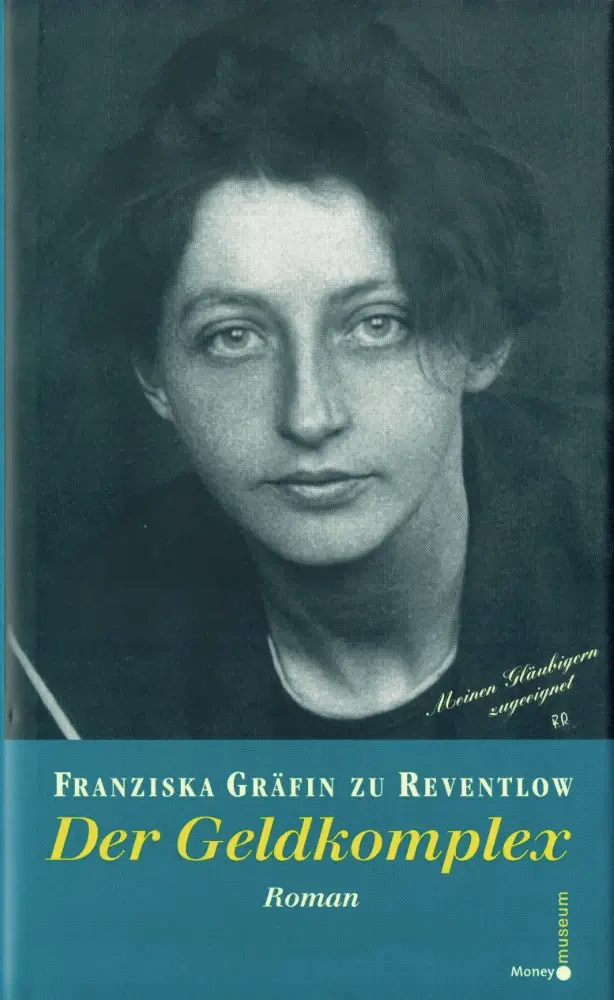


The Money Complex: When the Counting Never Ends
by
Teresa Teklić

The Money Complex: When the Counting Never Ends
A young noblewoman breaks away from her family to seek the freedom of an artist's life in the big city. Having escaped the shackles of her background, however, she soon finds herself subject to a new power: that of money. A story of dependence.
Artikeltext:
In 1871, a war ends in Europe, a Prussian king is crowned emperor, and at a castle near Husum a girl is born. While the newly founded German Reich searches for its place among the great powers, a true wild child grows up in its far north. Early on, the girl runs up against the narrow limits set by her noble birth. As a young woman, the world of her parents becomes finally too confining. She wants to leave the small town, leave behind conservative Prussianism and the restricted notions of how a woman ought to be. She seeks great freedom. Some years later she has made it. Her life is now in Munich, at the epicentre of the Schwabing Boheme. She paints and writes, mingles with artists and free spirits, celebrates raucous parties, and lives with unmarried men. Her first marriage she has already left behind by her mid-twenties. But she is already caught in another, grinding relationship, one she will never escape for the rest of her life: her relationship with money.
The Money Complex tells the story of a woman who is hiding from her creditors in a sanatorium and there longs for an inheritance that is to free her from her worries. At first glance the novel is an entertaining, ironic treatise on people's obsession with money and their inability to handle it properly. But read against the life story of its author, it sounds in a different key. Beneath the light chatter the seriousness of a life in poverty resonates. Behind the fiction lies the real story of Countess Fanny zu Reventlow, the girl from Husum. Who wanted to exchange money for freedom, only to discover that there is no freedom without money.
Rich People Enjoy Themselves in the Sanatorium
The Money Complex is as short as it is entertaining. In letters to her friend Maria, a nameless narrator reports on her summer in a Swiss sanatorium near the Italian border. She ostensibly stays there to have her 'money complex' treated, diagnosed by a well-known psychoanalyst. The cause of her miserable situation -- she is, once again, broke -- is her pathological relationship to money. She absolutely must transform her unconsciously-repressed approach to money into a conscious one, so as not to be visited by such bankruptcies again and again. In reality the narrator sets little store by Freudian psychoanalysis or by her diagnosis. But the flight to the sanatorium suits her for another reason: she wants to hide from the creditors who wear out their knuckles knocking at her door daily.
The narrator makes little effort to present herself in a favourable light. She is hard-bitten, irreverent, and a little vulgar. She has no intention of mending her ways, does not take her fellow patients' suffering in the sanatorium very seriously, and the institution's rules not at all. She is sharp-tongued and disobedient -- but also quite funny. To extricate herself from her predicament, she hopes for the death of an 'old gentleman,' her father-in-law, which holds out the prospect of a substantial inheritance. But the old man does not die and the inheritance does not come. Stephanie Bremerich, in her book Narrated Misery, draws attention to the parallel with Samuel Beckett's Waiting for Godot. Some wait for God, others for money, and both hope for deliverance. The waiting is, in a manner of speaking, the main plot. Otherwise not much happens.
While she waits, the narrator makes herself as comfortable in the sanatorium as possible. In the neighbouring village she encounters her acquaintance Henry, a financier who regularly gambles his money away in high-risk investments, and promptly recruits him as a new patient for the clinic, since he obviously suffers from a money complex too -- and because she finds the other patients too dull. Together the two make themselves at home in the clinic. They go to the village to drink, have summer flings with visiting actors, gossip, gripe, and play matchmaker among the fellow patients for all they are worth. One can get through it quite well like this.
Where Is the Moral?
'Since the last economic crisis I have become utterly characterless,' the narrator confides to her friend Maria. What makes her so characterless? Not that she has debts, but that she does not pay them, even when she has the opportunity. Not that she maintains a careless relationship to money, but that she makes no effort to improve. When at last the father-in-law dies and part of the inheritance reaches her as an advance payment, she leaves the sanatorium without settling her bill and drives to Monte Carlo to the casino. Elsewhere she freely admits: 'There is certainly no meanness I would not commit with pleasure, if it paid -- but there are too few opportunities.'
The image the narrator draws here is that of a selfish, hedonistic woman with questionable moral standards. The chatty tone reinforces the impression that the whole thing is great fun to her. The dedication placed before the novel seems downright impertinent: 'Dedicated to my creditors.' The story serves not as an apologetic gesture that morally exculpates the debtor by citing mental illness in the sense of diminished responsibility. Instead she freely admits that she simply has no desire to repay her debts.
To get to the bottom of the irritation of this dedication, two things are important. First, the ironic tone that repeatedly questions whether what is told is meant seriously. And second, the life story of the author. For she did not take questions of money lightly at all.

'Money, Money, and More Money' -- On the Seriousness of Poverty
The Money Complex is an autobiographically inspired novel whose events can easily be linked to real occurrences. The author Fanny Countess zu Reventlow met during a stay in Ascona, Switzerland, a baron whose immensely wealthy father wanted to disinherit him because he was not married according to his station. She entered into a formal marriage with the baron, on condition that after the death of the father-in-law she would receive half his inheritance. When the father-in-law got wind of the arrangement, he disinherited them both again -- though a not inconsiderable compulsory portion remained, which under existing inheritance law he was obliged to relinquish. But even that was lost when the Ticino bank administering the estate went bankrupt.
Here the parallels between the 'real' Fanny zu Reventlow and the nameless narrator end. The real Fanny lived in precarious circumstances from the time she left her parents' home as a young woman. She held all manner of jobs, working as a journalist, translator, actress, trade-fair hostess, and prostitute. At times she translated eight to ten hours a day, amounting over her lifetime to nearly fifty books from French into German. She raised her illegitimate son alone, without financial support from family or husband.
This knowledge lends the narrative voice in The Money Complex a new urgency. When she reports that 'new people keep turning up wanting money, money, money, and more money. The whole atmosphere becomes overheated, unnatural, buzzing with abnormal demands. There is simply nothing there, and yet one hears, sees, reads, and learns of nothing else but that everyone wants their money,' it suddenly sounds very weary. This is not someone who does not understand the significance of debts. Even the symptom of the supposed money complex -- that those afflicted are always doing sums -- suddenly ceases to be funny. Poor people must constantly calculate: can I pay the rent this month? How long will the money last? How do I feed my child?
That is precisely what Reventlow's contemporary Oscar Wilde meant when he wrote in an essay: 'There is only one class of people who think more about money than the rich, and that is the poor. The poor can think of nothing else. That is their misfortune.' Read without prior knowledge, The Money Complex might give the impression that the narrator is a luxury-obsessed lady who has run out of money only because she throws it out the window with both hands. Knowing the author's life, however, one understands: the narrator thinks about money all the time not because she is rich. She thinks about money all the time because she is poor.
In this context the dedication 'Dedicated to my creditors' points to a banal fact in the author's life: for Reventlow, writing meant earning money. The book was a source of income and with the dedication she was proving to her creditors that she meant business. She even sold her own life story by fictionalising it.
Can Poverty Be Therapied Away?
With this double reading one can also consider the discussion of psychoanalysis and mental illness. At first glance the narrator espouses a highly questionable view of mental illness. She claims: 'My feeling is that almost all psychoses could primarily be cured by money.' This sounds, at least to readers in the 21st century, supremely ignorant. Of course not all problems can be solved with money!
But reading Reventlow as the author again, The Money Complex actually exercises a critique of the psychologisation of socioeconomic grievances. The psychoanalyst who is to treat the narrator's 'money complex' begins with the then-typical Freudian explanatory attempt involving repressed sexuality. The woman, he surmises, has repressed her sexual desires and has therefore compensatorily developed an obsession with money. The explanation 'The woman is frigid and therefore poor' is of course inapplicable in the case of a person like Fanny zu Reventlow, who defied the prudish moral standards of the Biedermeier German Reich all her life, conducted polyamorous love relationships, and worked as a prostitute. On the contrary, she used her body as capital. That she might have had too little sex, her narrator also confirms, was truly not her problem.
Such explanatory attempts that psychologise or moralise economic conditions have not disappeared from public discourse to this day. The notion is familiar, for example, that poverty is the result of weakness of character, and that if people were not so lazy they could escape their financial distress. Current debates about the wealth and income differences between the baby boom generation and the so-called millennials also repeatedly attempt to present economic differences as the result of differing value orientations. Boomers still knew what hard work was, were thrifty, and worked for decades toward home ownership. Millennials, on the other hand, are spoiled, less performance-oriented, and consumption-addicted. Those who can afford designer clothes, cafe visits, and Netflix subscriptions should not be surprised if there is no money left for their own home.
Against this background, claims like 'My feeling is that almost all psychoses could primarily be cured by money' read not as a misapprehension of the reality of mental illness. They rather demand that economic grievances be remedied through economic measures, rather than by shifting the problem onto the individual.
Credit, Capital, and the 'Capacity for Illusion' of Money
The great question that remains at the novel's end is: can the narrator be cured of her 'money complex'? If the complex is not a genuine mental illness, it cannot be therapied away. If destitution can only be cured by more money and the inheritance promising deliverance does not come at the last moment, things look bleak here too. But the novel takes an unexpected turn in its final pages. The narrator escapes her predicament by a trick from financial theory: she transitions from debtor to creditor. At the beginning of the plot she is the one who owes money to a series of people. At the end of the plot she unexpectedly becomes a creditor herself, because the bankrupt Ticino bank now owes her the inheritance. Of course this changes nothing at first: she stands at the beginning as at the end with empty pockets. At the same time it changes everything: when the narrator and her investor friend Henry return to the sanatorium after the bank's collapse, they find that those around them regard them as unimaginably wealthy. Because the two react to the loss of money with apparent composure, people conclude they must be millionaires -- and extend them unlimited credit.
This seemingly absurd trick also works on a grand scale on the world's financial markets, as the financial crisis of 2008 most recently demonstrated. No one should ever extend credit to the narrator again, given her history of repaying loans. And yet she gets it. Just as in the 2000s the subprime loans on the US real estate market should not have received false top ratings from credit agencies. In both cases something was wrongly classified as creditworthy -- and with very real consequences. Here the novel shows that a mere idea of something can be exchanged for matter. The innkeeper in the village believes that the narrator is rich, and therefore gives her wine. The sanatorium director believes that the bank will eventually pay out the narrator's money and that she will then settle her bill -- and therefore extends her board and lodging right now.
Perhaps the narrator's most important insight is that money possesses what she calls a 'capacity for illusion.' For a long time she is only interested in money when she can spend it immediately. She does not want gold bars, because she would first have to exchange them for money and then for goods. Share gains do not tempt her either, for they lie in the future, are still 'in the air' today. Only when she grasps that she can already have fun with the help of her 'air money' does she reconsider her attitude. She therefore changes, ultimately, not her relationship to money in the psychoanalytic sense, but her conception of money in the financial-theoretical sense.
Fanny zu Reventlow's The Money Complex shows how rewarding an engagement with previously little-noticed books can be. Although it may initially seem a trivial gossip novel, on close reading the text proves to be an idea-rich, intelligent starting point for many reflections on money, society, and gender that extend into our present day.


