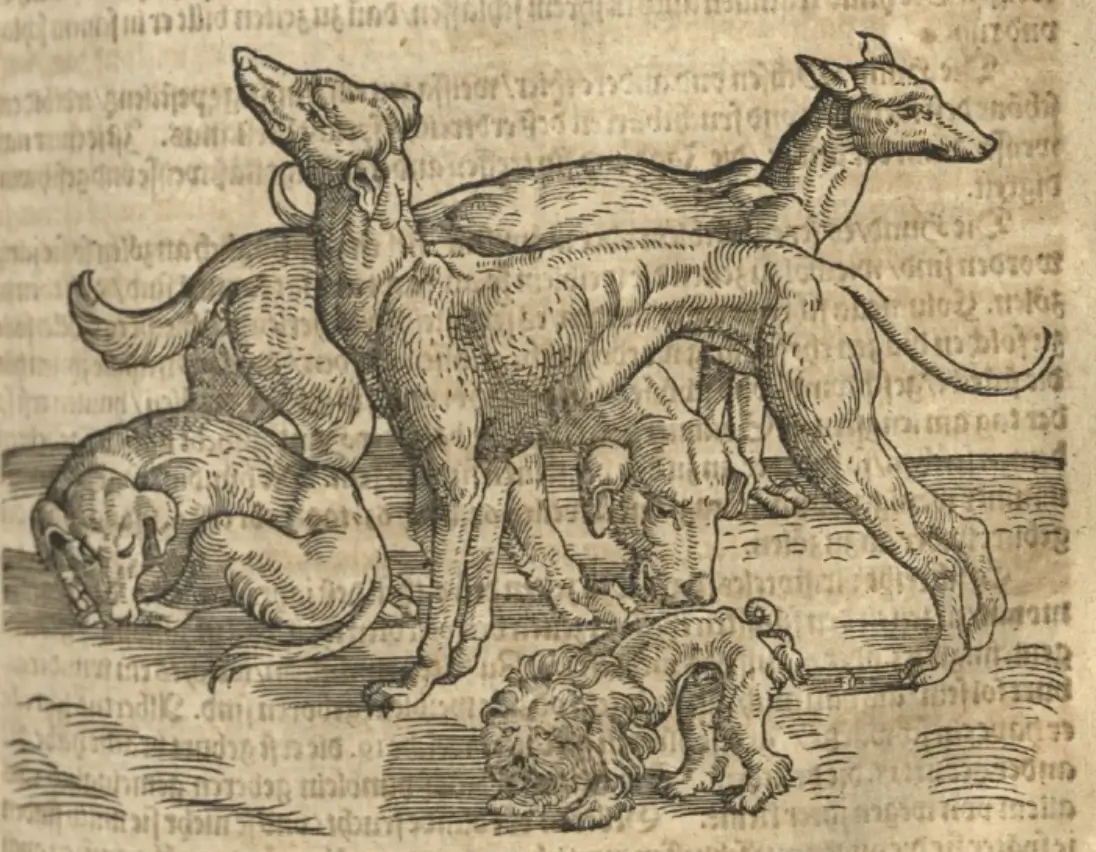
Whoever mentions the name Conrad Gessner mostly thinks of his Historia animalium, his history of the animal world, better known as the Book of Animals. No wonder! Few works can compete with Gessner's zoological encyclopaedia in terms of illustration. Most users confine themselves to admiring these beautiful woodcuts and forgo reading Gessner's texts. Yet it is precisely these that are so interesting. For they stand between the Middle Ages and the Enlightenment, partly adopting medieval fables uncritically, while dispensing with all religious embellishment. In Gessner the animal is no longer a sign of God, but a supplier of meat and an ingredient of medicines.
The MoneyMuseum is proud to own a copy of the German translation of Gessner's Book of Animals from the year 1606. It is a kind of licensed edition, for which the Heidelberg university bookseller Andreas Cambier joined forces with the successors of Christoph Froschauer. The Zurich publisher supplied the woodcuts of the Latin first edition for a fee, with the help of which the Heidelberg publisher produced an abridged German version.

Animals: Good Business
Why did Christoph Froschauer pay Conrad Gessner in the mid-16th century to describe all the animals in the world in several volumes? Why did he employ a whole workshop of artists to produce expensive woodcuts for these texts? Quite simply: for economic reasons. Animals were exciting at that time and promised good business. The educated world wanted to know more about the exotic fauna. After all, in the 16th century there was for the first time since Roman times a real chance to experience rare animals live.
Let us look back: since antiquity the menagerie had been part of the self-presentation of rulers. The Roman emperors made a point of having the most exotic animals possible killed in the Circus. In doing so they demonstrated how far the Roman Empire must extend, since it was capable of bringing together animals from such distant places. This idea had its effects on the Middle Ages. Anyone of standing had a small menagerie or at least a bear pit. While great, internationally connected monarchs like Charlemagne occasionally received an elephant as a gift, local rulers had to make do with deer, wild boar, and at most an eagle. In other words: the better stocked a menagerie, the better for the prestige of its owner.
Now entirely new possibilities had presented themselves since the beginning of the 16th century. The Portuguese king Manuel I, for example, received from his 'discoverers' among other things an elephant and a rhinoceros, which he promptly sent on to Rome to win the support of the Pope. In 1580 the people of Augsburg craned their necks because a small herd of ostriches was resting in their city, being driven from Venice to Dresden because the Elector of Saxony had bought them. Whoever lived near Lake Constance perhaps managed to get an invitation to the menagerie of the Bishop of Constance, where peacocks and lions and even a camel were to be seen.
Through occasional contact with exotic animals, the interest of the educated world in them was sustainably heightened. And this need was satisfied by the resourceful entrepreneur Christoph Froschauer. He paid the Zurich polymath Conrad Gessner to write a comprehensive book about animals. Gessner was predestined for this. Before his return to Zurich he had led an unsettled life and maintained contact with dozens of scholars throughout Europe. He enlisted them all in his project, wrote thousands of letters, received hundreds of pictures and excerpts, and thus compiled what the educated world of Europe in the mid-16th century knew about its fauna. The illustrations were copied onto woodcuts in the in-house art workshop. And so in the years between 1551 and 1558 there appeared the most opulent encyclopaedia of all animals in four or five volumes that the world had seen until then. Gessner's work is divided into viviparous four-footed land animals, oviparous land animals (that is, amphibians and reptiles), birds, and finally fish and aquatic animals. After his death a further volume on snakes and scorpions appeared in 1587.
Gessner's book became what we today would call a benchmark. For centuries every author had to measure himself against Gessner in terms of completeness and illustration.

The Animal in the Middle Ages
But to understand in what way the Book of Animals was revolutionary, we must compare it with its most important predecessor in the Middle Ages. This is known under the designation Physiologus and was created sometime in the 2nd century AD in Alexandria. More important than the original text became the commentary of a theologian -- perhaps the Church Father Basil -- in the 4th century AD. For it interpreted each one of the 48 creatures treated -- the Physiologus was not limited to animals but also wrote about some plants and stones -- in the context of salvation history. For this reason the emphasis of the Physiologus lay not on biological information, but on the role of the animal in God's plan.
The elephant, for example, was regarded as a counterpart to Adam and Eve. It was believed that this species had no natural urge to mate. When it was necessary to produce offspring, the animals hid deep in the mandrake bushes. The serpent -- we recall the expulsion from Paradise -- was regarded as the natural enemy of the elephant, which mercilessly trampled it wherever it encountered it. That is why we still find so many elephants on the walls and portals of Romanesque churches today. They served as guardians keeping evil at bay.

Gessner's Elephant
The artist who created the woodcut for Gessner's elephant must have seen many guardian elephants. Folded ears, curling trunk, and stumpy legs are strongly reminiscent of the medieval model at Basel Minster.
Gessner too had to rely on literature. And so he adopts the claim that the elephant is particularly chaste and modest. Everything Gessner set down came from literature. He collected anecdotes and stories, paid little attention to what we today would call verification, and so created an entertaining text. This has nothing to do with modern zoology.

The Hedgehog -- in the Physiologus
With the elephant one can understand that Gessner was dependent on others' observations. But what about animals that the author could have observed, had he only left his scholarly study?
Let us take the hedgehog as an example. Whoever consults the Physiologus will probably be greatly amused by the image of how the hedgehog obtains its food: 'He goes to a vine and climbs onto a bunch of grapes and tears off the berries and throws them to the ground. Then he throws himself down from above and the berries stick to his spines, and he brings them to his children and leaves the grapes empty on the vine.' The Church Father of course interprets this in the Christian sense: 'And you now, O man, turn to the right and true vine, which is Christ ... and consider how you could have allowed the evil spirit to climb into your heart. ... Like a bunch of grapes you left your soul empty behind you.'
We can only shake our heads. After all, every garden owner today knows that the hedgehog is his best ally when it comes to destroying slugs and insects. Hedgehogs cannot digest plant material at all. If a hedgehog holds an apple between its paws, it is only to see if it can discover a tasty maggot inside.

The Hedgehog -- in Gessner
Gessner certainly had a garden. He did not use it to observe the hedgehog. He still belongs to the scholars who value written sources more highly than observation. Francis Bacon, first representative of empiricism, had not yet even been born when Gessner published his fourth volume of the Historia animalium. Gessner therefore naturally cites the Physiologus and describes how the hedgehog sets out to impale grapes and apples on its spines and drag them into its burrow.
If one wants to find a difference from the Physiologus, it lies in the fact that Gessner dispenses with all aspects of salvation history. Instead he carefully lists what use a person has from the hedgehog (one can use its spiny skin as a clothes brush or fashion an effective weapon against wild dogs from it). Gessner explains how best to cook its meat and which parts of the hedgehog's body can serve as medicine. In general the utility of an animal stands at the centre in Gessner. Thus he writes not one chapter on the common domestic cattle but three: 1.) ox and cow, 2.) bull, 3.) calf.
To summarise, one might say that each of Gessner's texts is exactly as good or as bad as the sources he uses for it.

The Unicorn
This applies of course also to the fabulous creatures whose existence Gessner does not doubt. Of the unicorn he merely establishes that none had yet been seen in Europe, which is why he must rely on literature. And he does so. He quotes Pliny, Aelian, Philostratus, Aristotle, and others. On its flesh he has no statement to make, but assumes it is not edible. He does, however, point to the high value of the horn. He has doubts when he cites Albertus Magnus, who claims that a virgin can catch the unicorn. But to doubt the fundamental existence of the unicorn? How could he? In every respectable Wunderkammer lay the horn of a unicorn.


The Little Horn of the Rhinoceros
How the illustration of the Historia animalium came about is wonderfully exemplified by the picture of the rhinoceros. We recall: in 1515 Manuel I received a rhinoceros. Before presenting it to the Pope, he displayed it in his own menagerie. On this occasion a sketch was made that, together with two detailed descriptions, came into Albrecht Durer's hands. The successful entrepreneur in the copperplate engraving business scented good business. After all, everyone was talking about this animal. Even the French king had travelled to Marseilles to see it. For all those who had no opportunity to do so, Durer produced cheap single-sheet prints and distributed them at all the markets. A profitable business.
Unfortunately the artist himself never had the chance to see the rhinoceros. As a result he made decisive errors in his depiction. His rhinoceros resembles a four-legged knight in plate armour and chain mail. Durer misinterpreted the folds of the animal indicated in the sketch as a kind of seam. The skin as a whole is more reminiscent of a tortoise shell, as could be seen in every respectable Wunderkammer. Particularly famous: that curious little twisted horn at the top of the animal's shoulder, which has entered zoology as the 'Durer hornlet.' Here the artist had probably misinterpreted a painted flourish.
Froschauer's art workshop certainly used Durer's woodcut as a model for the Book of Animals. The depiction is an exact copy.
The Fauna in 4,500 Pages
Elephant, hedgehog, unicorn, and rhinoceros are just a few examples from the wealth of magnificent animal illustrations that have made the book so famous. Gessner's Book of Animals was the most comprehensive that scholars had seen until then. It enabled them for the first time to think about a kind of systematics. That is why Gessner is regarded as the father of zoology. He became a foundation from which one could work further. And his successors did exactly that. One of them, Georges-Louis Leclerc, Comte de Buffon, we will present in a later issue of Bookophile.