


The Educational Discourse of the 16th Century: Who Needs Cicero?
by
Ursula Kampmann

Clearly the times were out of joint! Every year Baron Sigismund von Hohenlandsberg earned less. Revenues and fees were declining while the costs of a lifestyle befitting his station were growing. And his own position of power as a feudal lord was being restricted ever more frequently. The powerful dukes and counts, the bishops and abbots were ensuring that all lucrative business was being concentrated at their courts. In earlier times one could at least have sent one's sons to war to skim off a healthy profit plundering the merchants. But that was over. The great lords needed fewer and fewer knights. They preferred mercenaries. Soldiers for hire were cheaper, more quickly available, followed orders (at least most of the time), and had mastered the new style of warfare -- as they said in those days -- from the pike up. Knights? Nobody needed them anymore. They were a dying breed in the second half of the 15th century.

Artikeltext:
Johann the Strong of Schwarzenberg and Hohenlandsberg
Such was the world into which Johann von Schwarzenberg und Hohenlandsberg was born, the son of a knight. His father had him raised in all that was then required of a knight. Little Johann thus learned how to ride, how to hold a lance, how to comport himself in noble society, and how to win the goodwill of a noble lady. The boy was a quick learner. He competed in his first tournament at only fourteen! Many more would follow. Johann was among the best in this noble sport. No wonder: he was over six feet tall and as strong as a bear. It was said of him that he broke horseshoes with his bare fists and tore ropes that could have held a cow. This earned the young man the nickname 'the Strong,' which he carried with pride to the end of his life.
Such a life was naturally not without danger. The portrait that Albrecht Durer would paint many years later records that Johann the Strong received at least one life-threatening blow: a deep scar runs across the right cheek. We may be certain that this was not the only injury Johann the Strong sustained in the course of his life.
But despite the constant risk to life and limb, one no longer grew rich as a knight at the end of the 15th century. And yet Johann was in the service of the Emperor. The trouble was that Maximilian was notorious for his perpetually empty purse. The lion's share went not to the commanders but to merchants like the Fuggers and Welsers in Augsburg. Johann von Hohenlandsberg was far too clever not to see which way the wind was blowing. And so he decided to change profession and employer.
He left imperial service and sought a position with the substantially more powerful magnates of the Empire. They needed experienced men -- not for war, but for their administration. That promised a secure income. Johann therefore travelled in 1493 with Frederick the Wise, Duke of Saxony, to the Holy Land; he served the Bavarian Duke, the Bishop of Wurzburg, and finally hit the jackpot when the Bishop of Bamberg appointed him as his court steward in 1499. The Archbishopric of Bamberg was among the most powerful territories in the Empire, and the court steward stood at the head of its secular administration. For a man like Johann von Hohenlandsberg, who had probably barely learned to write, this was an incredible responsibility.
He discharged it with brilliance, and this despite having neither studied at a university nor learned Latin. Johann must have possessed the rare quality of choosing his assistants skillfully and winning their loyalty. For this man accomplished what other jurists failed to do. Under his leadership a new, innovative criminal code for the Archbishopric of Bamberg was created. It harmonised Roman with canon and local customary law so successfully that his law book met with broad approval.
The Bamberg Criminal Code became a milestone in legal history. His contemporaries celebrated its creator as the leading jurist of the Empire. Emperor Charles V appointed him to the Imperial Council. In this capacity Johann participated in the Diet of Worms of 1521 and was decisively involved in the first drafts for the Constitutio Criminalis Carolina -- that criminal code which, under the name of the Penal and Neck Courts Ordinance of Emperor Charles V, became in 1532 the first generally valid German criminal law.
Why Cicero of all people?
Only one year before the Diet of Worms, in 1520, Johann had entrusted an Augsburg printer with his colourfully illustrated manuscript: it contained not a legal text but a rendering of De Officiis from Latin into German. This philosophical treatise on the duties of a 'well and rightly living' man had been written by the Roman senator Marcus Tullius Cicero. And at this point it makes sense to ask why a knight who had risen in the service of princes found it necessary to acquaint his peers with the work of a long-dead Roman. To understand this, we must first grasp what role the author and the book played in contemporary discourse at the time of Johann von Hohenlandsberg.

Cicero was celebrated by the humanists of the 15th century as the great representative of republican Rome. They saw in him a role model. After all, he had resisted the tyranny of a Caesar and a Mark Antony with integrity and eloquence. That the historical figure of Cicero is morally quite questionable was of course not yet known at the time. The humanists praised him as a martyr of aristocracy -- of the rule of the best. And that only the best deserved to govern a state was regarded as beyond dispute within the academic elite. They considered themselves the best, and therefore predestined to guide and direct princes with their wise counsel.
Whether in the privy council or at the dining table, the academic gentlemen constantly quoted Cicero. De Officiis was particularly popular. Cicero had written it when, after the Philippics -- those orations of hatred against Mark Antony -- he retired to his country estate. There he sat in his comfortable exile and wrote a book about what could be good and useful for a man of honour. De Officiis subsumed the Stoic doctrine of virtue that through the Church Fathers became a substantial part of Christian moral teaching.
The content? Well, I do not wish to burden you here with Cicero's prolix philosophy. His thoughts revolve around the question of what is honourable, what is useful, and whether a conflict between the honourable and the useful can exist. (In his view, no: what is honourable is at the same time useful.) He formulates the four cardinal virtues on which honour rests: wisdom, justice, courage, and moderation. Whoever acts wisely, justly, courageously, and moderately cannot help but do what is honourable and at the same time useful. Through examples from Roman history Cicero illustrates the practical application. What is decisive for him is that the benefit to the community -- to the state -- always takes precedence over the benefit of the individual. Hedonism -- retreat into one's own needs apart from the external world -- he vehemently rejects. Not the peaceful hermit but the energetic politician is, according to Cicero, good and useful for the world.
All of this may not sound particularly original to your ears. In fact one can very well debate the merits and demerits of Cicero's theses. It was by no means self-evident that he of all people remained so present for centuries. Why this happened? Well, it was connected with the training of the academic next generation. All had to engage with rhetoric, and for this they read the standard work by Quintilian. It served as the basis for teaching and staged Cicero exemplarily as the model orator who -- according to Quintilian -- possessed both: eloquentia (eloquence) and sapientia (wisdom). It was Quintilian who made Cicero a classic, whom the Church Father Augustine cited just as the saintly Thomas Aquinas did.
This had the consequence that Cicero's works were read and copied throughout the entire Middle Ages. Again and again. Thus the humanists, searching for ancient authors in monastery libraries, found Cicero's writings everywhere. Those who read them delighted in his elegant Latin. Scholars in love with language, like Petrarch or Erasmus of Rotterdam, were full of praise. And so Cicero became the favourite author of humanism. They cited the ideas laid down in De Officiis again and again.

Cicero's Significance as the Basis of a New Morality
While the education of a knight focused on the body and its performance, the universities debated what Cicero's theses meant for effective administration. Put yourself in the role of a territorial prince striving to centralise his territory. Whom would you prefer to have by your side: a dim-witted brawler who rolls his eyes when the moral limits of the exercise of power come up for discussion? Or an eloquent jurist who explains to you precisely under what circumstances it is morally defensible to impose even higher taxes on the peasants, and how you are to justify before the Imperial Court stripping a local clergyman of his privileges?
Cicero and his message that reasons of state justify the means under numerous circumstances was most opportune. Johann von Hohenlandsberg must have heard the academic gentlemen argue often enough before he decided that De Officiis would help his peers understand the new moral guidelines.
The trouble was that Cicero had written in Latin! In those days only theologians and humanists mastered that language. How was Johann von Hohenlandsberg to convey the complex contents of De Officiis to his peers? And even if he had provided a first-class translation into German, that alone would have been far from sufficient. Read the text yourself: even if you understand every word, its meaning will not immediately reveal itself.
Literal or Paraphrased: How Does One Convey a Classic?
Johann von Hohenlandsberg thus faced the problem of conveying a complicated content to an educationally disadvantaged group -- as the 'ordinary' imperial knights simply were -- in such a way that they would not only understand the text but also be able to apply it. And at this point we grasp the genius of Johann, who had himself learned no Latin and enjoyed no higher education.
He commissioned his chaplain Johann Neuber to translate the text from Latin into German -- as freely and paraphrastically as possible. Then Johann took the text himself, altered sentence constructions, added a word here, left one out there. And when Cicero seemed to him altogether too abstruse, he struck out a sentence, even a whole passage. After completing this phase he brought in a humanist to ensure that nothing had been lost in terms of content.
The humanist was named Lorenz Behaim. He served as notary in Bamberg, where Johann von Hohenlandsberg knew him personally. Behaim was an authority in the classical sciences. He had studied in Ingolstadt and Leipzig, held master's and doctoral degrees, and meticulously copied all the Roman inscriptions he could lay his hands on. No wonder that the lack of classical learning evident in the translation of Cicero before him appalled him. But Johann von Hohenlandsberg succeeded in winning Behaim over to his target audience. And so the humanist revised the text according to the directives of his knightly patron. In 1520 Behaim had completed his work. The result was a compromise -- a text translated freely enough to be readable for people without classical education, yet close enough to the original to satisfy a classically educated person.
But the text is not the most important thing about the book. It remained the backdrop against which Johann formulated his learning objectives. For this he employed an entirely new form of communication that enabled even the illiterate to understand the philosopher and apply him in everyday life. Johann von Hohenlandsberg illustrated his learning objectives with meaningful pictures and provided them with rhyming, easy-to-remember maxims.
The New Image of Money
Let us look at a concrete example. How did Johann von Hohenlandsberg proceed to convey to his peers a contemporary approach to money?
Let us recall: the new ways of doing business were one of the great themes of the 15th century. The princes needed ever more money to finance their mercenary armies and their new administration. This was a problem, because the traditional relationship between overlord and vassal made no provision for regular taxation.
Far worse was the Church's rejection of filthy lucre. For centuries knights had demonstrated their piety by despising money and spending and giving it away just as quickly as they received it. In the Middle Ages, the person who wasted the most money was the most esteemed. But those times were over. Everyone knew what a mercenary army and the accompanying artillery cost. Therefore it was now the person who, thanks to the money accumulated in their treasure chambers, could pay such high costs who gained in prestige. This was a paradigm shift that had not yet dawned on most knights. It was this that Johann von Hohenlandsberg wanted to hammer into his readers.

And so the first illustration on the subject of money shows not -- as was previously inevitable -- an alms-giving Christian, but a carefully calculating householder leafing through his account book. To his left we see the lines on which, before the introduction of Arabic numerals, sums were added and subtracted. Heavy bales of goods and provisions lean against the wall. To the right, men are loading a cart to transport the goods to where they can be sold at a profit. That careful housekeeping is not to be confused with pernicious greed is taught by the maxim above the picture: how a person turns toward the good and is not seduced by wicked profit-seeking -- that one learns here.

The centuries-old fear of being fetched by the devil for one's own greed was deeply rooted. Johann von Hohenlandsberg knew this and addresses it in his Cicero. Another illustration shows us the devil in person, turning to a nobleman and showing him a treasure. Will Satan cart this poor rich man off to hell?
Look at the chain. It winds around the man's feet, but the devil only holds it in his hand. He has not (yet?) bound the rich man to himself.
And indeed the nobleman raises his right hand in a gesture of rejection. He grasps his head with his left, as if asking: where does sensible thrift end and greed begin?
Johann von Hohenlandsberg helps the questioner with a maxim: Do not hold money too fast, nor let it go. The generous man seeks the right mean. He neither saves nor squanders too much -- he gives generously where reason demands.

But what did this look like in practical life? As a knight one had obligations! One could not afford to absent oneself from important tournaments and entertain guests meagrely.
To illustrate the right relationship to money, Johann von Hohenlandsberg shows a householder in his high armchair. He raises his right hand in a gesture of caution. Before him stand three persons: a young, fashionably dressed man, a richly attired housewife, and a young girl with loose hair. What do they want from the householder? Money for pleasures, for tournaments, festivities, hunting, fine clothing, expensive weapons, and horses. In the background we see what they will spend the savings on. Johann's readers would have nodded with understanding as they looked at the pictures. They knew the situation of their money not sufficing to satisfy all desires.
At the same time, a Johann von Hohenlandsberg naturally knows that no knight can forgo all status symbols. Therefore his maxim reads: Whoever shamefully wastes property and goods praises the folly that hates wisdom. But generosity requires that one spend money on amusement. This should however be done in moderation, as suggested here.
In other words: yes, one must spend money, if only to demonstrate one's status, but this should remain within a sensible framework, because otherwise one very quickly -- as illustrated on the left -- ends up as a beggar.

Of course the householder wishes to fulfil all the desires of his beloved family! And not only theirs. The vicar wants alms, the tenants want tax remission, the overlord wants gifts. At some point even the greatest means are exhausted. One cannot give endlessly to everyone. One must keep one's own well-being in view. And that is precisely what this picture formulates. It describes a message that today we call mindfulness -- the perception of one's own needs. Johann von Hohenlandsberg formulates it as follows: The wise man shall take appropriate care of his (own) health just as of his money and his goods.
This message is illustrated on the left by a man being bled, and on the right by a picture we already know: the householder sits with his account book at the table, calculating what he has earned and spent.

But how were the poor treated in Johann's time? This is shown to us by this picture. The accompanying verse reads: I beseech you, Lord, let yourself show mercy and support me, imprisoned and poor; for gift and help I beg you greatly, so that I may fare better again. The most help is due where need and virtue are felt.
In fact the wealthy donor at the centre has a choice of whom to give a charitable offering. On the right stands humbly a simply but cleanly dressed man with his family. He is devout -- one can see this from the rosary -- and bows deeply with gratitude as he receives money.
Unheeded is the nobleman on the left. He appeals to the donor's sense of rank, proudly presenting his long letter of nobility with the imperial seal. Although expensively dressed -- he wears a gold cap and his sleeves are slashed, the latest fashion of the day -- he wants even more money, probably not to buy bread but to squander it.
To say no to such people -- that is what Johann von Hohenlandsberg advises his readers.

How should the financial relationship between rulers and subjects be constituted? For this too Johann von Hohenlandsberg has an appropriate picture and an appropriate maxim at hand: Such a guardian does evil / who steals from his ward's goods. / No less do you, ruler, stumble / when you abuse the common good.
The picture repeats once more the careful householder with account book and calculation lines. He gives to a man who humbly begs for support, yet is nonetheless richly dressed. Again we see the fashionable gold cap and a fur-lined beret that he holds in his hand. Beside him stands his ward, full of expectation. He is helpless before the guardian and can only hope that the guardian will use the money entrusted to him to feed, clothe, and educate him.

Let us look finally at a political message that Johann von Hohenlandsberg must have given often enough at council meetings: in the face of existential threats, not to be timid and take half-hearted measures, but to throw everything into the balance to overcome the danger. Or as the maxim reads: By this parable note herewith, / when war and combat are to be risked, / do nothing too timidly, nor too freely, / the benefit to all spoils no broth.
This maxim is illustrated by a stranded ship, from which the merchants are throwing all their goods overboard to lighten it and thus get it afloat again.
A Few More Words on Publication History
When Johann von Hohenlandsberg sent his manuscript to press in 1520, he did so -- according to a very plausible hypothesis -- at one of the most reputable printing houses in Augsburg. There, at the time, was situated the south German centre of book printing. There Sigmund Grimm had his workshop, financed by Marx Wirsung.
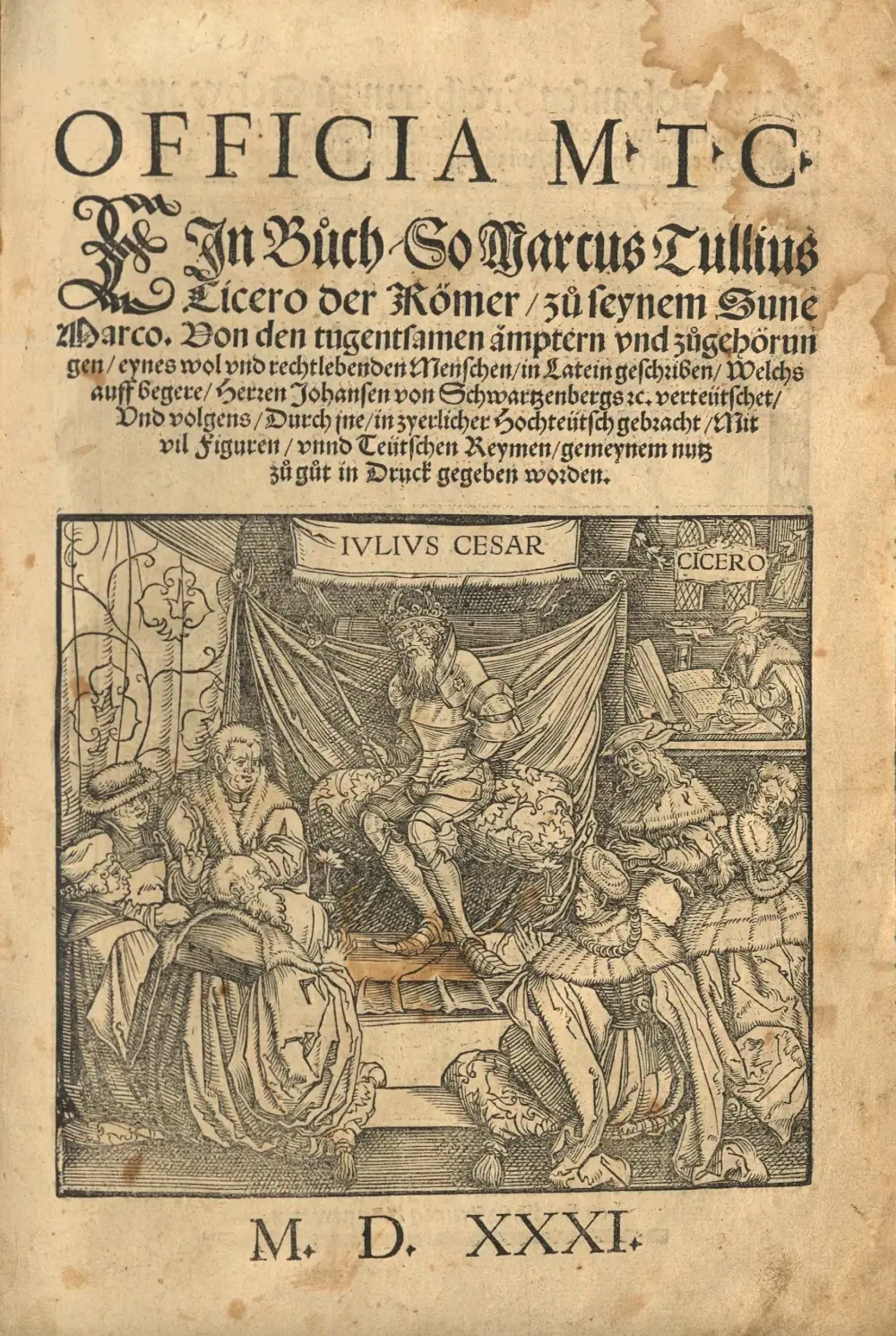
But this time Johann von Hohenlandsberg had miscalculated. At the end of 1521, Wirsung died. His heirs withdrew their capital. Grimm ran into financial difficulties and could no longer complete even projects already begun. In 1525 he published his last book. In October 1527 he was declared bankrupt. Heinrich Steiner purchased from the bankruptcy estate, among other things, woodcuts already made. He probably also took over the manuscript of Johann von Hohenlandsberg. But Johann died in October 1528. He therefore did not live to see the overwhelming success of his work. The MoneyMuseum succeeded in acquiring the rare first edition of January 1531. That same year it had to be reprinted twice; further editions appeared in 1532, 1533, 1535, and 1537, two printings in 1540, and another in 1545. That makes a total of 10 known editions!
We should not be surprised. The Cicero translation of Johann von Hohenlandsberg fulfilled a need of the time. Even the non-humanists wanted to know what values this Cicero stood for -- Cicero, whom all the learned gentlemen had constantly on their lips! For us the book affords a unique insight into an era in which much was in flux and a new relationship to money was spreading through all levels of society.


