
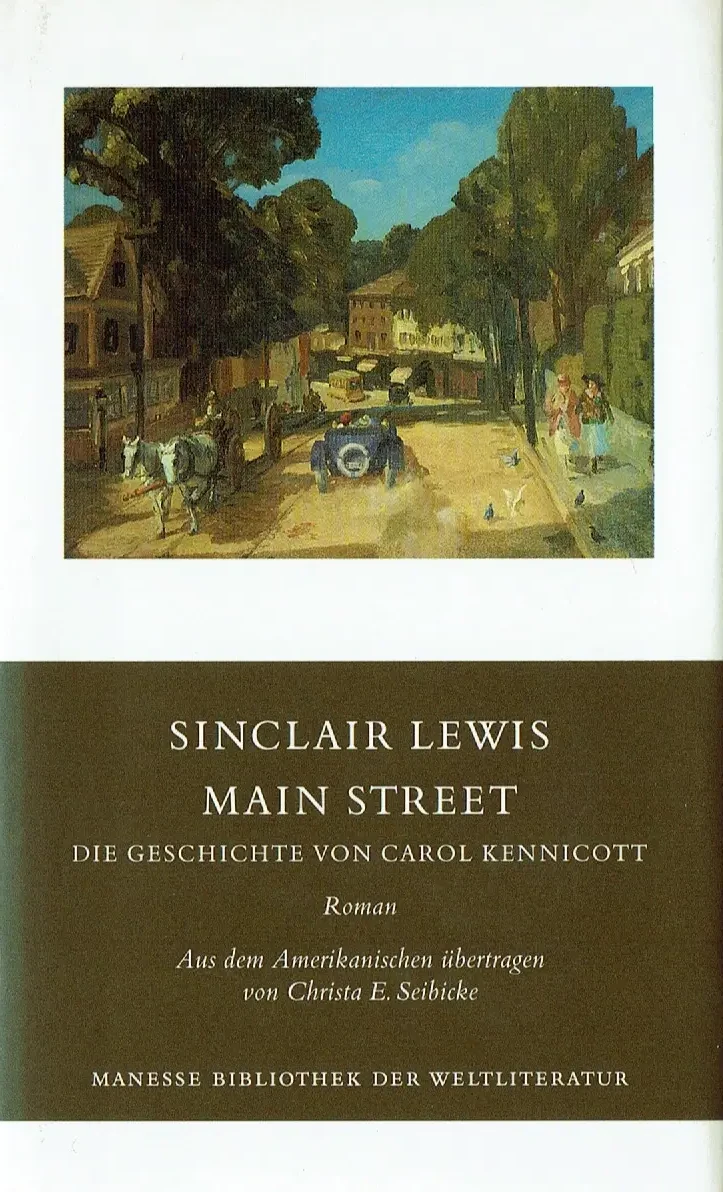


The Divided America: Main Street by Sinclair Lewis
by
Ursula Kampmann

The Divided America: Main Street by Sinclair Lewis
We believe today that the intellectual division of the United States is new. But when Sinclair Lewis wrote his novel about an ambitious young woman in a small town in the 1920s, this division already existed. Down-to-earth, traditional, deeply conservative: the small town; progressive, tolerant, detached from reality: the big city. The heroine of the story had already observed at the time that small town and big city are not geographical terms but states of mind.
Artikeltext:
It is a clash of cultures when the young Carol enters the small town of Gopher Prairie, Minnesota, as the wife of country doctor Will Kennicott. Gopher Prairie? You can consult the most detailed map of the United States and you will not find it! GP -- as its fictional inhabitants fondly call it -- stands for all the Gopher Prairies of the United States; its citizens for the quintessential American small-town dweller, that is, for all those for whom it is enough to go to work every day, pile dollar on dollar, and gossip about the failings of their dear neighbours.
And it is precisely into this narrow-minded nest that the young Carol moves with all her ambitions and dreams, with her aspiration to make the world a little more beautiful, better, fairer, and more worth living in. No wonder she quickly hits the limits of tolerance as an impractical idealist. Her ambitions are interpreted as arrogance, as criticism of small-town life. People laugh at her, undermine her efforts, and let her fail. Carol Kennicott must come to terms with the fact that she cannot change the small town. But does she even have to?
For the citizens of the small town too have their virtues. Take only Carol's husband, the country doctor Will Kennicott. Carol accompanies him only once on one of his many drives across the countryside to save lives. There an amputation is performed on a kitchen table; a child is brought into the world despite all adversity. A blizzard prevents the journey home, and Carol is astonished at how deftly, boldly, and confidently her husband masters the difficulties of life. She has to admit to herself that she, the great world-improver, is not even capable of providing him with the smallest assistance.
Carol and Will: they both stand for different types of human being. Carol is the eternally searching idealist who strives for reflection, stimulation, and improvement. Will is the contented and grounded realist who saves money for old age and incidentally helps his fellow citizens to better their harsh lives.
Breaking Out of the American Small Town
When Sinclair Lewis wrote his decidedly satirical novel, the entire American world was in a state of departure. The economy was booming, there was full employment in the cities, the stock market was at a peak. Main Street was created in the Roaring Twenties, before the speculative bubble brought the merry goings-on to an end on Black Thursday.
Part of this upswing was an unprecedented flight from the land that drove many young, ambitious people from the small town to the big city. They all wanted to escape the narrowness of their home towns and lead an exciting life in Washington, New York, or San Francisco. This exciting life quickly turned out to be hard work in an office or factory -- with the cultural stimulation that a big city offered, but without the close-knit neighbourly network that had held one so securely and firmly in the small town.
Sinclair Lewis had himself gone this path. He was born in 1885 in the small town of Sauk Centre, Minnesota. He made his first attempt at escape at the age of 13, when he enlisted as a drummer in the Spanish-American War. In 1902 he left the small town behind for good. After studying at Yale University he moved first to San Francisco, later to Washington D.C., where he recorded his small-town and big-city experiences in the novel Main Street.
The Financial Ties of the Small Town
In Main Street, Sinclair Lewis dissects the conditions of a small town minutely. He unmasks all the invisible connections that hold such a little town together. Carol learns from her husband what unwritten rules govern her life. No, one does not shop where the goods are best. One shops at the places of those who let themselves be treated by her husband. Just as it is not pleasant company that marks out a friend, but the question of whether this friendship proves economically useful. The whole little town divides invisibly into those who let Dr. Kennicott treat them and those who do not; just as it divides into those who shop at one store or the other. No inhabitant can afford not to choose one side or the other, because otherwise they would not be able to do business with either party.
And then there is money. Carol sees through her situation only too quickly. She is dependent as long as her husband gives her housekeeping money each day -- and occasionally forgets to. So she fights for a fixed budget, so as not always to have to wheedle the necessary money out of her husband. In doing so she breaks the unwritten law of Gopher Prairie, which has elevated the superiority of the man to a dogma. This law is just as iron as the one that says the rural producers must not earn anything from their produce -- only the small town and its traders may. Here everyone sticks together firmly -- across all economic divisions. What gives all those German and Swedish immigrants the right to demand a fair price or even a fair wage! They should be glad to be given work -- just as glad as all the underpaid servant girls of the respectable citizen ladies! They slave away for bad food, even worse lodgings, and a starvation wage round the clock. Oh, how people laugh at Carol when she pays a Swedish servant girl what she asks -- and how they envy her the competence of that very servant girl.
These small-town exploiters have no moral qualms. In an emergency they even resort to lies and threats to induce the foreigners to participate in American war bonds and the financing of the YMCA. Those who do not, they are told, will be sent to prison immediately.
Even if no one says it aloud: money is the great god of the small town! Even a Will Kennicott does not fulfil his beloved Carol's burning desire to travel -- even if it were only for a few days to the neighbouring town -- because he wants to save every penny. That breaks Carol just as much as the self-righteousness of her dear fellow citizens. The outside world? It does not interest a real inhabitant of GP. His life unfolds along Main Street, between ice cream parlour and lumber yard, between silo and railway station, between school and church.
A Compromise Between the Two Americas
In the end Carol dares to flee to Washington. But only for a few months. She and her husband love each other and so they find a compromise that both can live with. Will gives way in many things, spends money to satisfy Carol's hunger for culture, and Carol tempers her expectations, learning thereby to appreciate the virtues of the small-town dweller. So the two Americas come together in Main Street at the end. Today, a century after the first publication, now that the inhabitants of the USA have moved yet further apart from one another, such a conciliatory ending would probably be unbelievable.
A Bestseller
Sinclair Lewis scored an unexpected bestseller with his novel Main Street. His agent had expected 25,000 copies to sell. But already in the first six months 180,000 books had been sold. Within a few years this had grown to two million.
The reason for this was that Main Street hit the nerve of the times. Almost every citizen of the United States had fled from a small town or was (still) living in one. Everyone had personally experienced what Sinclair Lewis described so humorously and without pathos. Of course there were also those who showed offence because they recognised themselves in the less flattering portraits of the small-town dwellers. For Lewis had let himself be inspired by the citizens of his own home town, Sauk Centre. All of America understood this, and thereafter called the sports teams of Sauk Centre the Main Streeters.
Small-Town Dwellers and Citizens of the World
Sinclair Lewis almost won the Pulitzer Prize for Literature with Main Street as early as 1921. But the staid gentlemen of the board overturned the jury's daring decision. They refused to officially confirm that Main Street was the best 'American novel published this year' that 'captures the atmosphere of American life and represents the highest standard of American manners and humanity.' For this reason Lewis declined the Pulitzer Prize in 1926 when a further, considerably less controversial book of his was to be honoured.
The prize money connected with the Pulitzer Prize Sinclair Lewis could decline with an easy heart. Main Street had made him fabulously wealthy. He had earned around 3 million dollars -- at the time a truly fabulous fortune. In 1930 he also received the considerably more prestigious Nobel Prize for Literature -- and as the first American ever to do so. That one he did not decline.
Sinclair Lewis, born in Sauk Centre, died in 1951 in Rome, during one of his many travels. He was cremated, so that his ashes could be brought back to Sauk Centre, where he has his grave today in Greenwood Cemetery.


