
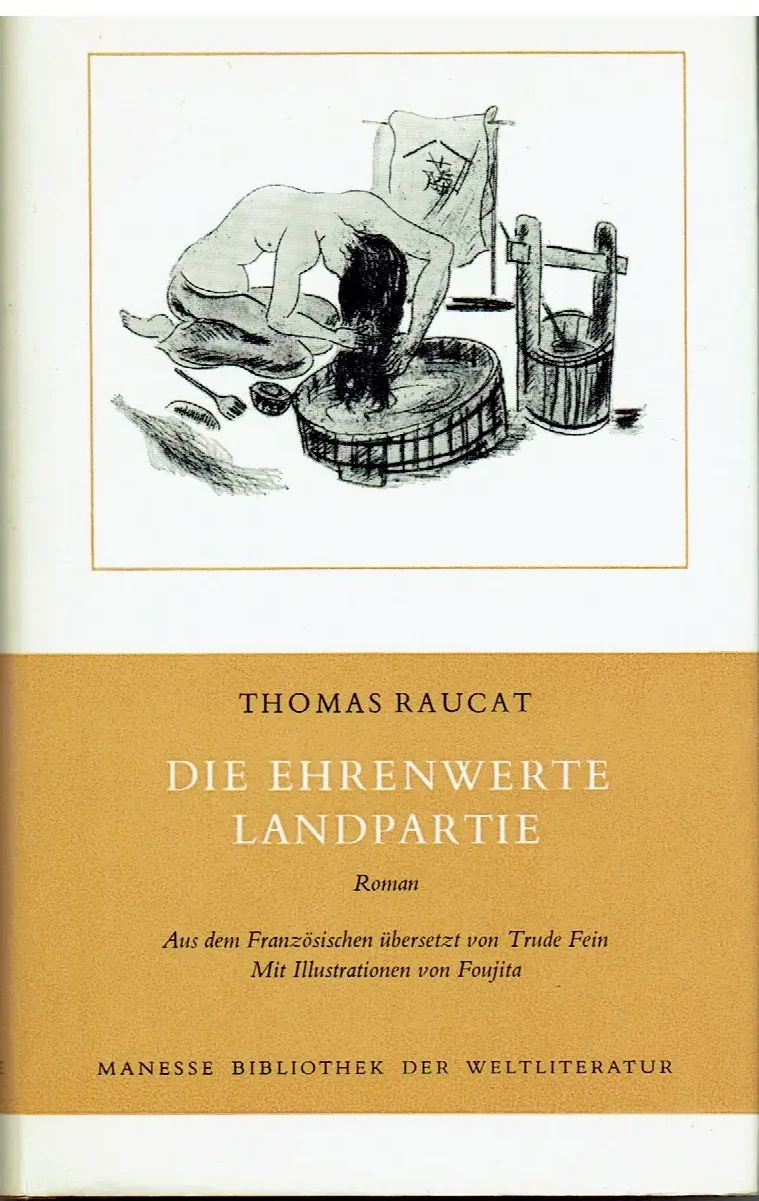


The Comedy of the Foreign: The Honourable Country Excursion
by
Ursula Kampmann

Can you sometimes tell from a person's face what they are thinking? Well, you may be right, or you may not be. The whole thing would not even be a problem if we did not occasionally base our actions on what we believe the other person is thinking. Ask any couples' therapist: from such unfounded assumptions the finest quarrels arise. And do not imagine it becomes simpler when a divergent cultural background is added to the mix.
Such concerns are far from Thomas Raucat's mind. The entire wit of his satire The Honourable Country Excursion, in the original L'honorable partie de campagne, rests on Raucat peering inside the heads of his protagonists -- Europeans and Japanese alike -- and relating events from their perspective. For the European reader, the thinking that Raucat postulates in his Japanese characters is so absurd that he can only laugh at it.
The content of the story itself is quickly told: a Swiss diplomat wants to get a Japanese beauty into his bed. To this end he invites her on an excursion. A Japanese business partner learns of this. Under the mistaken belief that the Swiss really wants to go on an excursion, he in turn invites him to one. From the divergent ideas of what is embarrassing and what is appropriate, the most delightful chaos arises, and more than one risque situation. No wonder the novel was an enormous success in the France of the annees folles and the London of the Roaring Twenties. That the author Roger Poidatz had already factored in the scandal at the time of publication is proven by his self-chosen pseudonym: Thomas Raucat sounds in French pronunciation like the Japanese Tomaro ka -- which could be freely translated as: 'So, shall I stay the night at yours?'

Thomas Raucat introduces us in a virtually brilliant and convincing way into the imagined inner world of the Japanese as he conceives it. Take for example the young woman the Swiss diplomat -- let us say it plainly -- intends to exploit. For her, the greatest problem is not her potential rape, which she has factored in, but the appropriate clothing for the occasion. It must be expensive -- more expensive than what she wore when the foreigner first saw her. A matter of honour! And a problem, for at that point she had already been wearing her finest clothes. So within a few days she assembles an even more expensive outfit, which Raucat describes at length and in full detail. Naturally the reader laughs with the author as he describes how she is so preoccupied with her outfit that she forgets to keep back even enough from the foreigner's generous gift of money for a train ticket. And he laughs still more when the problem resolves itself because the two girlfriends she has invited on the excursion give her the money -- so that she is in effect paying for her own invitation. Last but not least, the Swiss seducer complains that these Japanese women always wear something different, when he can only recognise them by their clothing. Their faces all look the same to him.
The novel is a little firework of cross-cultural misunderstandings. Raucat leaps virtually from one absurdity to the next: but of course a Japanese geisha values a camera more highly than jewellery. It is the optimal status symbol! Jewellery can be fake, which is not apparent at first glance. The price of a camera, by contrast, anyone can look up in the sales catalogue.
And then these gifts. They need not suit the giver or the recipient. They need only be appropriate to the occasion. Giving is a high art -- not because one wants to please the recipient, but because the gift must be precisely calibrated. And so postcards that one can obtain at home for a fraction of their price are bought as precious gifts for the dear ones left behind.

Whoever reads The Honourable Country Excursion is initially impressed. Roger Poidatz alias Thomas Raucat seems to know the Japanese inside and out. In fact, Raucat lived in Japan for only two years. He was one of fifty military instructors sent by the French army to Japan to train suitable candidates in specialist fields. Poidatz was a specialist in aerial reconnaissance. He certainly had contact with his students and other military personnel. But that he spoke fluent Japanese may well be doubted. So one may ask how he came into contact with Japanese women and learned to know their thinking. Was he invited to people's homes? What does he know from personal experience? What from literature? And where does the author heighten the effect for the sake of comedy? In short: how realistic is Raucat's depiction of Japanese inner worlds?
Indeed, while the French were enchanted and tittered over Raucat's story, the author met with harsh criticism in Japan. The Japanese found the thoughts attributed to the Japanese protagonists anything but realistic. They found the text more of a slur on their way of thinking. And with that we are back to our opening question: can we guess what the other person is thinking? Or is it not rather a presumption to want to guess another person's thoughts at all? And does it not go further still: may one people laugh at the value systems of another? What may satire do? And what may it not? Who decides whether a joke is appropriate: the one laughing or the one being laughed at?
One thing at least is clear: laughing without care about the most sacred convictions of others has become a political matter at the latest since the attack on Charlie Hebdo.


