
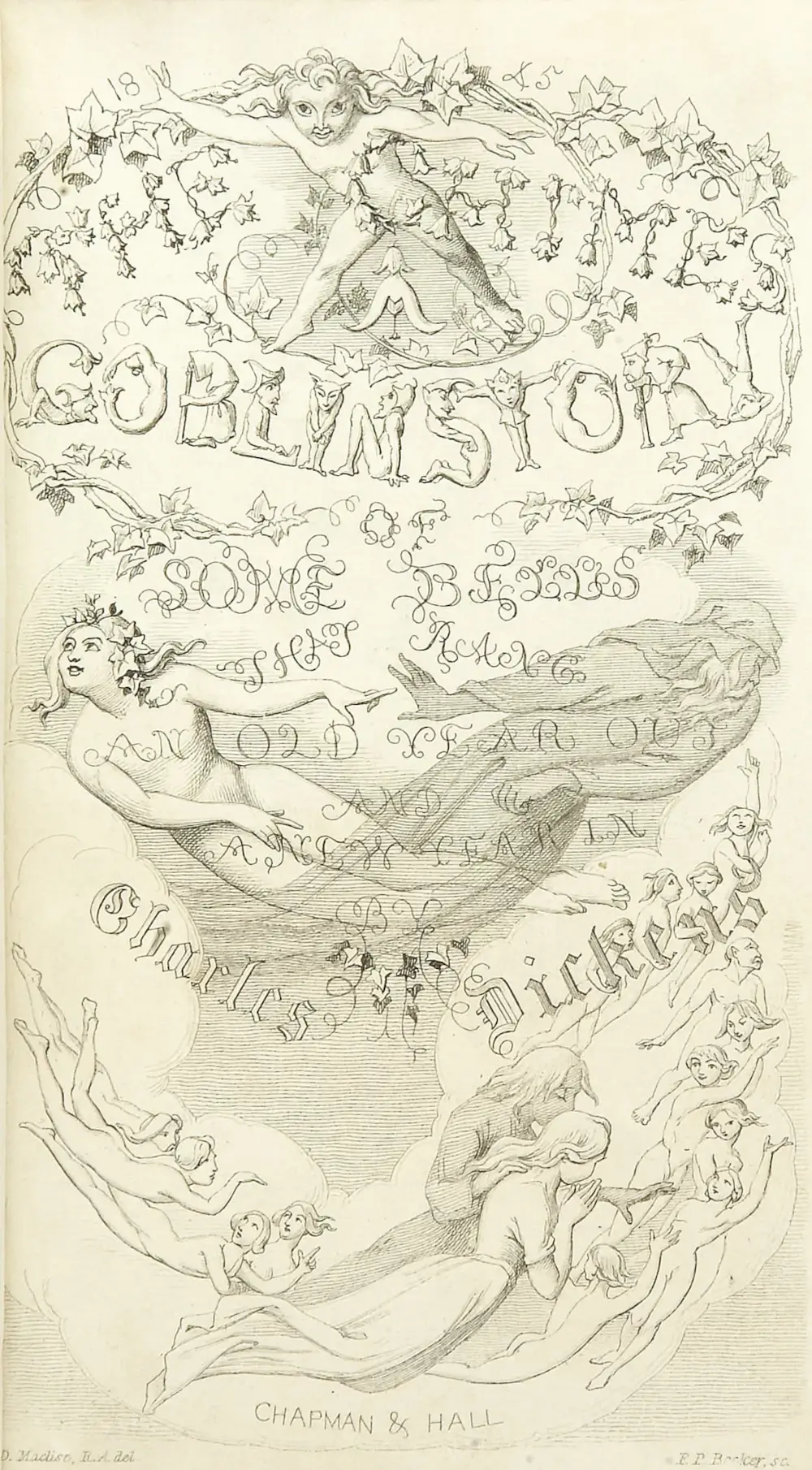


The Anti-Malthus: The Chimes by Charles Dickens
by
Ursula Kampmann

The Anti-Malthus: The Chimes by Charles Dickens.
While 'A Christmas Carol' by Charles Dickens is among the best-known Christmas stories, almost no one today knows his 'The Chimes.' This is understandable, for 'The Chimes' must be read against its historical background. It reflects the British poverty debate of the 1840s.
In the spring of 1844, a scandal shook bourgeois London. A British court had sentenced Mary Furley to death for infanticide. Her defence counsel made the background to the act widely known: the unmarried mother had attempted suicide because she saw no other way out. Without family, without lodgings, without work, the only path remaining to her was the workhouse. Mary Furley was afraid of this. She knew that she would immediately be separated from her child. Hard labour, sadistic or at best indifferent overseers enforced merciless discipline. Food? It was barely enough to prevent death by starvation. Most children did not survive this treatment. Mary Furley preferred the leap into the Thames to the workhouse. Her baby died. She was rescued and dragged before the judge. And now an entire nation debated whether Mary Furley was to be condemned or pitied. Did the moral depravity of a Mary Furley, or the untenable conditions of British poor relief, bear responsibility for the child's death?
Artikeltext:
A New Poor Law
In Mary Furley's fate the terrible consequences that the Poor Law of 1834 had for those affected were unmistakably apparent. And yet when it was passed, this law had originally enjoyed broad consensus. Only a few radicals had rejected it. It was based on the latest research. Malthus had demonstrated with mathematical precision that it was counterproductive to give the poor generous assistance, because this would only increase the number of the poor in the long run. The workhouse was regarded as an elegant solution. Those who saw no other option would at least receive enough food there to survive. Any preservation of human dignity was not provided for.
For unmarried mothers in particular, the new Poor Law represented a great deterioration. Previously, the poor relief authorities had tracked down the father of the child and forced him to pay maintenance. After the change in the law, they no longer troubled themselves to do so. The argument was that state welfare had previously virtually enticed women into immorality. Out of fear of the consequences, women should prefer to lead moral lives. That the abuse of domestic servants was commonplace, that occasional prostitution was often the only means of earning a living for women without training -- none of this interested the authorities.
Mary Furley and the death of her baby called into question the efficiency of the new laws. Her fate inspired Charles Dickens to write the novella we know in English as 'The Chimes.'
Toby the Ticket-Porter and Alderman Cute
Charles Dickens had addressed the fate of the poor before. Their needs and fears run through all his works. But 'The Chimes' is different. It lacks the kindly optimism that still makes Dickens so worth reading today. Instead we find resignation, hopelessness, anger, and blame.
The story lives from the juxtaposition of the simple-minded ticket-porter Toby with the smooth Alderman Cute. Poor man and his benefactor, so to speak. Cute even has a real model: in him Dickens parodied the former Lord Mayor of London, Sir Peter Laurie, who in letters to newspapers and articles sought to demonstrate, in the manner of Malthus, that the poor were to blame for their own misery. In 'The Chimes,' Toby's meal becomes a subject of debate. His daughter Meg has brought him a portion of tripe to put him in the mood for the news that she is finally to marry her beloved Richard. Tripe is little known today. It is the stomach lining of cattle or sheep, a by-product of the great slaughterhouses. To make this meat palatable, it must be cleaned for several hours, boiled for several hours, and only then prepared. What we today give to our dogs is for Toby a greatly coveted delicacy. But while he is still feasting, Alderman Cute comes along, takes the plate from the hungry Toby, and dissects the food on it. With well-chosen words he informs Toby that the consumption of his tripe robs the community of more resources than any other meat on the market.
Toby is impressed. He believes the politician, just as he agrees with the Member of Parliament Sir Joseph Bowley when that man loudly proclaims that many poor people are fundamentally wicked, obstinate, rebellious, and unworthy of his benevolence. Bowley demonstrates this with the troublemaker Will Fern, who refused to knit in exchange for his charitable gift!
It is this same Will Fern that Toby encounters on the icy New Year's Eve streets of London. He is carrying his foster-daughter Lilian and is completely exhausted. The two are starving, freezing, homeless, and do not know where to turn. Toby takes them home and gives them the food that was meant for Meg and himself. Faced with their misery, he prefers to go hungry rather than send the desperate pair away.
The Dream
So much for the first part of the story. In it Charles Dickens shows us his protagonists at their most loveable. Thus he arouses our sympathy for the good-natured Toby, the cheerful Meg, the resolute Richard, the loving Will, and the trusting Lilian. But now Toby falls asleep and dreams. He dreams his own death and that the spirits of the New Year's bells reveal to him a glimpse of his loved ones' fates.
These fates are terrible, and yet so logically inevitable! Convinced by Alderman Cute's arguments, Meg decides not to marry. The lonely Richard becomes an alcoholic. And that is still better than the fate of Will Fern, whom the authorities have branded a troublemaker. Sometimes they throw him in prison because he picks an apple; sometimes he begs in the wrong district or lacks a residence permit; sometimes he whittles a stick; sometimes a police officer simply has a bad temper. No matter what Will does, he ends up in a cell. Naturally he can no longer provide for Lilian. She survives only by prostituting herself. She becomes an outcast, from whom even Meg will no longer accept anything -- even though Meg is in bitter need of it herself. For out of pity she has married the alcoholic Richard, shortly before his death. He leaves her alone with a small child. Abandoned by the whole world, nothing remains for the no-longer-cheerful Meg but one way out: she goes to the Thames to drown herself and the child.
A Dream within a Dream, or Even Hope?
At this point Dickens breaks off and announces that all of this was a dream. And so the story ends with a happy ending after all: Meg and Richard marry. Will and Lilian find a well-off relative who is glad to care for them. All's well that ends well.
All's well that ends well? No, says the author. Could this ending not have been a dream within a dream? Is not the inescapable misery of poverty far more realistic? At any rate, as long as all readers do not make an effort to make poor relief a little more humane!
Discussion of a Radical Piece of Literature
The impact of 'The Chimes' went far beyond what Christmas stories normally achieve. They stimulated debate. In every club, in every salon, on the street and in Parliament, people argued about how the poor should be treated. Dickens gave them a face with which people could identify. A further scandal two years later brought slight corrections to state poor relief legislation at the end of the 1840s.
But ultimately it was not human compassion but the political struggle against communism that transformed the capitalist state into the welfare state.
Oh yes, and although it plays hardly any role in the story: Mary Furley was not executed. She was reprieved to transportation.


