


The Animated Automaton: Descartes' Treatise on Man
by
Ursula Kampmann

The Animated Automaton: Descartes' Treatise on Man
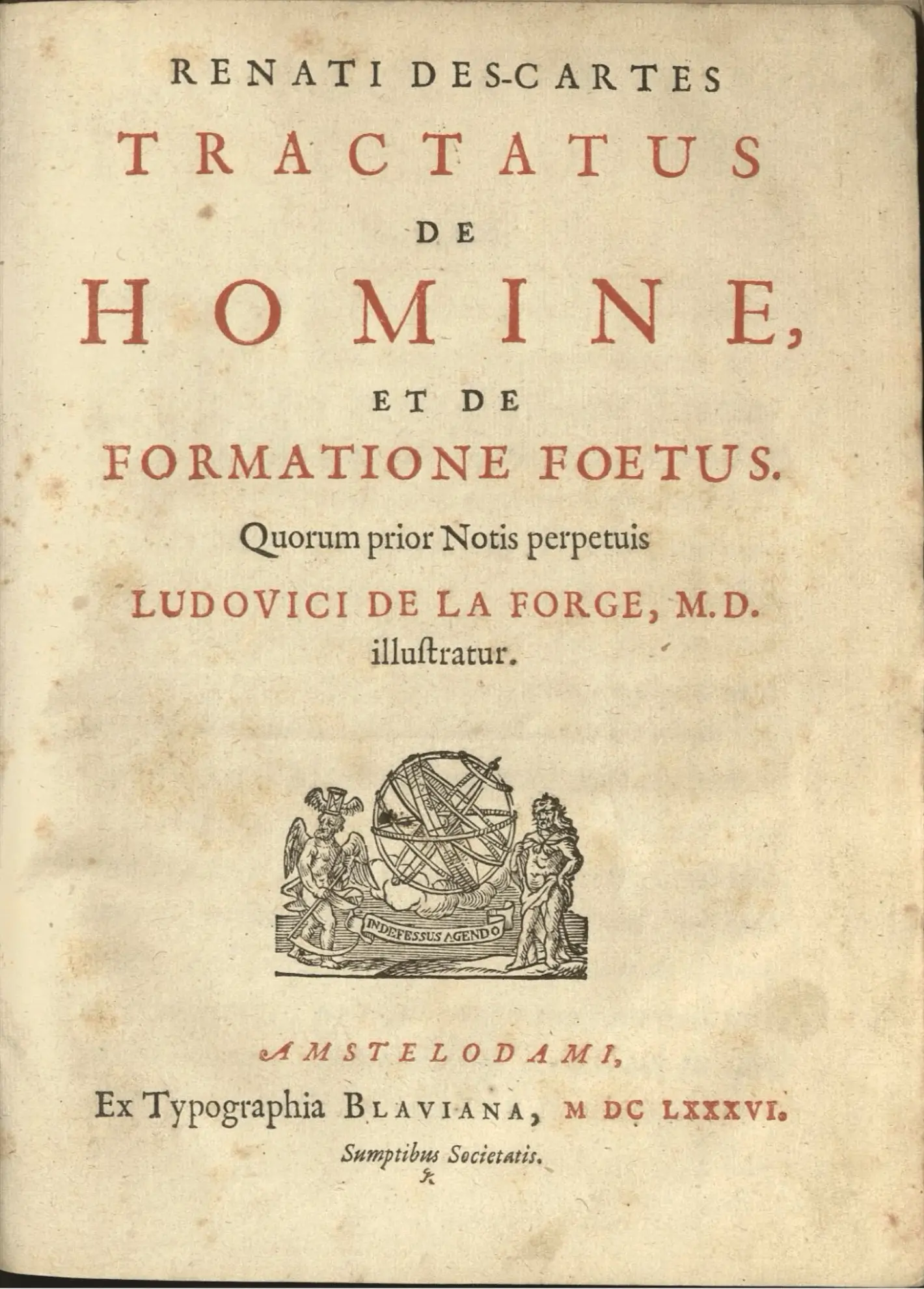
Whoever hears today of the great philosophers of the past often thinks of unworldly theories about right and wrong, good and evil, God and the world. That their theories had concrete effects on our daily lives rarely becomes apparent to us. We would like to show you in this contribution an example of just such a practical effect: a book by Rene Descartes permanently changed the attitude of educated doctors toward medicine. Whenever you take a tablet today or undergo an operation, you therefore owe a small debt to Rene Descartes. His approach in the much-discussed Treatise on Man inspired generations of doctors to seek the causes of diseases and to develop concrete methods of healing. The MoneyMuseum possesses an edition of this treatise. It was created in 1686 in Amsterdam at the publishing house of the Blaeu family and bears the title Tractatus de Homine, et de Formatione Foetus (= Treatise on Man and the Formation of the Foetus).

Theory and Practice of Medicine before Descartes
To assess the importance of Descartes for modern medicine, we must first concern ourselves with how sick people were treated at the turn of the 16th to the 17th century. Fundamentally, medical procedure had not changed significantly since antiquity. What to do about wounds and broken bones was known. However, this was the responsibility not of the doctor but of the barber-surgeon, who had learned his craft not at a university but in practice.
The university-trained doctor concerned himself exclusively with internal diseases, but in these he could not do very much. Of course there were methods to relieve symptoms. The problem was that the doctor had to rely solely on his experience. Why a method helped one patient and not another was beyond his knowledge.
The Doctores concealed their ignorance behind learned theories. Some speculated about the constellation of the stars, others about the imbalance of the four humours, still others spoke of the connection between diet and temperament.
Most widespread in Descartes' time was the idea that illness was a kind of harmful substance moving freely inside the body. It chose its own place of action and could just as well cause a cold in the nose as gout in the legs or toothache in the cheek. The German word Rheuma -- from the Greek rhein, to flow or stream -- recalls this idea. The aim of every doctor thus had to be to remove the sick substance from the body; hence the many bloodlettings, sweat cures, and laxatives at which we can today only shake our heads.

The Discovery of the Circulation of the Blood
Of course people in the 17th century were no less intelligent than we are today. There were also doctors then who asked why. They would have loved to look inside the bodies of their patients, but that was difficult. Imaging procedures did not yet exist, and autopsies were anything but everyday. Even if they were not subject to any church prohibition, people regarded them critically -- not the matter itself, as long as it was performed on strangers. But no family of any standing allowed the corpse of their dear deceased to be used for an autopsy. Therefore the supply of bodies was limited to the corpses of executed criminals, who had forfeited all rights to body and life. And this meant that autopsies could be performed only very rarely.
Rarely, however, does not mean never. At every dissection, interested parties flocked together and observed closely what was to be seen under the human skin. The textbook by Andreas Vesalius on the human body developed into quite a bestseller. And in 1628 William Harvey published another book that caused a sensation. In De motu cordis he described the human blood circulation and its pump, the heart. With this Harvey called into question the theses of the ancient physician Galen -- at that time 'the' medical authority par excellence. Whether one should rather believe the authorities or the findings from autopsies soon came to be discussed throughout Europe.
Descartes too was interested in anatomy. After all, philosophers at that time concerned themselves not only with ethical questions but also with the natural sciences and mathematics. We know that Descartes frequently watched at slaughterhouses, had himself dissected, and enjoyed observing the experiments of other doctors. We also know that he read Harvey's book on blood circulation -- in the year 1633. He connected Harvey's findings with some ideas he had probably been carrying around with him for some time.

The Connection Between the Automaton and the Blood Circulation
And with this we return to Descartes' ideas about the human body. To find the origins of his theory we must travel back still further in time, to the years shortly after the turn of the 16th to the 17th century. Descartes was still a young man then and was in Paris for his education.
Now in 1603 the artificial grottos of the Chateau de Saint-Germain-en-Laye near Paris were completed. They were regarded as a unique attraction, which the curious Rene Descartes also went to see. Unfortunately these grottos have not been preserved, but we can quite well form an idea of what Descartes saw. For at Schloss Hellbrunn near Salzburg a similar pleasure garden has been preserved in which some automata still function.
For that was precisely the great sensation of Saint-Germain-en-Laye: in the artificial grottos of the French royal palace, human-sized statues moved apparently by themselves and emitted sounds. While some boundlessly astonished visitors spoke of a miracle, engineers like Descartes were interested in the technology -- and there was much to learn. The automata were a masterpiece of the engineering art of that time, in which water provided the energy to set them in motion.
Today we can hardly imagine what a deep impression these automata made. They pierced the boundary between animate and inanimate, suggesting that perhaps this boundary did not exist at all. Thus Descartes probably arrived at the idea that the human -- and the animal -- body too might be a kind of automaton. Of course the human body was considerably more complex than anything to be seen at Saint-Germain-en-Laye. But that could easily be explained: after all, its creator was not just any engineer, but God.
Descartes probably pondered this idea for many years before reading Harvey's work on blood circulation. It seemed to him like final proof that the human body too was only a machine -- one driven not by water but by blood.

Soul + Body = Human Being
And that is precisely what Descartes' Treatise on Man is about: he describes the human body as a kind of machine set in motion by the blood circulation. The heart serves as a pump. There a lightless fire burns, warming the human body and setting the blood in motion. Just as water drives mills and automata, so the bloodstream sets all human organs in motion. A proof that the human being too is an automaton Descartes sees in all the bodily processes that the will cannot influence. Breathing, blinking, digesting, or the beating of the heart: all this occurs automatically, just as in the water-driven machines. And with this we arrive at the conception of the human being that Descartes represents in his Meditationes. There he treats the body as a machine completely separated from the soul. We recall that Descartes divides the whole world into three areas:
into the infinite substance called God
into the finite, thinking substance -- the human mind
into the finite, non-thinking substance -- matter
Just as the soul as res cogitans is connected with the divine and immortal, so the human body, the res extensa, belongs to the material world and like the automaton is inanimate and a machine.
What Are the Consequences if the Body Is a Machine?
The idea that the body is a machine may not seem to us quite as spectacular as it did to Descartes' contemporaries. Whoever replaces hearts and hip joints has long drawn the consequences from Descartes' world view.
For the doctors of the coming generations felt themselves positively liberated by this interpretation. Now they could research to their heart's content. After all, the human body was no longer a sacred vessel of the soul but only a kind of material shell without much significance. The animal, to which Descartes denied the possession of a soul, even mutated into a thing. Sounds of pain from a tormented creature could thus be interpreted as a purely mechanical process, to which roughly the same significance was attached as to the organ pipes that water caused to emit a sound.
The indifference toward animal suffering: that was the dark side of Descartes' theory. The positive effect, by contrast, was that medicine elevated the principle of cause and effect to the measure of all things. If a body was sick, one 'only' had to recognise the cause and eliminate it through the right measures to set the machine human being in motion again.

Why the Tractatus de Homine Appeared Only After Descartes' Death
However, some decades were still to pass before that point. For Descartes' theory was so revolutionary that he himself did not dare to publish the treatise during his lifetime. Descartes had been educated by Jesuits and knew exactly that his theses bordered on blasphemy. After all, they called into question all ecclesiastical conceptions of life and death, of bodily resurrection, and of the afterlife. The forced recantation of Galileo Galilei on 22 June 1633 was in the air. And so Descartes wrote to Marin Mersenne in November 1633: 'I wish to tell you that I had inquiries made these days in Leiden and Amsterdam about whether Galileo's system of the world was available there, because it seemed to me as if I had heard that it had been printed in Italy last year. I was told it was true that it had been printed, but that at the same time all copies had been burned in Rome and that he himself had been condemned to some punishment. This has astonished me so much that I have resolved to burn all my papers, or at least to let no one see them. ... But just as I would not for anything in the world want a draft of mine to come out in which there could be found even the slightest word that would be disapproved by the Church, so I prefer to suppress it rather than to have it appear mutilated. I have never had any desire to produce books, and if I had not bound myself by the promise I gave you and some other friends, so that the desire to keep my word to you might oblige me all the more to study, I should never have completed it.'
The Further Fate of the Tractatus de Homine
Descartes did not destroy his treatise on man, but made at least two copies during his lifetime. Thus his ideas spread within his circle of friends. After his death the manuscript passed together with his literary estate to Claude Clerselier (1614-1684). When the latter embarked on the publication, he realised that no reader would be able to understand Descartes' statements without illustrations. So he sought a medically trained draughtsman.
Our work is illustrated and commented upon by Louis de la Forge. He was a great admirer of the deceased philosopher and at the same time an experienced doctor practising in Saumur. He worked with Descartes' original text, which has since been considered lost. So we shall never know whether and to what extent the editors introduced their own ideas into the publication.
However that may be, the Tractatus de Homine irrevocably changed our view of the human being. Whoever today laments how the Enlightenment turned the animal into a thing must be aware that it was precisely thereby that the development of modern medicine first became possible.


