


Rivals or Allies? Wallace, Darwin, and Evolution
by
Ursula Kampmann

Rivals or Allies? Wallace, Darwin, and Evolution
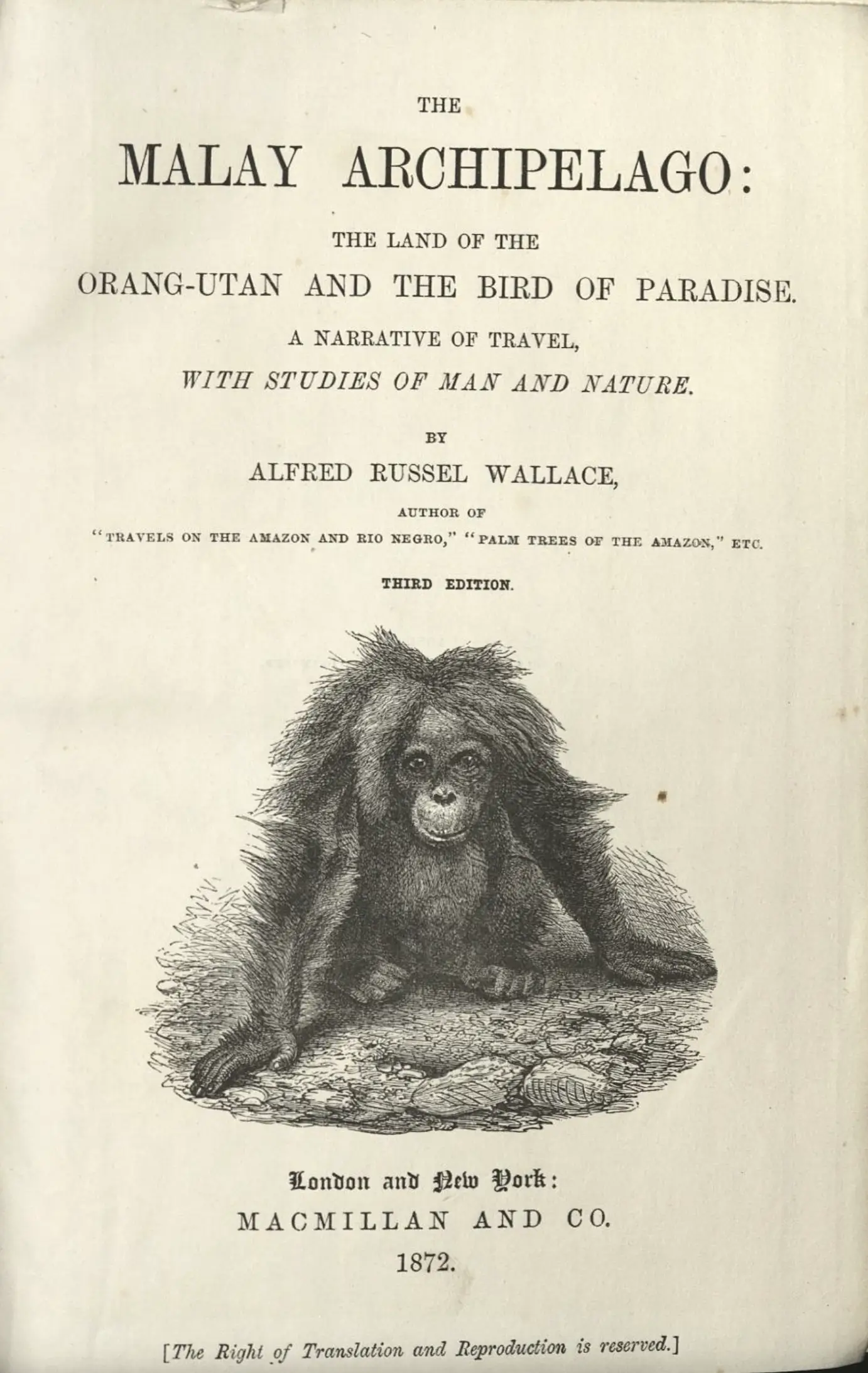
Alfred Russel Wallace published a book in 1869 about his journey to Indonesia. It became an international bestseller that still today bears witness to how Wallace developed his theses on evolution independently of Darwin. He informed Darwin of his theory as early as 1857. Today there are people who therefore claim Darwin stole his fame from his unknown colleague. Can this be true?
Artikeltext:
A library lives from its new acquisitions and the reflections its curators publish on the new books. Thus the acquisition of the most important work of Alfred Russel Wallace at the Bern antiquariat Daniel Thierstein inspired us to reflect on the relationship between Wallace and Darwin. Both discovered evolution at roughly the same time and grounded it in natural selection. But while Darwin is still celebrated for this today, hardly anyone until recently knew the name of Wallace. This tempted a biologist to publicly claim that Darwin had stolen the ideas of the economically struggling Wallace. Did he really?

A Zoologically Interested Land Surveyor
One would like to contrast the poor Wallace with a super-rich Darwin. But it is not quite that simple. In fact the father of Alfred Russel Wallace, born in Wales in 1823, was quite wealthy. He was at least able to send Alfred to grammar school. But in 1836 the family encountered financial difficulties. Alfred had to leave school, but was permitted to learn the trade of a land surveyor. That was an honourable, lucrative profession, and he earned good money from it. Best of all: his work left him time for his own interests.
When Alfred Wallace met the famous entomologist Henry Bates, he was captivated. Entomologists collect and classify insects, and Wallace was enthusiastic about this branch of zoology. Inspired by the travel accounts then widely read, he and his mentor Bates decided to go to Brazil to conduct research there.
But how does one finance a research journey if one is not called Charles Darwin and does not have a wealthy father? The secret lay in the widespread interest of private collectors and public museums in zoological specimens. While Bates and Wallace were researching in Brazil, they simultaneously collected specimens to sell at high prices in England. When classifying the animals and plants collected, Wallace realised that the broad Amazon formed a kind of geographical dividing line between closely related species. In an article on the monkeys of the Amazon that he published after his return in 1852, he therefore asked: 'Are closely related species ... separated by a wide geographical distance?'

The Voyage to the Malay Archipelago
Only two years later Alfred Russel set out on his second journey. The destination was the Malay Archipelago -- today we would speak more of the island world of Southeast Asia. He visited the large and small Sunda Islands, the Moluccas, the Philippines, and New Guinea. He saw similarities to what he had already experienced on the Amazon and what Darwin knew from the Galapagos Islands: broad waterways separated the islands and this was reflected in the distribution of the species living on them, something Russel must quickly have noticed. After all, he had to collect specimens again to finance his journey. He appeared in the manner of a modern entrepreneur and employed sub-contractors to multiply his profit. Up to 100 indigenous assistants collected specimens for him that he planned to sell at a profit at home. In the end Wallace brought home a total of 125,660 specimens: 310 mammals, 100 reptiles, 8,050 birds, 7,500 shells, 13,100 butterflies, 83,200 beetles, and 13,400 other insects.

Wallace classified them all. After all, the sale of a rare or even undescribed species promised a substantially higher profit than the specimen of a widely distributed species. And in the describing he discovered that a zoogeographical boundary existed between the islands, namely at the strait between Bali and Lombok. Today we know that this boundary separates Asian from Australian flora and fauna. Up to the Wallace Line Australian species could advance. Other researchers later determined how far Asian species spread, and in which area an equilibrium between the two prevails.

Wallace Dreams of Malthus
What Wallace was establishing there was initially merely a very clever observation. But Wallace asked himself the same question that Charles Darwin had asked himself in view of his material. Could it be that species changed not only through human breeding, but in a natural way? But what could be the trigger for this change? And once again Malthus was to have set a researcher on the right track: during a bout of fever, as Wallace reports in his autobiography, he for the first time applied the thesis of naturally given overpopulation as postulated by Thomas Malthus to evolution: 'It then occurred to me that these causes or their equivalents are continually acting in the case of animals also; and as animals usually breed much more rapidly than does mankind, the destruction every year from these causes must be enormous in order to keep down the numbers of each species, since evidently they do not increase regularly from year to year, as otherwise the world would long ago have been covered by those species which breed most quickly. Vaguely thinking over the enormous and constant destruction which this implied, it occurred to me to ask the question, why do some die and some live? And the answer was clearly, that on the whole the best fitted live. From the effects of disease the most healthy escaped; from enemies, the strongest, the swiftest, or the most cunning; from famine, the best hunters or those with the best digestion; and so on. Then it suddenly flashed upon me that this self-acting process would necessarily improve the race, because in every generation the inferior would inevitably be killed off and the superior would remain -- that is, the fittest would survive.'
Darwin versus Malthus
According to his own account, Alfred Russel Wallace had this idea in the spring of 1858. On 9 March of the same year he had written it up in an article that he sent to Charles Darwin, with whom he had been corresponding for some time. Wallace asked Darwin to forward this article for publication if he considered it worthy. Darwin, who received the letter in June, forwarded it to his friends. He himself had no head for this matter at the time: his youngest son had contracted scarlet fever and died within a few days.
And so the friends of Charles Darwin took over. On 1 July 1858 during a session of the prestigious Linnean Society in London, they presented the works of Wallace and Darwin simultaneously. With that the theses of evolution and natural selection were out in the world.

Alfred Russel in England
When Alfred Russel returned to England in 1862, the entire natural science world was talking about evolution. Not because of the presentation before the Linnean Society, but because Charles Darwin had published the evidence material for his theory, gathered over decades, in a comprehensive work in 1859. We speak here of the world-famous book On the Origin of Species, which we introduced in a previous issue.
Russel seems not to have been offended by this. On the contrary: he developed into one of the most ardent champions of Darwinism. He already applied evolution to human beings in 1864. In his article The Origin of Human Races and the Antiquity of Man Deduced from the Theory of Natural Selection he crossed for the first time the gulf between human and animal. No wonder; during his travels he had come to know many different species of ape, including the orang-utan, which we today count among the so-called 'great apes.'

The Publication: The Malay Archipelago
The sale of his specimens had made Alfred Russel wealthy. Now he could afford to marry and could expect to live on his fortune for the rest of his life. In addition, his book about the journey to the Malay Archipelago became a bestseller. The Malay Archipelago: The Land of the Orang-utan And The Bird Of Paradise. A Narrative Of Travel, With Studies Of Man And Nature was exactly what went down well in the Victorian era. The book, dedicated to Charles Darwin(!), narrated in an extremely lively language not only of geography, flora, and fauna, but also of exotic peoples and the experiences of the researcher.
Wallace composed a wonderful combination of adventurous travel account and natural science textbook. Everyone could pick out what appealed to them most. Some were fascinated by the diversity of beetles and butterflies. Others enjoyed exciting stories. There Wallace experienced an earthquake first-hand, or removed an enormous python from his hut roof with his bare hands. European salon readers marvelled at the story of Thomas Stamford Raffles, who founded Singapore in 1819, or at the researcher's encounter with James Brooke, the White Rajah of Sarawak in northern Borneo.
After introductory remarks on geography and geology, Wallace covered all the islands systematically one after another. His accounts were illustrated by the best available artists. Their graphics were used again and again as the work developed into one of the most popular works of the 19th century: the English version went through ten editions and even more reprints. It was translated into at least twelve languages. The first German version, from the pen of the then well-known zoologist Adolf Bernhard Meyer, appeared already in the year of the English first publication, namely 1869.

In Darwin's Shadow or Darwin's Protection?
But with this, unfortunately, the high point of Wallace's career had already been passed. He made a series of wrong decisions that robbed him of the esteem of the bourgeois world. First there was his advocacy of spiritualism, which his scientific colleagues in particular took very much amiss. Then Wallace lost practically his entire fortune because he had invested in the wrong shares. And to top it all he also joined the Socialists. In 1881 the Land Nationalisation Society elected him its president to advance the struggle for the expropriation of wealthy landowners.
Wallace had made himself so unpopular that he did not succeed in obtaining a quite appropriate government pension for scientific achievements. This secure income was procured for him only by Charles Darwin, who threw all his authority into the balance to enable his colleague a dignified old age. The rest of the story is quickly told. Alfred Russel Wallace held numerous further lectures, wrote many more articles and some books -- not only on natural science subjects but also on the social questions of his time. He died in 1913 at the age of 90. The press dedicated numerous obituaries to him and even the wish to bury him too in Westminster Abbey was voiced. But his wife wanted to lay him to rest in the small cemetery of his home town. Nonetheless some scientists founded a committee to attach a memorial tablet in honour of Wallace near Darwin's grave. It was unveiled on 1 November 1915.
And Why Do People Believe Darwin Stole Wallace's Ideas?
His contemporaries would never have hit upon the idea that Darwin and Wallace were rivals. This thesis was put forward by the American biologist John Langdon Brooks in a book published in 1984. He based himself on the correspondence that Wallace and Darwin had conducted while Wallace was still on the Malay Archipelago developing his theories. It seemed to him unfair that the present had forgotten Wallace, and so he attempted to enhance the reputation of his hero by denigrating Darwin.
The press naturally took up this theory with enthusiasm: nothing it is currently fonder of than knocking a great man from his pedestal.
But the truth looks different: two men developed similar ideas under similar conditions. They allied themselves and established these ideas together in the scientific world. Who had first formulated this idea was less important to them than it is to us. And in fact it is often not decisive who said something first. Far more important is the person who convinces us with his arguments of the correctness of a theory. And there Charles Darwin did better work than Alfred Wallace.


