
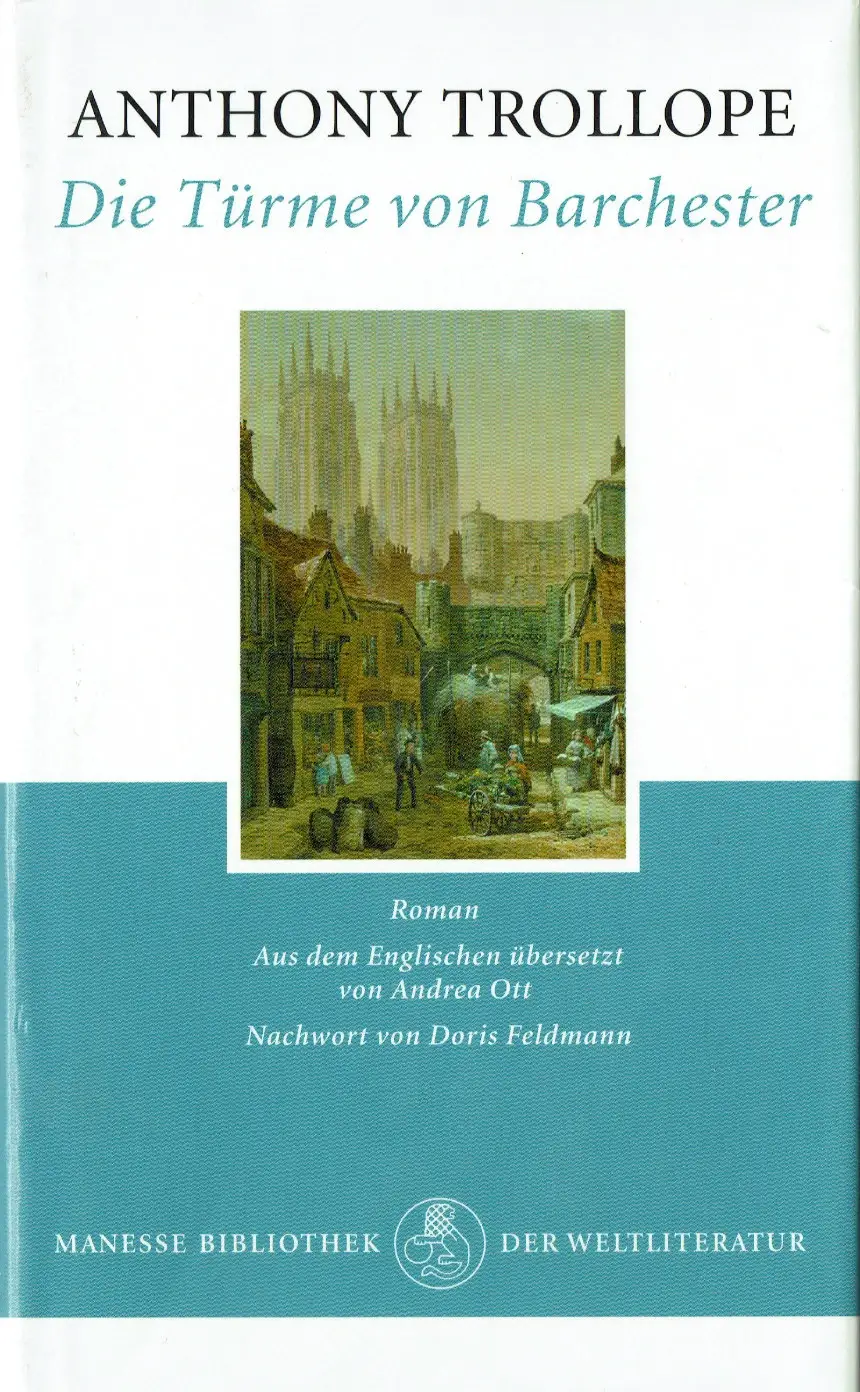


Actually -- if one looks at it closely -- the entire story that Anthony Trollope tells us across nearly 900 pages revolves around 450 pounds, 1,200 pounds, and a modest fortune. One could of course also put it differently. At the centre of the plot stands the struggle between High Church and Low Church -- between the traditionalists of the Anglican Church and the Evangelicals who seek to renew that church through lay ministry. However, the protagonists of Trollope's novel 'Barchester Towers' do not fight over matters of faith, but over two offices and a widow. At stake are the post of Warden, with an income of 450 pounds, the post of Dean, with an income of 1,200 pounds, and the hand of the beautiful (and above all wealthy) widow Eleanor, daughter of Mr. Harding.
Mr. Slope, Mr. Quiverful, Mr. Arabin, and Mr. Harding
Let us look at the competitors who seek one or two of these three sources of income. First there is the villainous schemer Slope, who under the cloak of piety pursues his own advancement. No trick is too low for him, no flattery too thick. As a slimy nobody he insinuates himself into the hearts of the ladies to make them useful for his purposes. His admirers initially include the Bishop's wife. She has foisted him on her husband as personal chaplain. She can do this, for her husband is a milksop who knows who procures or withholds the small pleasures of his life. His wife exploits his weaknesses to shape the fate of the diocese according to her own preferences.
And so she takes pleasure in promising the post of Warden (450 pounds annual income!) to the husband of Mrs. Quiverful, mother of a lively brood of fourteen. 450 pounds! A fortune for a family that had previously had to manage on a vicar's living of 50 pounds. 450 pounds! This even turns the tailor's head, and he rushes over immediately to fit the wife and her older daughters for the coveted silk dresses on credit. 450 pounds! Plus a large house with a magnificent garden! Mr. Slope, the slimy bishop's chaplain, would much prefer to bestow this on Mr. Harding. For Harding is after all the father of the beautiful Eleanor, and so the living of 450 pounds per year would have two advantages for Mr. Slope: 1.) Eleanor is so grateful that she immediately marries him; 2.) at 450 pounds a year the father-in-law is not a burden to him but is saving up a handsome inheritance.
Yes, Mr. Slope aims at the jackpot, the wealthy Eleanor. That she might perhaps prefer not to marry him does not enter his head at all. Eleanor has to give him a slap in the face -- how unladylike! -- before he finally understands that his marriage proposal has been declined and that he should kindly keep his hands to himself.
But the red marks of the slap have not yet faded when Mr. Slope hears of the Dean's death. His living of 1,200 pounds annually is therefore available. 1,200 pounds! How quickly Mr. Slope runs to set in motion once again his intrigues and flatteries, to secure at least this position if the young widow is already too immature to appreciate the honour of his marriage proposal. However, Mr. Slope has not reckoned with the Bishop's wife. Slope's opposition to the appointment of Mr. Quiverful as Warden has turned the energetic lady against her creature. Slope's resistance must be eliminated -- and with it Slope's person. The Bishop naturally does not dare to peep (he does not appreciate burned roasts and ice-cold rooms at all) and so Slope is icily dismissed. Thus the post (not to mention the 1,200 pounds!) falls to Mr. Harding.
And this brings us to the secret hero of the novel, the only clergyman in Barchester who does not covet a living but wishes to serve the people. He is to be Dean? Mr. Harding does not feel equal to this office. He wishes to decline it (and thereby renounce the 1,200 pounds), which neither his friends nor his relatives can comprehend.
How fortunate that his daughter, the beautiful widow Eleanor (yes, the one with the fortune), knows all too well whom she wishes to marry. A clergyman, naturally -- the shy but capable Mr. Arabin. On him she bestows her heart and fortune. Mr. Arabin has his heart in the right place and appreciates money and property while not placing them at the centre of his life. A happy ending is guaranteed. As the icing on the cake, Mr. Harding renounces the post of Dean in favour of his son-in-law. And the latter thus gains not only the widow's fortune but also the 1,200 pounds a year. And all is well.
A Revealing Novel
Anthony Trollope grants us in 'Barchester Towers' a detailed view into the minds of all his protagonists. He describes each and every one of their thoughts (hence the 900 pages!). They are selfish and calculating, proud and stubborn, naive and loveable, offended and in love -- they are as we human beings are: products of our feelings, hopes, and errors.
Trollope makes each individual character stand so clearly before our mind's eye that we almost believe the citizens of Barchester really existed. And yet even the name of the city is an invention. It is reminiscent of the great dioceses of England such as Winchester, Chichester, or Rochester. In fact, Trollope depicts the hierarchy and conditions of all these dioceses in his novel with realism down to the last detail.
In doing so it is barely noticeable that his protagonists are types rather than individuals. They may not act quite so black-and-white as in popular fiction, but nonetheless the careerist Slope behaves like the archetype of the careerist; Mr. Harding is too good to be true; daughter Eleanor is the incarnation of the naive widow with little sense and much intuition.
The Victory of the Worldly
In fact, Trollope's novel is a brilliant, uproariously funny, and entertaining caricature of the Anglican Church of his era. In reality it was probably no better and no worse than institutions are in all ages, but through Trollope's depiction we gain the impression that it is a completely antiquated and superfluous institution. What clergymen performed in those days in terms of social and psychological care work in the countryside is entirely lost sight of.
In this, Trollope aligns himself with the spiritual currents of his time. State reformers of the day were making the demand that all social affairs be placed under government control. Their opponents had to be portrayed as blackly as possible. That a differentiated view fell by the wayside -- had to fall by the wayside -- in the process is understandable.
Just imagine a novel today taking aim at the work of an NGO and reducing it to the desire for recognition of some of its representatives, the career ambitions of some of its CEOs. If we can imagine that, we can roughly gauge how realistic Trollope's depiction of the Anglican Church is. For the clergymen of that era, the same presumably held true as holds for NGOs today: there may be the occasional person who misuses their post for their own benefit, but how much good work would go undone without NGOs?


