
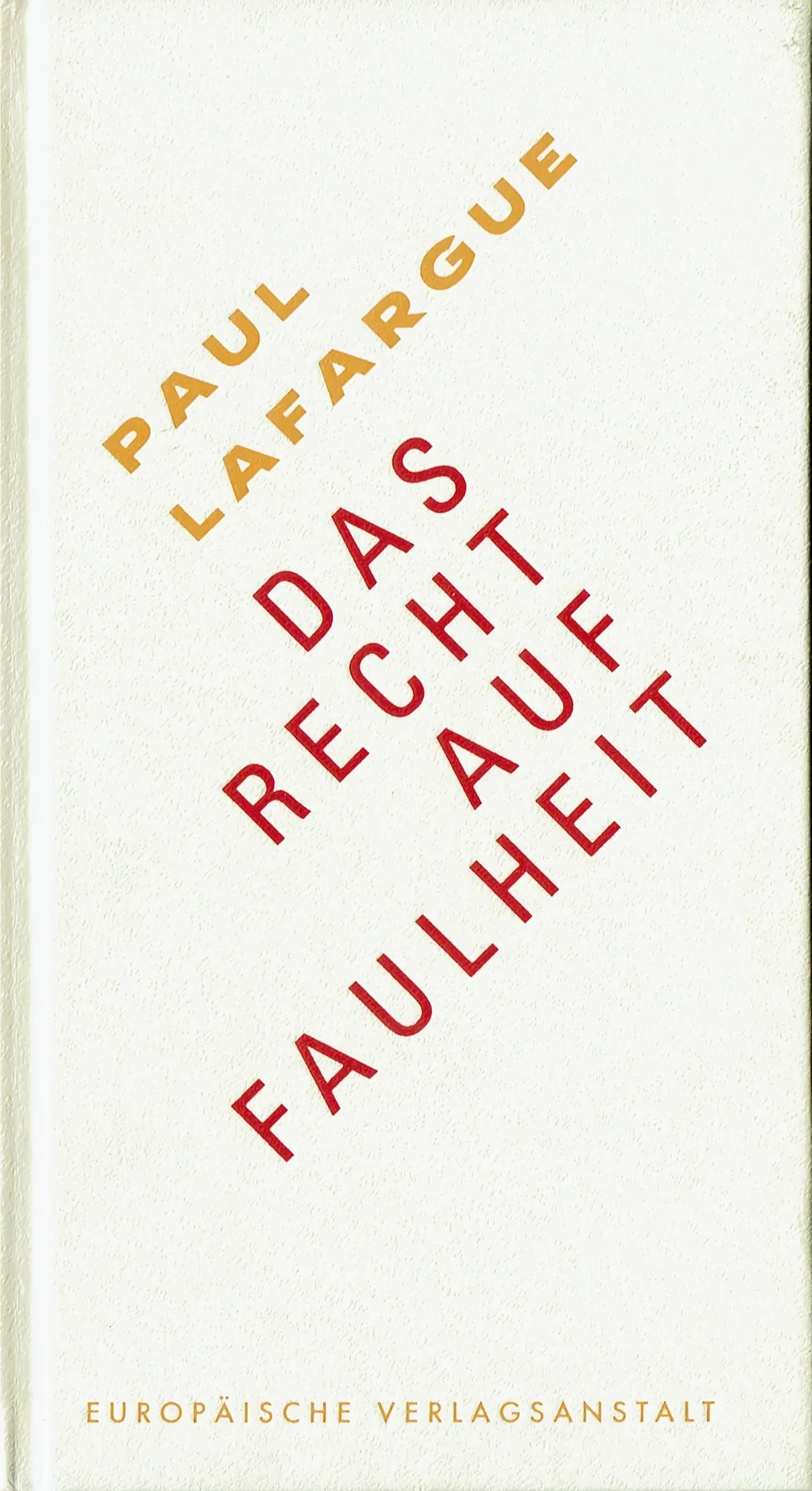


In 1880, the notorious socialist Paul Lafargue published his polemic Le droit à la paresse — The Right to Be Lazy — in the journal L'Égalité. In it he postulated that workers themselves held the key to improving their living conditions. The sole cause of their misery, he argued, was their own bourgeois work ethic. Today, when even job advertisements address the buzzword 'work-life balance,' one wonders whether Paul Lafargue's theses have finally made their way into workers' minds.

Artikeltext:
Who Was Paul Lafargue and When Did He Live?
Paul Lafargue (1842–1911) belongs to those professional revolutionaries of the 19th century who tried to change the lot of the working class without ever having performed physical labour themselves. His parents enabled him to study medicine in Paris. But Lafargue was more interested in socialism than in lectures. A passionate (and perhaps reckless) speech at a student congress in Belgium earned him a lifetime ban from all French universities. So his parents paid for his studies in London. There Lafargue again sought contact with revolutionary circles. In doing so he got to know Friedrich Engels, Karl Marx, and Marx's daughter Jenny rather better. He married her, which earned him the generous financial support of Engels. Thus Lafargue never had to practise medicine, but could concentrate on agitation unburdened by financial worries.
He published his book Le droit à la paresse in 1880 as a contribution to a socialist journal. It was his first independent proposal for a solution to the labour question. Lafargue revised the text during a prison stay in 1883 and published it as a monograph. Shortly thereafter, The Right to Be Lazy was already translated into German. This entertainingly written little book became Paul Lafargue's best-known work.
The socialist achieved even greater fame, incidentally, through his end: on the night of 25–26 November 1911, he took his own life and that of his wife Jenny. He left behind a letter informing the world that he had resolved to die when he was no longer of use to the socialist cause. More than 15,000 people are said to have followed his coffin, Lenin among them.
The Bourgeois Work Ethic
One cannot understand Paul Lafargue's work without first engaging with the bourgeois work ethic. In the 19th century this was still fairly new. Through the collapse of estate society at the end of the 18th century — in which birth defined a person's standing — a new, far more permeable social order had been established. Now money played the decisive role. Whoever earned enough money through their own efforts could rise in society.
Paul Lafargue's parents are a fine example of what this 'meritocracy' made possible: the labour on their Cuban coffee plantation secured them the money to go to France, live as wealthy rentiers, and finance an excellent education for their son. What had been necessary for their success was hard work, diligence, skill, perseverance, and a high degree of individual initiative — precisely the qualities that the bourgeois work ethic glorified.
In theory, advancement was open to anyone who possessed these virtues. From dishwasher to millionaire! Even if this image was not formulated until the early 20th century in the United States, the possibilities it implied were already attractive in the 19th century. For this reason, bourgeois politicians did not demand social change, but equality of opportunity. They considered that sufficient, since it appeared to give everyone who submitted to the bourgeois work ethic the chance to rise.
Work Addiction
In theory, this possibility also applied to members of the working class. In practice, the percentage of those who actually achieved the ascent was vanishingly small. Paul Lafargue addresses in his book the dangers that an internalisation of the bourgeois work ethic holds for the factory worker. He sets the right to laziness against the right to work (and advancement).
In doing so, Paul Lafargue postulates that the entire working class has been seized by something he calls work addiction. This indoctrination, he argues, has been spread by 'the priests, economists, and moralists' who have 'hallowed labour.' This, he says, enabled the capitalists to so blind the workers that 'in 1848 the proletarians, arms in hand,' demanded their right to work. In doing so, they harmed themselves. Too much work makes people ill. He compares the pale and stooping 'machine-men' of England, the Auvergne, and Upper Silesia with the 'bold, chestnut-brown, elastic as steel Andalusians' of Spain and with the 'proud savages' not yet 'corrupted by Christianity, syphilis, and the dogma of labour.' He recalls that among the free Greeks, it was once only 'permitted' for slaves to work, and that it is precisely in the most progressive and most highly industrialised regions that workers are worst off.
Overproduction as the Cause of Colonisation
Even if one may consider the first part of Lafargue's book romanticising and unworldly, the second thematic complex is highly compelling and pertinent. The author notes that overproduction is a consequence of the combination of entrepreneurial profit-seeking and workers' addiction to work. In other words: to maximise profit, the entrepreneur must maximise production. But this is only possible because an army of work-addicted workers stands ready. Overproduction brings in its wake not only a lack of markets — and the financial problems for the entrepreneur thereby caused — but also a shortage of raw materials. Both, Lafargue argues, are responsible for the Western industrial nations engaging in a race for colonies. In the colonies they hoped simultaneously to sell their surplus products and to acquire additional raw materials.
Lafargue writes: '...they cry out for trading colonies in the Congo, they demand the conquest of Tonkin, they force their governments to smash down the walls of China, only so that they can sell their cotton goods. In recent centuries England and France fought a duel to the death over which of the two would have the exclusive privilege of selling in America and India.'
Laziness as the Engine of Innovation
Because workers are addicted to labour and work correspondingly cheaply, the entrepreneur has no need to replace human labour with machines. Or conversely: only where labour is expensive does innovative thinking occur. He writes: 'In America, the machine takes over all branches of agricultural production, from the making of butter to the weeding of grain. Why? Because the Americans, free and lazy, would sooner die a thousand deaths than lead the livestock existence of a French peasant. The labour that in glorious France is so arduous, with so much bending, is in the American West a pleasant outdoor pastime, enjoyed seated while one puffs comfortably on one's pipe.'
This lazy life is what Lafargue wants for all workers. The time freed by machines should therefore not be used to produce yet more superfluous goods, but to give the worker more leisure. He writes: 'If the labour required by society is necessarily limited by consumption and by the quantity of raw material, why devour the work of a whole year in six months? Why not distribute it equally over the twelve months and compel each worker to be content with five or six hours daily throughout the year, instead of ruining his stomach with twelve hours a day for six months?' And with this Lafargue moves to his utopia of a grand future in which people work less and harmoniously consume what they have produced.
The Logical Flaw
Paul Lafargue's ideas seem compelling at first glance. Produce only what the world truly needs, distribute what is produced equitably, and consume it together in peace and joy. That is what paradise on earth should look like. The problem is that the inhabitants of this earthly paradise are not angels but human beings, for whom their own well-being comes first. Consider national egotism. We are witnessing again how unwilling even the citizens of the wealthiest nations are when asked to share even a little of their wealth with a few others.
Imagine a world government forcing Western nations to share their surplus with the inhabitants of the Global South. We could no longer travel, would have to give up cars, and in our leisure time would read library books instead of going shopping. Such redistribution could not be achieved consensually, even if all people in the world thereafter performed exactly the same amount of labour with exactly the same output.
For we then face the next problem: labour in our world is not evenly distributed. And contrary to what Lafargue postulated, it is not those who live in highly industrialised countries who are badly off — on the contrary. That has not changed for generations, despite our ministries for development aid working at full capacity to improve the situation. For this reason, Paul Lafargue's idealistic ideas seem very, very unworldly. They remind me a little of the perpetual motion machine, which should theoretically function quite well — in a perfect world without friction. But because this perfect world does not exist, Lafargue's reflections are for everyday life just as useless as the perpetual motion machine.
What Does Paul Lafargue Have to Do with Our Work-Life Balance?
But, one might object, do we not want to adopt at least Lafargue's wonderful ideas for our own countries? In Germany, Switzerland, France, and many other European nations it should surely be possible for everyone to work less! Well, we already do. We live in a world where it has become a matter of course to choose one's work. Not just any hard labour, of course: for rubbish collection and the abattoir we bring in our foreigners. Everything else we have outsourced. Our cheap T-shirts are produced in low-wage countries. How our food is produced is something we would rather not know too precisely. Occasionally we are indignant about blood diamonds and child labour, and immediately forget who recycles our electronic waste.
Lafargue had in fact precisely the right image for this: just as the free Greeks could afford political participation only because slaves worked for them, we live in luxury because our slaves in the Global South were not fortunate enough to live in our meritocracy with its opportunities for advancement. For there is one thing Lafargue could not have foreseen: that the industrial revolution would raise the prosperity of the Western world to such a degree that today a worker lives better than a wealthy bourgeois did in the 19th century.
On the Afterlife of Paul Lafargue's The Right to Be Lazy
Incidentally, it is quite remarkable that actually existing socialism could make nothing at all of Lafargue's Right to Be Lazy. In the USSR and the GDR his works were not, it is true, banned, but they were neither printed nor translated. Surprising for a son-in-law of Karl Marx who was in his day so well-known a socialist. Lafargue's theses received greater attention only when the youth of 1968 set out, flowers in their hair, to move to San Francisco, while their parents earned the money for them.


