
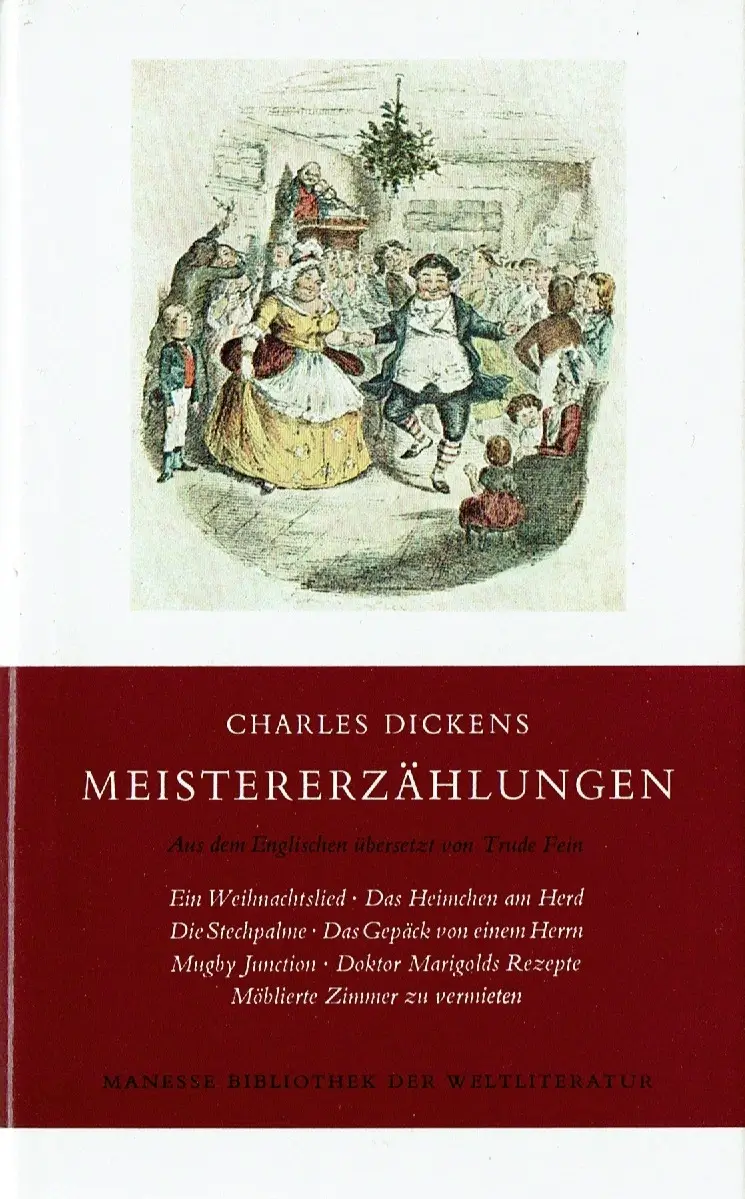


Oh Joyful Christmas Season: Charles Dickens' Christmas Stories
by
Ursula Kampmann

Oh Joyful Christmas Season: Charles Dickens' Christmas Stories
Charles Dickens still ranks among the most beloved authors of the English-speaking world. This is due to his wonderful characters. They give the reader the illusion of standing on the right, the good side through identification with the loveable poor. Charles Dickens is feel-good literature of the finest kind, especially at Christmas time.
It is roughly half a century since my mother and I were doing our Christmas shopping in Munich's pedestrian zone. But I remember well that she could not walk past a single one of the countless beggars without throwing at least 20 pfennigs into his hat. This habit she had from her father. He was born in 1901 and thus far too young to have been sent to the front during the First World War. This fact filled him with gratitude and a guilty conscience. He taught my mother to give at least a small something to all the unfortunate war-wounded who begged on the streets after the First World War.
For years I followed along dutifully and a little anxiously when my mother sent me to throw the 20 pfennigs into the beggar's hat. And then came adolescence. I developed my own thoughts on the matter and soon felt far superior to such useless treatment of symptoms! Instead I discussed in political working groups over cola and pretzels how we could support the farmers in Nicaragua and alleviate the famine in Ethiopia.
Neither my mother's 20 pfennigs nor my empty words achieved anything against the misery of the world. But both she and I felt like somewhat better people in the process. And it is precisely this longing that countless NGOs exploit today for their donation campaigns, and that Charles Dickens exploited around a century and a half ago to sell his Christmas stories.
Artikeltext:
The Business Model of Charles Dickens
For Charles Dickens was not only an author; he was also an outstanding businessman for whom money played a decisive role. This had its roots in his childhood. He came from a middle-class family, but his father's carelessness in financial matters brought the whole family to debtors' prison and burdened the 12-year-old Charles with the responsibility of contributing to the family's upkeep. He had to leave school to stick labels on shoe polish in a factory for six shillings a week. Only a fortunate inheritance prevented the little boy from sliding from the middle class into the working class. Through the inheritance the father was freed from debtors' prison, Charles was sent back to school, and never again in his life did he forget that only a regular income provides social security.
And it was precisely this regular income that was not entirely easy to achieve even for a successful writer, especially if, like Charles Dickens, one had a large household with a wife and ten children, as well as a crowd of poor relatives to provide for. That is why the successful author invented an entirely new form of publishing. Instead of first writing a novel and then publishing it, Charles Dickens published in instalments. He had the individual parts printed in magazines or had cheap pamphlets printed at his own expense that even the simplest citizen could buy for a few pence. Only afterwards did the bound book appear, which was more likely to be purchased by the wealthier citizens.
This form of writing also gave Dickens the additional opportunity to gain insight into his readers' buying behaviour. Which stories were doing especially well? Which sold poorly and thus still needed an extra emotional spin in the plot? Dickens delivered what his readers wanted.
What One Wishes to Dream of at Christmas
And he knew these readers well. He knew that a respectable middle-class family sat united in the sitting room on long, cold winter evenings and tried somehow to pass the cultivated boredom together. Reading a story aloud was a wonderful way to pass the time. And so A Christmas Carol appeared precisely at Christmas 1843.
The story was conceived so that lunch and tea could be taken between individual chapters. It was family-friendly and its content did not even offend the most strait-laced aunt whom the Christmas festival had driven from the country to the city. The plot was fittingly embedded in the Christmas season and presented, with a variation on the repentant sinner, a touching theme that convinced every reader that the world is not entirely bad after all.
For the readers knew the protagonists of A Christmas Carol only too well from their own daily lives: the merciless misanthrope Scrooge, for whom at the beginning of the story only his income counts; the poor but loyal clerk Fezziwig, who despite honest work does not receive enough wages to earn a livelihood for himself and his family; his little son Tiny Tim, who has an illness that untreated ends fatally, but can be conquered with just a little money; the well-meaning citizens who go from house to house in the pre-Christmas season to collect charitable donations for the poor; and that kindly nephew who wishes to invite his lonely and rather disagreeable uncle to the family Christmas celebration.
Ah, what a wonderful balm this story is on the wounded soul! The poor are patient and bear their fate with devout resignation. Exploiter Scrooge is not really so bad and immediately sees his errors when they are urgently brought to his attention. In other words: the world is good -- exactly what one wishes to hear at Christmas. At the end everyone is happy and call out together: Merry Christmas!
Dickens' Christmas Stories: A Financially Successful Model
A Christmas Carol was a hit. It became a unique financial success. Already before Christmas 1843, 6,000 copies had been sold! And the demand was still far from satisfied. A Christmas Carol became a perennial bestseller that has permanently influenced our ideas of Christmas.
And so Dickens also published a Christmas story in the following year. It was called The Chimes and was so sad that readers did not like it -- and did not buy it. And this meant that his next Christmas story, The Cricket on the Hearth, had to offer all over again what readers already knew from A Christmas Carol: an enchanting poor sick girl who patiently bears her suffering; a repentant sinner; and plenty of well-meaning people spreading the spirit of neighbourly love around them. This hit the mark precisely. The Cricket on the Hearth not only sold like the proverbial hot cakes, but seventeen different London theatres adapted it for the stage -- and that within a month of the book's appearance!
Even though Dickens delivered several more Christmas stories to meet the seasonal date, none of them came close to A Christmas Carol and The Cricket on the Hearth either literarily or financially. So the two stories were reprinted again and again, and when Charles Dickens discovered public readings as a lucrative source of income, A Christmas Carol became his showpiece.
Reality or Fairy Tale: At Christmas We Allow Ourselves to Dream
Of course every reader of A Christmas Carol knows it is a fairy tale! And yet the idea that the world can become better is too beautiful to give up. Especially at Christmas, even dyed-in-the-wool atheists dream that Cinderella marries the prince, that the Little Lord improves the living conditions of a county, and that Ebenezer Scrooge transforms from exploiter into benefactor.
We need stories like these in order not to despair in the face of reality. We need these stories just as we need the small gestures of charity: the gift to the beggar and the talk about how one might improve the world. But we should not deceive ourselves into thinking that stories, small gifts, and well-meaning words only help ourselves to feel better. Changing the world requires a little more effort.


