


Notes of a Hunter: Russia Before the Revolution
by
Ursula Kampmann

It was no golden age, that era under Tsar Nicholas I of Russia, during which Ivan Turgenev published his books. Nicholas I reigned from 1825 to 1855. His epoch is regarded as a time of stagnation, an era in which a powerful state apparatus was busy preventing the revolutionary ideas spilling over from Western Europe from penetrating Russia. The problem was that many noblemen travelled to France, England, and Germany. They saw the enormous progress being made in those countries. What was responsible for it? The ability to rise through education, of course, to establish factories as entrepreneurs and thereby drive progress forward. But where were the workers for these factories to come from, when the peasant was bound to the soil? Many Russian intellectuals therefore saw in the abolition of serfdom the only means of leading agrarian Russia into the modern era of an industrialised society. One of them was Ivan Turgenev, who owed his excellent education to the revenues of his parents' estate — worked by serfs.
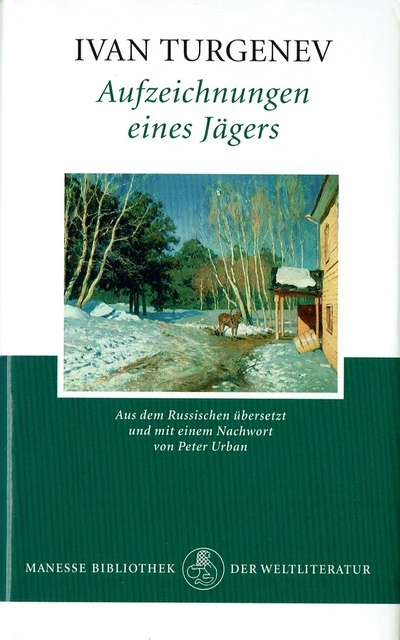
Turgenev became a convinced fighter against serfdom. And he did much to spread his own revulsion among his educated contemporaries. With his story collection 'Notes of a Hunter,' he permanently shaped the image of the Russian serf and his master.
To achieve this, Turgenev employed a frequently used literary device: he attributed his narratives to a seemingly neutral observer, a noble hunter who moves even among the dwellings of the poorest. Uninvolved, he observes what happens around him. He hears how the peasant is compelled to bribe the estate manager; he sees what cruelties the estate mistress, who plays the role of virtue so ostentatiously, inflicts on her pretty chambermaid. He notes drunken peasants — sometimes they beat a Jew, sometimes they are beaten themselves by their master. He praises the peasants' stoic endurance in illness, suffering, and death, and dissects the full spectrum of landlord failings. For the landowners are a caste that must be abolished! Sometimes well-meaning, occasionally courageous, always proud, but unbelievably stupid, they squander their money and leave their descendants penniless. Notes of a Hunter makes for uncomfortable reading: not one of all Turgenev's stories has what we would call a happy ending.
The problem is that Turgenev was not writing reportage but literature. He shaped his characters to achieve a particular effect. Turgenev championed the abolition of serfdom, and to that end he showed the enormous damage it caused. He naturally exaggerated. Yet his readers, then and now, do not perceive this. They assume that Turgenev described unvarnished reality.
And so Turgenev became one of those who, in the 19th century, created the myth of the Russian narod, the Russian people. This had not existed at all before the 19th century. Yet the Narodniki among the intellectuals firmly believed in it, and were convinced they would find allies against the Tsar among the people. In the spring of 1874 they set out to bring education to the peasants. The venture went wrong, because the rural inhabitants knew as little what to do with the intellectuals as the intellectuals knew what to do with the rural inhabitants. Much to the surprise of the Narodniki, the rural population turned out to be just as socially differentiated as that of the cities. A large-scale police operation brought the Narodniki's educational offensive to an abrupt end. It would have been doomed to failure in any case.
What remained is the myth of the Russian people — so good, yet uneducated; and therefore silently enduring the government's oppression. I would genuinely be curious to know what stories Turgenev would tell today.


