

Malthus: How a Rich Man Can Sleep Soundly in the Face of Poverty
by
Ursula Kampmann

Malthus: How a Rich Man Can Sleep Soundly in the Face of Poverty
Why does poverty exist, and how can we eliminate it? Around 1800, this question preoccupied all English people who witnessed the misery in the slums of industrial cities. The young Malthus came up with his own answer. He wrote that the rich could not eliminate poverty, because the cause of poverty lay with the poor themselves.
Artikeltext:
The Social Background of Thomas Robert Malthus
No, it is not surprising that Thomas Robert Malthus was among those who never had to go hungry in their lives. He was born in 1766 as the sixth of seven children into one of the wealthiest families in Great Britain. His mother was the eldest daughter of the royal apothecary, an office that her father had inherited from his father. A royal apothecary did not merely compound pills. This office carried with it the entire supply of the British Army with medicines. And from this one could earn excellently! Henrietta Catherine Graham, the mother of Malthus, thus brought her husband an enormous dowry. As if Daniel Malthus had needed that dowry at all!
For father Malthus too was wealthy. As the only son he inherited the entire family fortune of his father Sydenham Malthus. Work? Not at all. Daniel Malthus passed the time with his literary, artistic, and scientific interests. He was educated, had studied at Queen's College, Oxford. Naturally without taking a degree. What for? His wealth secured him the attention of the most important thinkers of his time regardless. Jean-Jacques Rousseau and David Hume considered themselves fortunate to number among his friends.

The Education of Thomas Robert Malthus
Jean-Jacques Rousseau? David Hume? For a member of the English aristocracy, these friendships were quite eccentric. Thomas Robert Malthus thus had the good fortune and at the same time the problem of having a very unconventional father who wished for an equally unconventional son.
Daniel Malthus saw himself as an Enlightenment thinker and dreamed of a better future. Like so many of his contemporaries he believed that the world is not better for one reason only: because its inhabitants lack education. And so his son was to receive precisely this education, from the most enlightened teachers and tutors that money could buy.
The young Thomas would perhaps have much preferred to stay in the background. He suffered under the stigma of a harelip and cleft palate, and thus had difficulty articulating clearly. Not a good start in the merciless world of British upper-class boarding schools. But Thomas had to attend a fashionable public school at the age of 16. Public schools were then as now anything but 'public.' Their attendance cost immensely a great deal of money. But in return they turned soft mother's boys into hard men such as the British Empire needed.
Papa Malthus chose for his son the Warrington Academy, a boarding school that systematically promoted resistance against the state and the Anglican Church. Warrington is regarded today as the cradle of Unitarianism, a religious movement that rejected the Holy Trinity and the concept of the divine nature of Jesus. Why does that matter? Well, wait a little! Warrington had to close in 1783. But Papa Malthus decided that tutor Gilbert Wakefield should give his son private tuition. Wakefield too was an enthusiastic Enlightenment thinker and an even greater enemy of the Anglican Church, whose biting pamphlets were to divide English society in later years.
In 1784 Thomas was sent to Cambridge. And there too the father must have pulled strings to win William Frend as tutor for Thomas. Frend was a radical social reformer and -- oh surprise -- also a vehement opponent of the Church of England.
In 1788 Thomas Robert Malthus completed his studies with a bachelor's degree. In 1789 he entered the service of the Church of England as a vicar -- and this despite family and all his teachers having for years sought to raise him to be an enemy of this institution.

The Belief in Progress of the Enlightenment
We should also see the book that was to establish Malthus's world fame against this background -- as a rejection of all that family and teachers had for years sought to impose on him. It appeared in 1798 and originally bore the title Principle of Population, as it Affects the Future Improvement of Society, with Remarks on the Speculations of Mr. Godwin, M. Condorcet, and Other Writers.
The title is revealing! Thomas Robert Malthus did not wish in his work to develop a groundbreaking new theory. In it he initially contradicted the ever-same tirades of his father by refuting his favourite authors. Both William Godwin and Nicolas de Condorcet had written a work concerning itself with the progress of humanity. Both works were much discussed in the educated world and celebrated by adherents of the Enlightenment. We must therefore first engage with their books before we come to Malthus.

Condorcet and the Belief in Progress
The Enlightenment thinker Condorcet -- full name Marie Jean Antoine Nicolas Caritat, Marquis de Condorcet (1743-1794) -- was actually a mathematician who had enjoyed the special patronage of the French finance minister Anne Robert Turgot. He had already died when his wife published his principal work in 1795. The original title was Esquisse d'un tableau historique des progres de l'esprit humain -- in German translation approximately: Sketch of a Historical Picture of the Progress of the Human Mind.
The influence of this work on our thinking can hardly be overestimated. For Condorcet turned the idea that humanity is in a constant process of perfection into a generally accepted fact. He claimed that this progress was unstoppable. For the better we understand the natural-scientific, cultural, and social background of the world, the more competent our decisions will be and the better the results. The enlightened human being makes the right decision as if sleepwalking in order to improve society. And so the world will one day become heaven on earth. In other words: poverty is a symptom of an unenlightened society. Religion is superfluous because the human being is itself capable of creating paradise.

William Godwin, Anarchism, and Direct Democracy
William Godwin is today better known as the father of the author of Frankenstein. His marriage with the internationally famous feminist Mary Wollstonecraft has drawn public interest to his unconventional life, although Godwin was actually an opponent of marriage and family. He demanded that the state take over the education of all children to make them enlightened citizens. The necessity of marriage would thereby be eliminated. Brave new world.
In 1793 William Godwin published his principal work. The date is important, as it proves that Godwin formulated his theory of the ideal state against the background of the events of the French Revolution. The book bears the title An Enquiry concerning Political Justice and its Influence on General Virtue and Happiness.
In it Godwin develops an anarchist theory of the state, which is why he is also described as the first anarchist. Godwin argues that state institutions impede rather than promote progress. He too postulates that every enlightened person will make exclusively rational and correct decisions. Therefore in his view no authorities are any longer necessary in the fully enlightened society. All decisions can be made jointly by those directly affected. But before the paradisial end goal of direct democracy is reached, all the other political systems must first be traversed, from absolute monarchy through aristocratic rule to plutocracy. All of these state systems are of course more or less bad intermediate stages before the progress of humanity brings freedom and happiness.
A Conversation Between Father and Son
One can quite well imagine that the ideas of Condorcet and Godwin fascinated the enthusiastic Enlightenment thinker Daniel Malthus. And one can equally well imagine that Thomas Robert Malthus, in the face of the horrors of the French Revolution, was simply getting fed up with his father's progress-believing tirades. The famines, the inflation, the food shortages -- together with the executions and the thousands of dead in the wars: from the son's point of view, the situation did not look as if the revolution in France had changed anything for the better.
And so Thomas Malthus wrote his study on population growth -- as he tells us himself! -- stimulated by a conversation with his father. His book became one of the most influential of the 19th century. It reduced all the noble progress dreams of the Enlightenment to absurdity. And this fitted exactly the mood of the time. Malthus published in 1798, that is, one year before Napoleon declared the experiment of the French Revolution at an end and returned all of Europe to political normality.
The Limits of Growth
Thomas Robert Malthus asked himself whether it was really only the lack of enlightenment that was responsible for poverty in the world. For this he took up an idea of Godwin's. The latter wanted, as mentioned, to entrust the care of children to the state, to have them raised at the community's expense. Malthus claimed that this would not lead to a better society but only to considerably more children.
Malthus stated, and substantiated this with figures, that better economic conditions would cause a higher birth rate especially in socially disadvantaged circles. The problem with this was that the population grows exponentially: thus in a boom, one more child than before survives in each of two families. This couple now in turn has four children; these four children have sixteen children with their partners; these sixteen children have 64 children in the next generation. In other words: in roughly 100 years, the two additional people have become 64 mouths to feed.

And yet food production can only increase by a percentage -- for example by 10, 20%, or even 50%. But that is then the extent of the percentage increase; it does not itself cause further growth. Malthus formulated his claims as a mathematical axiom, at that time a very new form of argumentation in economics. This worked incredibly convincingly. For everyone could see in black and white that increasing food production becomes a straight line, population growth becomes a curve, and thus both endpoints diverge ever further, so that famine is inevitable.
Malthus concluded that the failure of the poor to practise birth control was to blame for the conditions. It was their own behaviour and not any exploitation by capitalists that kept the poor in their poverty. Therefore any support of the poor was absolutely pointless, because it would only balloon into even higher population growth.
Malthus's hypothesis became a paradigm shift. While economists had previously assumed that more people meant more wealth for a state, Malthus for the first time raised the question of the limits of possible growth.
And with this he simultaneously provided all those who politically wished to do nothing about poverty with a theoretical justification for their actions. How Malthus was interpreted in the 19th century is summarised by a history of political economy written roughly a generation later: 'A man, he said, who is born into a world already possessed, if he cannot get subsistence from his parents on whom he has a just demand, and if the society do not want his labour, has no claim of right to the smallest portion of food, and, in fact, has no business to be where he is. At nature's mighty feast there is no vacant cover for him. She tells him to be gone, and will quickly execute her own orders, if he does not work upon the compassion of some of her guests.' Quoted after Adolph Blanqui, Histoire de l'economie politique en Europe.

The Consequences of Malthus
History often moves in waves. The spirit of departure of the French Revolution was followed by the resignation of Biedermeier and Restoration. And in this context Malthus was exactly what politicians needed to justify their heartless laws restricting social expenditure. Thus the Poor Law enacted in Great Britain in 1834 was based on the hypotheses developed by Malthus. It stipulated that able-bodied people should receive support only if they were prepared to work in a workhouse. Whose working conditions -- and this too was regulated by law -- had to be worse than those offered by private industry. The aim was to prevent a poor person from living comfortably at the state's expense.
Naturally this radical position did not find only support. Some dared open criticism, for example Charles Dickens, when he lets Scrooge, protagonist of his Christmas Carol, decline the request for charitable donations for the poor with these words: 'I wish to be left alone,' said Scrooge. 'Since you ask me what I wish, gentlemen, that is my answer. I don't make merry myself at Christmas and I can't afford to make idle people merry. I help to support the establishments I have mentioned [prisons, workhouses, treadmills, and the Poor Law] -- they cost enough; and those who are badly off must go there.' 'Many can't go there; and many would rather die.' 'If they would rather die,' said Scrooge, 'they had better do it, and decrease the surplus population.'
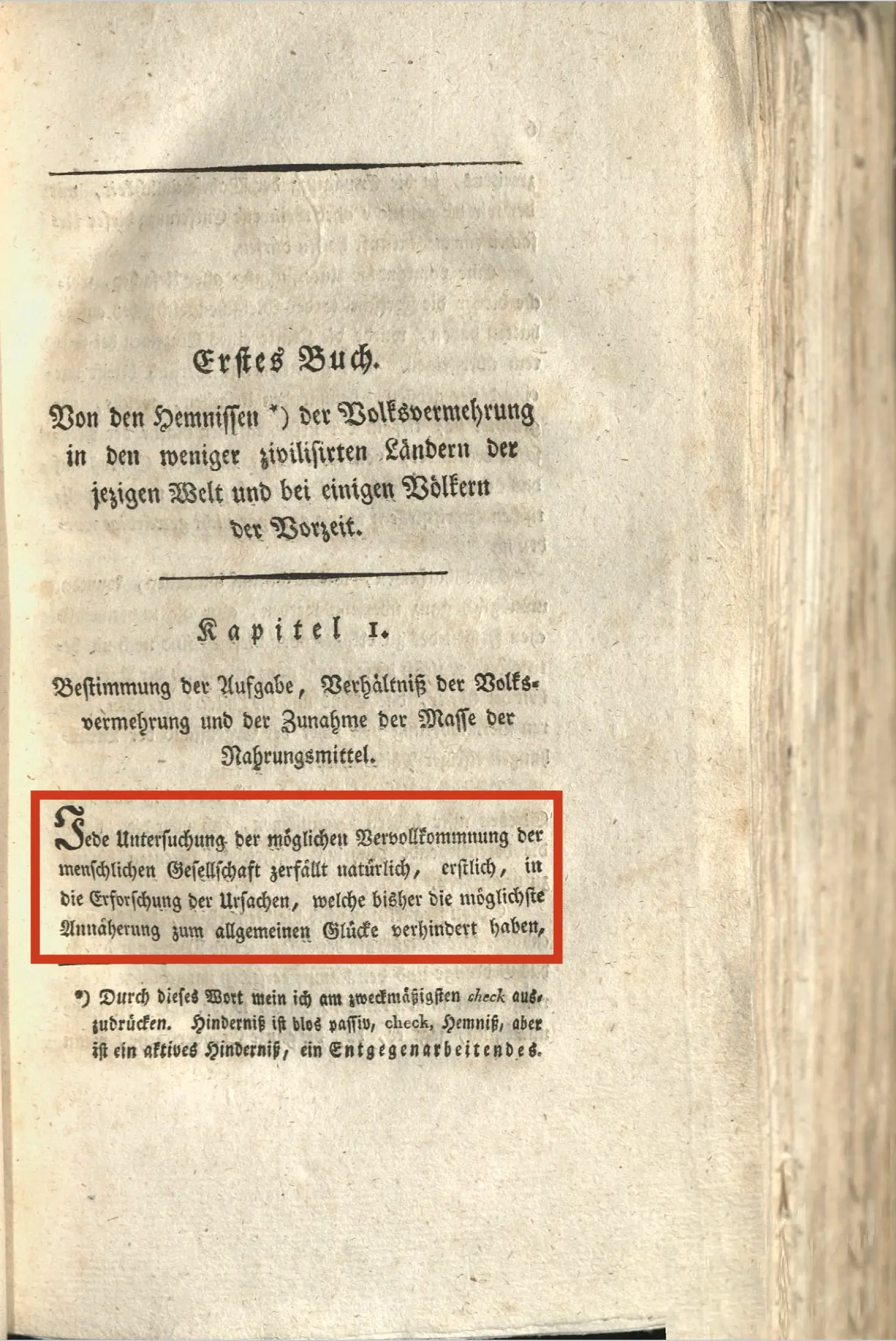
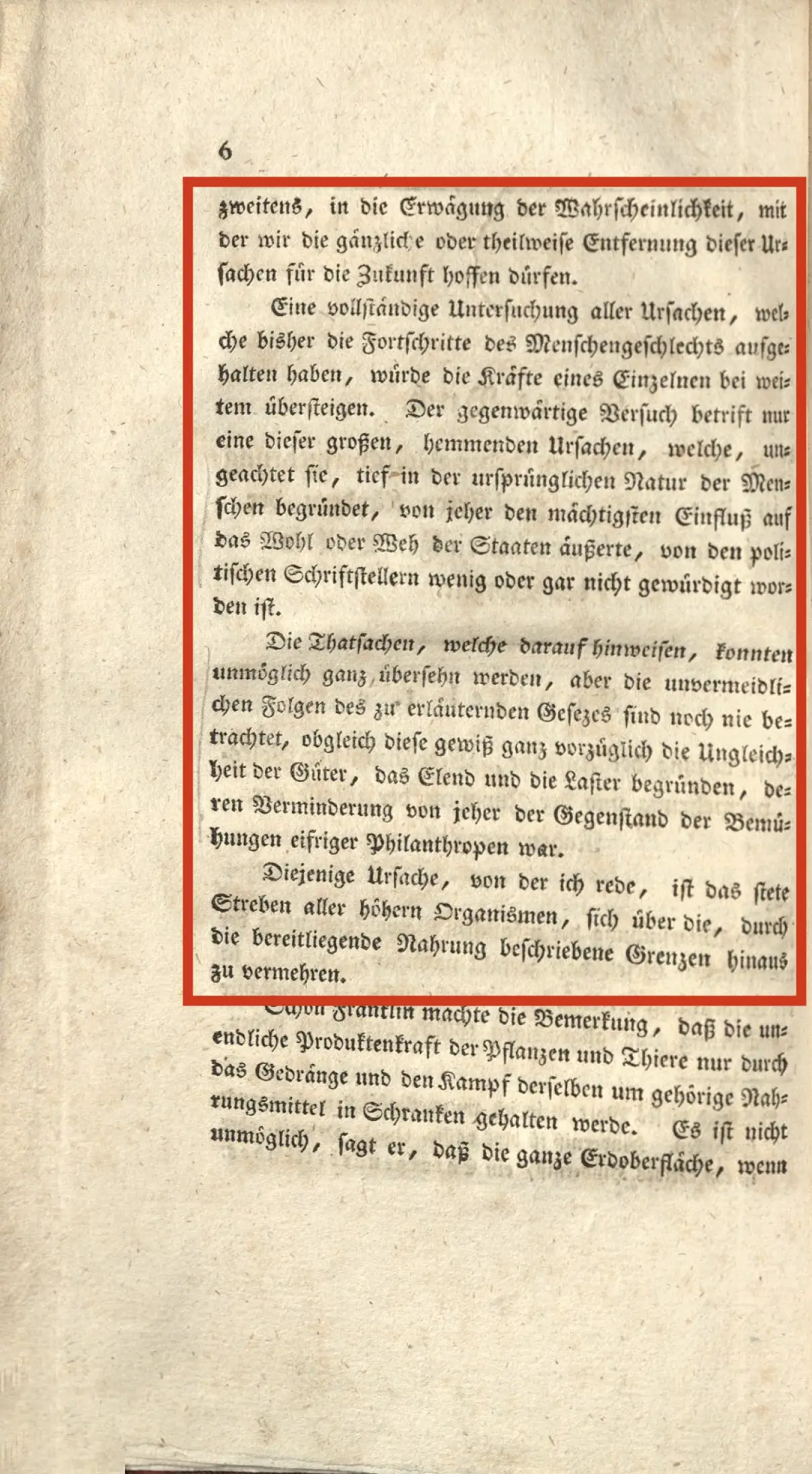
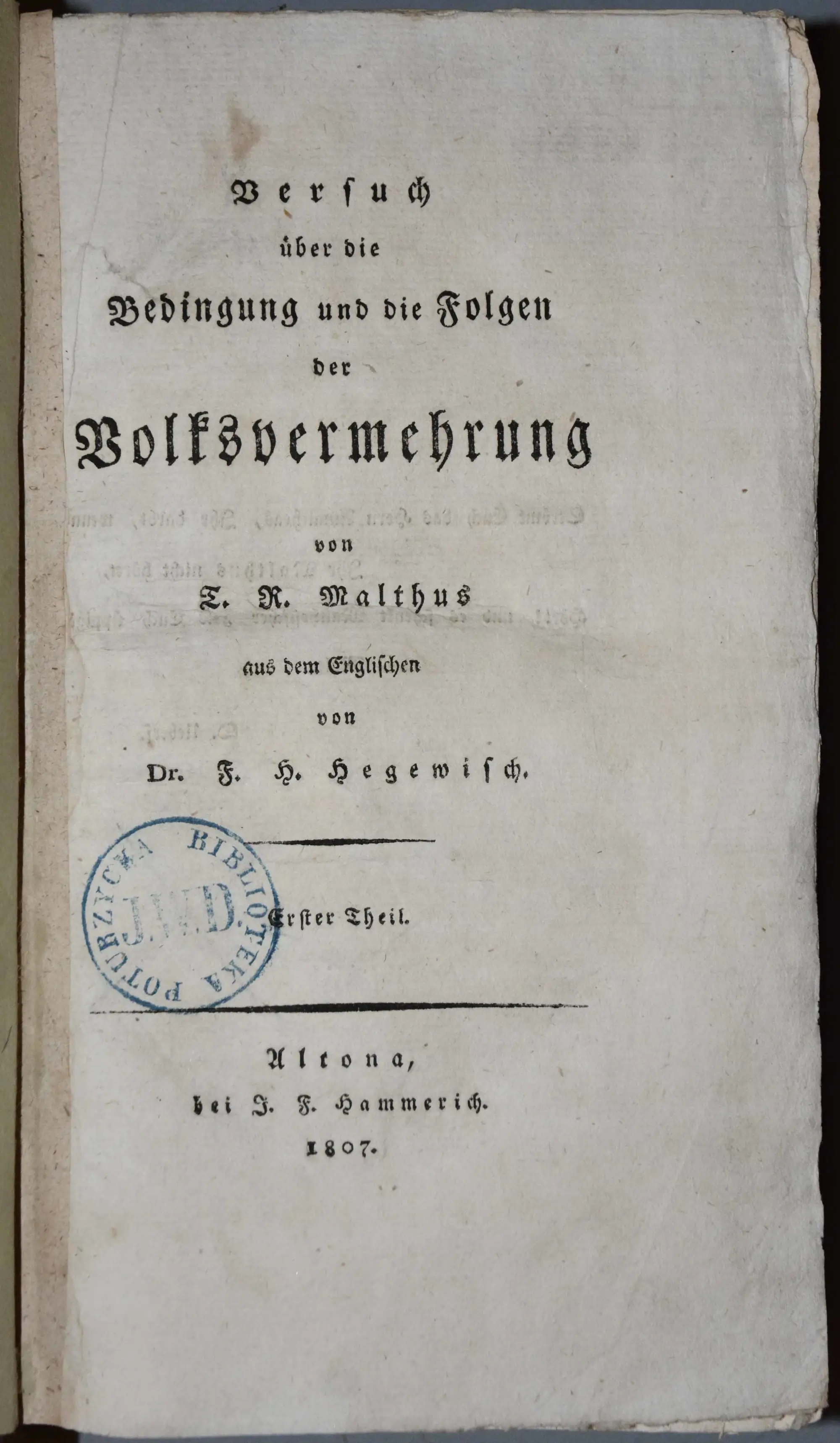
Malthus and his thesis on overpopulation are still discussed internationally today and have had effects on how we perceive our world and its possibilities. Friedrich Engels and Karl Marx engaged extensively with Malthus. Did they use a German translation of the work for this? One had existed since 1807. The MoneyMuseum has succeeded in acquiring a copy of the first German translation from the Antiquariat Tresor am Romer.
When today immigrants are regarded as a burden on the state and not, as formerly, as an enrichment of economic life, then the ideas of a Thomas Malthus are in the air: the idea that at some point there are so many people in a country that the boat is full.