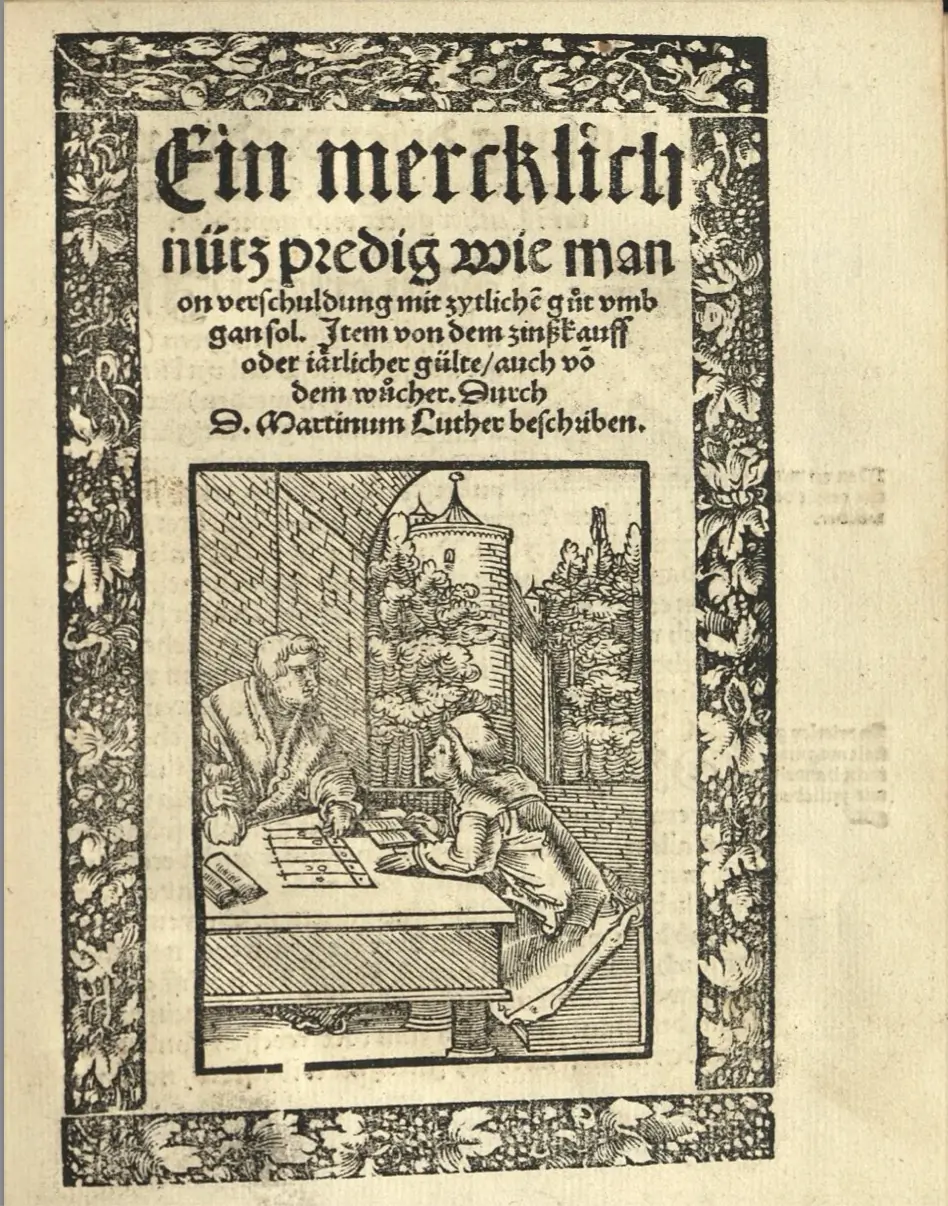


It seems at first glance a peaceful scene: two men sitting together at a table to converse. But appearances are deceptive. The contemporaries who studied this woodcut closely would have grasped immediately that two people were here committing a mortal sin. They were transgressing the Christian commandment against usury and making themselves guilty of the mortal sin of avarice.

On the left stands a very rich man. A contemporary observer would recognise this immediately from his clothing. Only the uppermost stratum of urban society was permitted to wear such a fur collar. In his right hand he holds a well-filled purse. His left hand moves the counters along the lines of the counting board to calculate how large a sum he can earn with the help of the money in his purse. Opposite him sits a man in the dress of a merchant. He places his right hand on the ledger into which he is about to enter the capital that the rich man is depositing with him at interest.
Artikeltext:
What We Call Saving
The title illustration thus shows a process that seems completely normal to us today: a man brings his capital to the bank to invest it at interest. This is prudent, forward-looking, and morally quite acceptable. The bank generates a profit from it by lending it on to those who need it to make an investment. Today hardly a house is built, hardly a business founded, without a bank standing at the beginning, using its customers' money to create livelihoods.
All well and good. But what for us represents a morally neutral matter of course was the subject of controversy at the beginning of the 16th century. Earning money with capital and without labour stood in the early 16th century in the crossfire of criticism.

The Historical Situation
To understand why this question was discussed with such emotion, we must recall the historical situation. Around 1500 we stand on the threshold between the Middle Ages and the modern era. Much was changing at that time, and among the most important changes was the conduct of war. While the medieval ruler had called up his vassals for this purpose, at the threshold of the modern era professional mercenaries were hired who were capable of operating the modern and expensive cannons. Maximilian I (1486-1508), for example, founded the Habsburg world empire and in doing so incurred such enormous debts that he had to avoid many cities in his empire because, having so often failed to pay his bills, no innkeeper was willing to give him lodgings. This was not because Maximilian was economically incompetent, but because the methods of tax collection could not change as quickly as the costs of warfare.
At this point the wealthy merchant families stepped in. They lent money to the princes -- not against interest but against privileges. The Fuggers, for example, became so rich partly because the Tyrolean territorial lords, in exchange for enormous loans, granted them special privileges in silver and copper mining at Schwaz. But the Fuggers themselves needed liquid capital to advance these loans, and they obtained this by paying interest on their customers' deposits.
The Fuggers were only the most visible tip of the iceberg. Many banking houses operated as intermediaries between small lenders and large borrowers, with all the lucrative business opportunities involved. Luther himself saw in his immediate surroundings the consequences of such business. Albrecht of Brandenburg financed the confirmation fee of 20,000 guilders due when he was appointed Archbishop of Mainz through a loan from the Fuggers. They received in return the privilege of selling indulgences in Albrecht's dioceses. And it was this trade in indulgences that motivated Martin Luther to write his 95 Theses.
His ideas would not have been so successful had the economic situation in 1517 been different. As mentioned, the economy was then changing rapidly. And it was precisely ordinary people who felt the changes that bourgeois profit optimisation was bringing them. Anyone who had to attend to profitability and cost-effectiveness was no longer able to pay a fixed price, but had to orient themselves to the requirements of the market. This meant that small entrepreneurs in particular came under economic pressure such as they had not experienced for decades. Merchants no longer accepted their goods at the 'just' -- that is, the traditional -- price, but at a market price. The hard-pressed producers had to watch while merchants grew rich trading in the goods they had manufactured, while they themselves earned less and less.
New forms of taxation were added to this. All authorities sought effective ways of financing their budgets. They taxed long-distance trade with high customs duties, which a capable merchant naturally incorporated into the selling price. Small traders of the local market paid their regular levy through currency debasement. They were required to exchange their money from time to time for new coins that were nominally worth just as much, but which they frequently received only at a surcharge. Where no surcharge was to be paid, the silver content of the coins had at least been substantially reduced. Anyone who saved their income in pfennigs could watch as it steadily lost its value.
While inflation, value-added tax, and direct taxation are self-evident to us, to many people of the 16th century they were a scandal that violated God's rules. They did not understand why the institutional Church was not reacting. But its rulers themselves came from the noble and bourgeois upper classes and knew how to make use of the new economic tools.
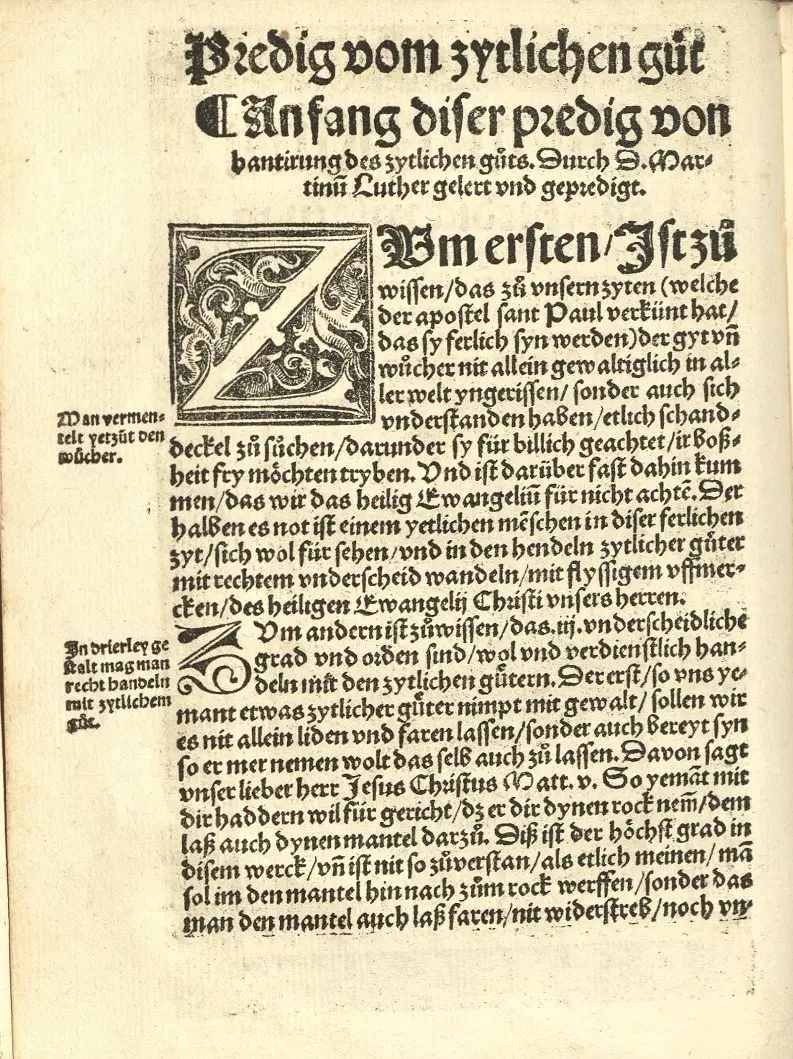
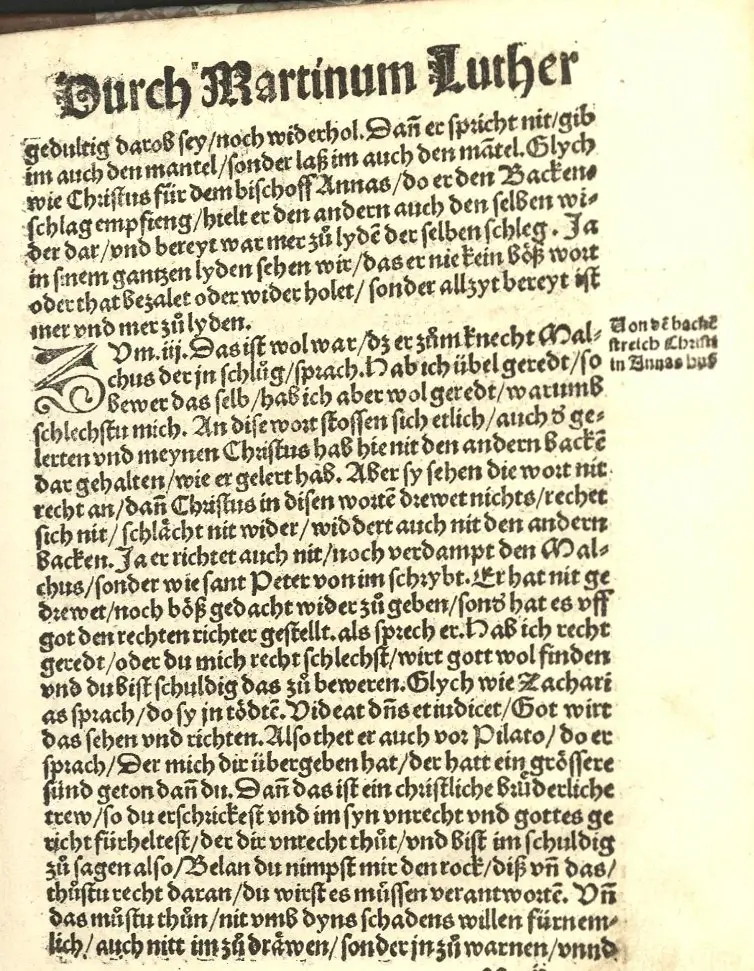
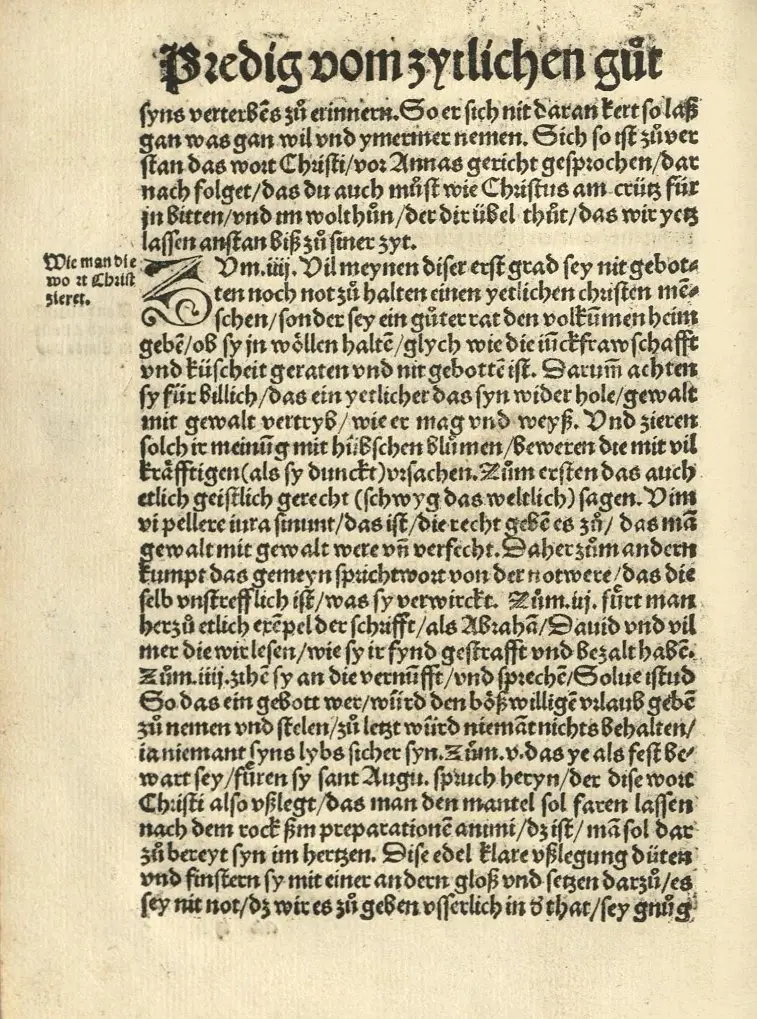
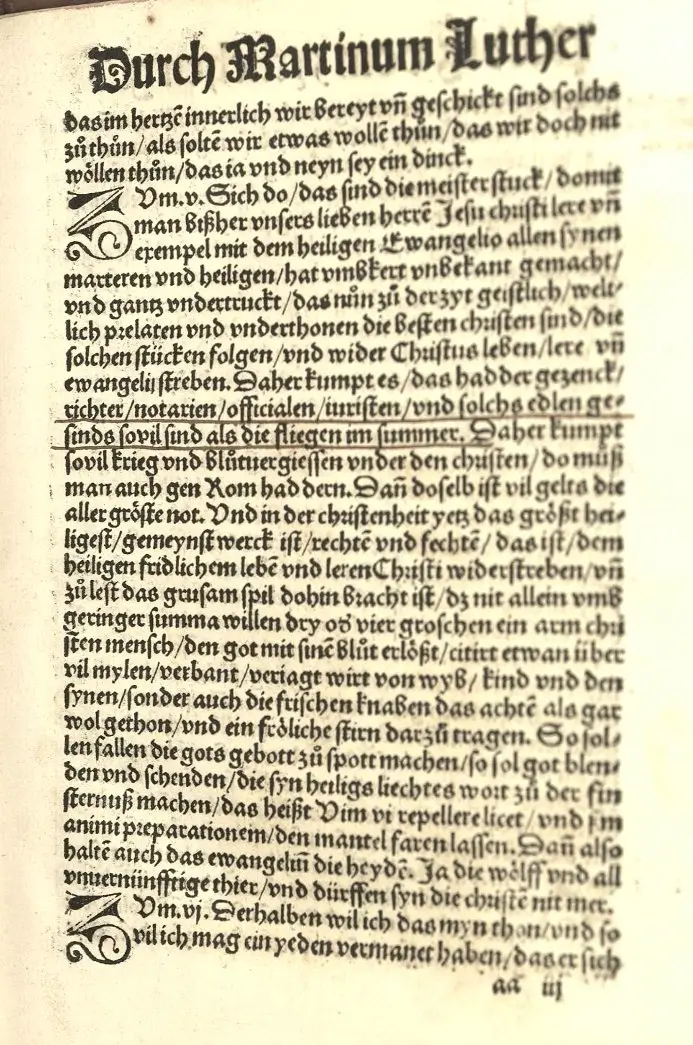
And so a radical church reformer like Martin Luther found broad support. Although his teaching still had to change considerably before it became useful enough to the authorities that it spread. The sermon we present to you in this article comes from the early period of Martin Luther. It was written two years after his 95 Theses. It is printed in a broadsheet that the MoneyMuseum was able to acquire in 2022 from the antiquariat Tresor am Romer in Frankfurt. The second sermon contained within it was written shortly afterwards and added to the manuscript.
The Basel Printing House of Adam Petri and the Reformation
How successful this sermon was can be seen from the fact that it first appeared in 1519 and our Basel print of 1520 is already the 9th edition. It comes from the printing house of Adam Petri, which concerned itself primarily with publishing writings on practical theology. Among the more than 300 printed works that Petri published, 88 came from the pen of Martin Luther, to which were added writings by other reformers such as Philip Melanchthon and Huldrych Zwingli. Adam Petri even ventured to publish a new edition of a central work by Jan Hus, who had been burned as a heretic at the stake in Constance a century earlier. Adam Petri thus belongs to those printers who spread the ideas and values of the Reformation through their printed works in Germany.

How Does Luther Stand Toward Worldly Goods?
Anyone who wishes today to style Luther as a pioneering thinker of an anti-capitalist society is in excellent company. Karl Marx cited Luther's sermon on the proper use of worldly goods only too gladly, for Luther propagated central ideas that in the 19th century were to be found in socialism and communism.
Luther permitted ownership, but not in the form we know today. He forbade, for example, defending one's own property by force or in court. Divine peace could only arise through the willingness to suffer injustice and to trust in the secular and spiritual authorities. Expropriation and collectivisation Luther would have understood as wonderful means of realising God's kingdom.
Job as the Model of Every Good Christian
He presents the Old Testament Job as the ideal. Job, whose story is preserved in a book of the Old Testament, became the victim of a wager between God and the Devil: the Devil wagers that even Job would curse God if God robbed him of all his possessions. God accepts this wager and first takes away all Job's possessions, then his children, and finally his health. When Job piously accepts all this human suffering, God declares himself the victor and replaces Job's possessions, children, and health. This God bears no resemblance to our understanding of God; for Luther the story of Job was part of divine revelation and Job was the very embodiment of the good Christian.
What Does Job Have to Do with Usury?
From the example of Job, Luther derives that a Christian should not be attached to his possessions. And from this follows for him the believer's duty to give to everyone -- whether friend or enemy -- from his own possessions what that person needs, and to do so without any recompense. This would also put an end to begging. And in any case it was far more pleasing to God to feed the poor than to spend money on the expensive accessories of a lavish religious service. To hope for remission of sins through such senseless donations was contrary to every commandment of God.
In this too Luther has his finger on the pulse of the times: thousands were making their way from monastery to monastery to beg their subsistence there. Return to a secure existence was not possible for them. The children of beggars swelled in turn the ranks of those seeking help, with no prospect of wages and bread.
To give to them was divine commandment -- in this Luther's view did not differ from that of the institutional Church. But Luther went further: if it were Christian to give to the poor, then one must also lend money to those in need, and to do so without self-interest and regardless of how probable it was that the money would be recovered. Lending money was only justified when it was made available to the borrower free of charge. Whoever drew a profit from the loan was no longer lending but was committing the mortal sin of usury and avarice -- by which Luther meant, unlike us, primarily greed for money.
Even if theologians devised elegant models -- for example calling interest not interest but a gift, a practice commonly employed at the time -- it remained usury, Luther declares. Just because loans and interest had become customary did not make them Christian.
In other words: if you have a bank balance, securities, shares, or any other possession that brings you a regular income, Luther would have seen you in the eternal fires of hell.

The Second Sermon: On Interest and Debts
For all those who believe they have not quite understood Luther, the reformer summarises the essential points of his first sermon once again as an introduction. For him the Christian use of all property rests on three pillars:
- A Christian gives without expecting anything in return.
- A Christian lends without charging interest.
- A Christian does not resist when another takes his goods by force.
This is strong stuff today in countries where the guarantee of property is among the fundamental rights, and already at that time went far beyond what the institutional Church demanded of its faithful. Luther's demands would have catapulted the development of the bourgeois economic model back by centuries.
The same holds for the demands of his second sermon. It bears the title 'On the purchase of interest or annual rent' -- translated into modern German: On loans and debts. In it Martin Luther is concerned once again to declare explicitly every loan at interest a mortal sin, and he begins by justifying his view on the grounds that it is a new form of business. We see here how deeply Martin Luther is rooted in medieval thinking, in which everything new was regarded as suspect.
Precisely because debts and interest were so new to many of his readers, Luther first had to explain how the system functions and for what reasons other theologians approved of it: a man gives another man 100 guilders. With these 100 guilders he could now himself engage in trade and earn 5 or 6 guilders thereby. But instead of trading himself, he passes on the money on condition that the other man reimburse him the 5 guilders that the lender would have earned under other circumstances. This is accepted by the Church because the lender could after all have earned a larger sum with his money. The 5 guilders in fact correspond to the interest rate recommended by the Church.
But Martin Luther criticises the fact that the risk rests entirely with the borrower. Thus the lender has all the advantages on his side, and therefore it is not directly usury but is nonetheless an injustice that stains its perpetrator with the mortal sin of avarice. After all, everyone would prefer to be a lender rather than a borrower and thus to become rich effortlessly. It is only just to take interest when both parties bear an equal risk. What sounds unworldly to us today was in the High Middle Ages a common economic model: risky merchant voyages were to a large extent financed in such a way that the lenders received a share of the profit proportionate to the size of their loan.
Martin Luther was well aware that no one would make money available if he received no interest. But instead of seeking a reconciliation between the Christian message and the economic system of his time, he used this observation to illustrate that the system of interest was wrong. Precisely this showed, Luther argued, that lending at interest had avarice and usury at its core.
The Protestants and Luther
Luther's teaching was, as we all know, taken up with particular enthusiasm by the free imperial cities and the independent German princes of the Empire. Not because of Luther's theses on the system of interest, but because he provided them with an excellent theological justification for confiscating all church property in their territories and directing its income into their own (empty) pockets. Luther's economic reservations were quietly ignored. They did not fit with the economic development of the modern world. And therefore it was another theologian who formulated the definitive interpretation for the Protestant merchant.
Calvin vehemently contradicted Luther. He appealed to the attributes of God: God is good, just, and all-knowing. How, therefore, could a just and good God, who knows in advance that a person will prove himself, not reward him with success even in this world? With this Calvin justified wealth -- and to wealth it of course also belonged to allow one's own capital to work for one as a lender.
What neither Luther nor Calvin justified was a life without work. Our concept of leisure, holidays, and retirement would probably have seemed godless to them.
But that troubles nobody today. We have become accustomed to citing the revered theologians, just as we cite the holy scriptures, in ways that support our own views. What does not suit our purposes we generously leave out.